Submit Your Request Now
Key takeaways
- Pair the modalities when the uncertainty splits into protein-level functional signal and cell-state/composition resolution for the same comparisons.
- If the question is vague, a second layer usually adds complexity more than clarity.
- Define convergent evidence (and what discordance would mean) before generating data.
- Integrated studies break when group structure and sample strategy aren't aligned across both layers.
- A scoping-ready inquiry states: matrix + groups + primary comparison + role of each layer + what decision the combined data should support.
Introduction
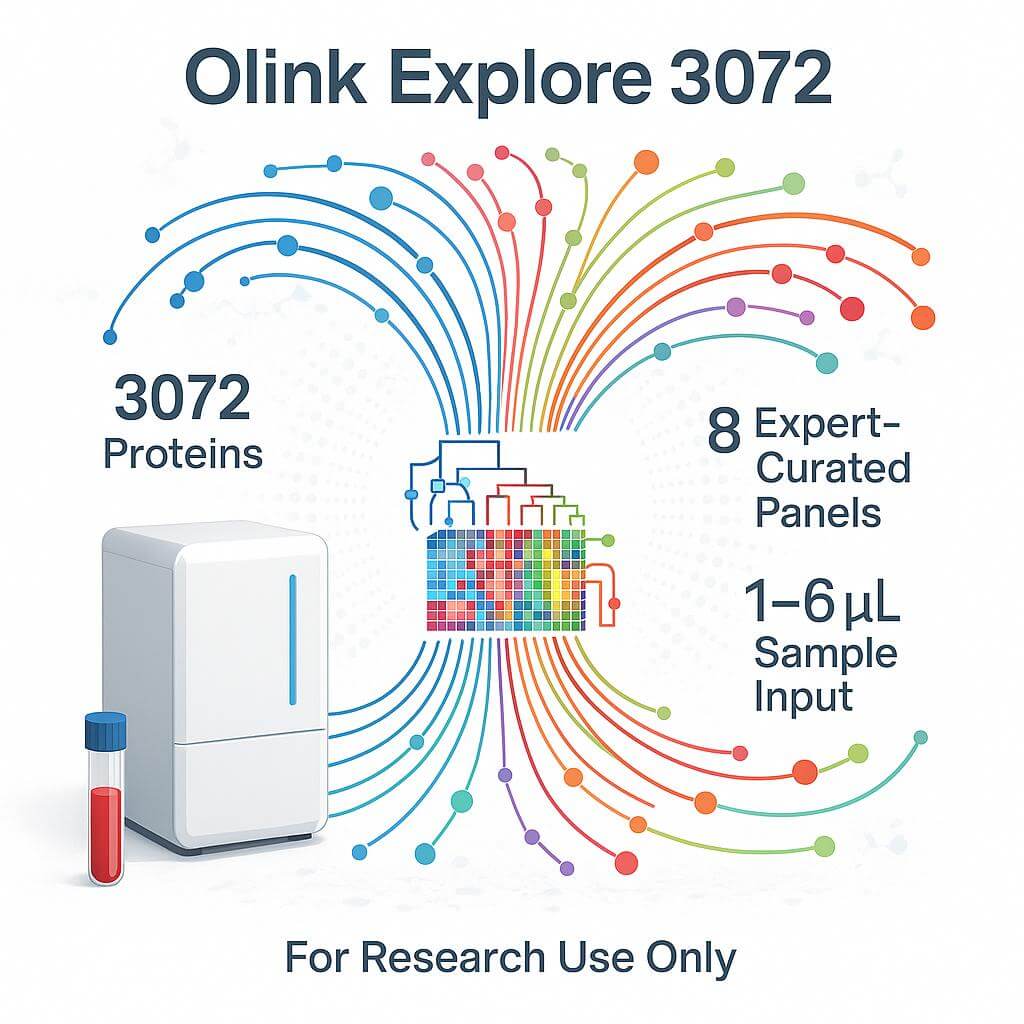
Pairing Olink proteomics with single-cell transcriptomics is an attractive idea because the two layers look complementary on paper: scRNA-seq clarifies cell states, while protein profiling tests functional/circulating signal.
In practice, though, "complementary" doesn't automatically mean "worth doing together." The real question is whether a second layer will sharpen interpretation or mostly expand complexity.
A common scenario is a six-group animal study—sham, injured, and drug-treated in both males and females (n=5/group). Before pairing modalities, ask: What will scRNA-seq resolve, what will proteins resolve (often plasma/serum), and would either layer alone already answer the primary comparison?
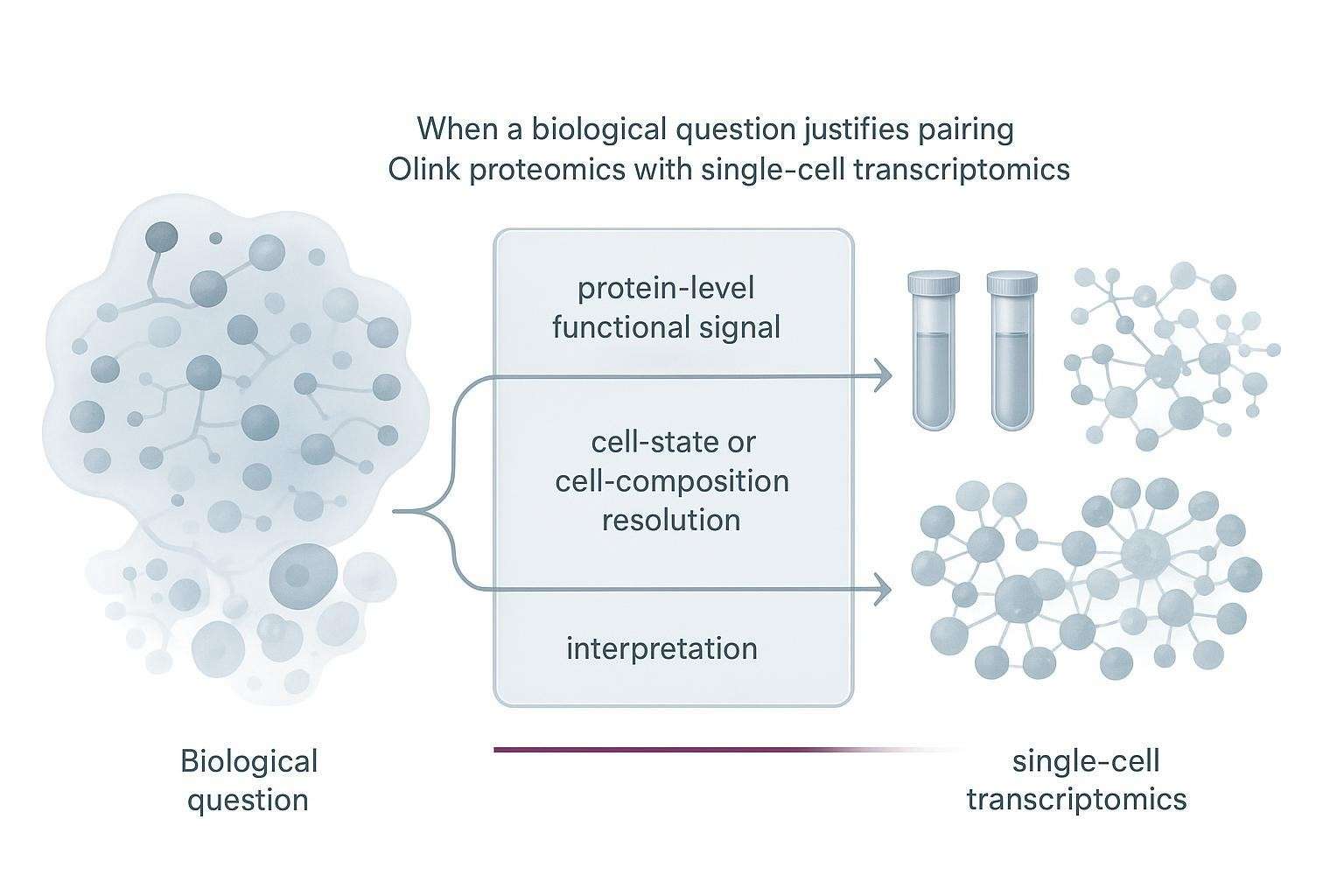 Figure 1. Pairing Olink proteomics with single-cell transcriptomics is most useful when the biological question naturally separates into a protein-level and a cell-state-level uncertainty.
Not every project that can use two omics layers should use two omics layers
If you're asking when to pair proteomics with single-cell transcriptomics, start by identifying the specific ambiguity that neither layer can resolve alone.
Multi-omics ambition is not the same as multi-omics necessity
Adding layers can become a substitute for scoping. If the decision-critical question isn't explicit, extra data often increases the number of plausible stories.
A useful rule: add a second layer only when it resolves a different part of the uncertainty for the same comparison.
Olink and scRNA-seq answer related but different biological questions
Olink proteomics and scRNA-seq often overlap in pathway labels, but they are not measuring the same biological objects.
- scRNA-seq is strongest for structure: cell types, cell states, activation programs, and compositional shifts.
- Protein profiling is strongest for functional signal: what is present at the protein level (especially secreted/circulating biology), and where transcript-level changes do not translate cleanly.
Reviews on single-cell multi-omics emphasize that different layers reflect different regulatory steps and should be integrated with a clear objective rather than forced into one-to-one correspondence (for example, see the 2018 framework review on quantitative multi-omics models in single-cell multi-omics (2018)).
The first design mistake is adding a second layer before defining what it contributes
If you can't say—in one sentence—what uncertainty the second modality resolves, it's usually too early to pair.
Key Takeaway: Pair the layers only when each one resolves a different part of the biological uncertainty for the same comparison you care about.
Start with the biological question before deciding to pair Olink with single-cell transcriptomics
Are you trying to identify cell states, validate secreted protein biology, or connect both?
Most "Should we pair?" decisions collapse into three archetypes: cell-state discovery, protein-level validation, or mechanism + biomarker chaining (linking cell programs to plasma/serum proteins). The key is matching the question to the comparisons you will actually make.
Mechanism-mapping and biomarker-ranking are not the same type of project
A mechanism-mapping study asks: What is changing, where, and through what programs? A biomarker-ranking study asks: Which measurable signals best track the comparison we care about?
They overlap, but they don't share the same "definition of success." Mechanism projects can tolerate multi-pathway complexity. Biomarker projects typically cannot—they need ranking, stability, and interpretability.
A clear question makes the integrated design more interpretable
Teams often ask when to combine Olink and scRNA-seq; a practical answer starts with naming the comparison and stating the integration objective in plain terms.
A useful scoping template is:
- Primary comparison: What is the main contrast (injury vs sham; treated vs injured)?
- Biological uncertainty: Is the ambiguity cell composition/state, protein-level function, or both?
- Integration objective: What does "convergent evidence" look like?
If those are explicit, pairing can be clean. If not, pairing often multiplies plausible narratives.
| Study type | Primary biological question | What Olink contributes | What single-cell transcriptomics contributes | Common scoping mistake |
| Cell-state discovery | Which cell types/states shift across groups? | Optional: a parallel systemic readout | Cell-type/state resolution and program discovery | Adding Olink before defining how proteins will be interpreted |
| Protein biomarker ranking | Which proteins best track the key comparison? | High-sensitivity multiplex protein profiling (often plasma/serum) | Optional: helps interpret origin of signals | Assuming scRNA-seq is required for biomarker ranking |
| Mechanism + biomarker chain | Which cellular programs drive the protein signature we want to follow? | Protein-level functional readout and candidate biomarker panel | Links proteins to cell states/composition and pathways | Expecting one-to-one RNA–protein concordance |
| Response stratification | Why do responders and non-responders differ? | Protein signature of response / systemic biology | Cellular basis of response heterogeneity | Underpowering subgroup comparisons |
Table 1. What kind of multi-omics question are you actually asking?
CTA: If your study may benefit from both Olink proteomics and single-cell transcriptomics, share your matrix, cohort or group design, and primary biological question with our team so the integrated strategy can be scoped clearly before analysis begins.
What Olink adds that single-cell transcriptomics alone cannot provide
In practice, Olink scRNA-seq integration works best when the protein layer is treated as functional evidence for the same contrasts, not as a second discovery exercise.
Protein-level readouts help validate whether transcript-level changes translate into functional signal
Even in well-controlled systems, RNA abundance is an incomplete proxy for protein abundance and protein activity. Protein-level measurement adds a layer closer to function: secretion, circulating levels, and post-transcriptional regulation.
Multimodal profiling methods such as CITE-seq were developed precisely because protein readouts can refine biological interpretation beyond transcript-only measurements (see Stoeckius et al. in Nature Methods (2017)). While CITE-seq focuses on surface proteins in the same cells, the larger conceptual point holds for integrated study design: proteins are not just "RNA confirmation."
Secreted and circulating biology is often not captured fully by transcript-only logic
Many studies aim to connect tissue-level mechanisms to systemic biomarkers. If the readout you care about is plasma/serum, a protein layer helps test whether transcript programs translate into a measurable circulating signal and whether that signal is interpretable for your primary comparison. For service context, see the Integrated Olink Proteomics & Single-Cell Transcriptome Service page.
Olink can narrow false-positive biological interpretation when RNA and protein diverge
RNA–protein divergence can create attractive but fragile mechanistic stories. A protein layer can act as a constraint: it helps you test whether pathway changes are purely transcriptional signals or whether they manifest as measurable proteins in the matrix you care about.
This is not about forcing concordance. Divergence is information.
What single-cell transcriptomics adds that Olink alone cannot resolve
Cell-type resolution can explain where broader protein signals may be coming from
Olink measurements are typically not cell-resolved. That's a feature, not a bug—plasma/serum proteins are often the decision-relevant readout. But it creates an interpretation problem: the same protein shift can reflect many upstream sources.
Single-cell transcriptomics adds attribution—especially in injury and immune activation models where composition changes can dominate signal.
Single-cell data helps deconvolute heterogeneous biological systems
If your tissue context is mixed (immune infiltration, stromal remodeling, changing cell proportions), bulk summaries can hide the mechanism. scRNA-seq is the tool that can show whether "group differences" are:
- a change in composition,
- a state change within the same cell type,
- or both.
Modern reviews of single-cell multiomics stress that multimodal approaches increase resolution but also require explicit integration objectives and careful handling of modality-specific noise (see overview discussions in Single-Cell Multiomics (2023)).
Transcript-level structure can refine how protein patterns are interpreted
A practical benefit of scRNA-seq is that it provides structure for interpretation: cell-state programs, markers, and pathway-level patterns that can be mapped back to protein signatures. That mapping does not need to be one-to-one. The value is that it narrows plausible upstream explanations for systemic protein shifts.
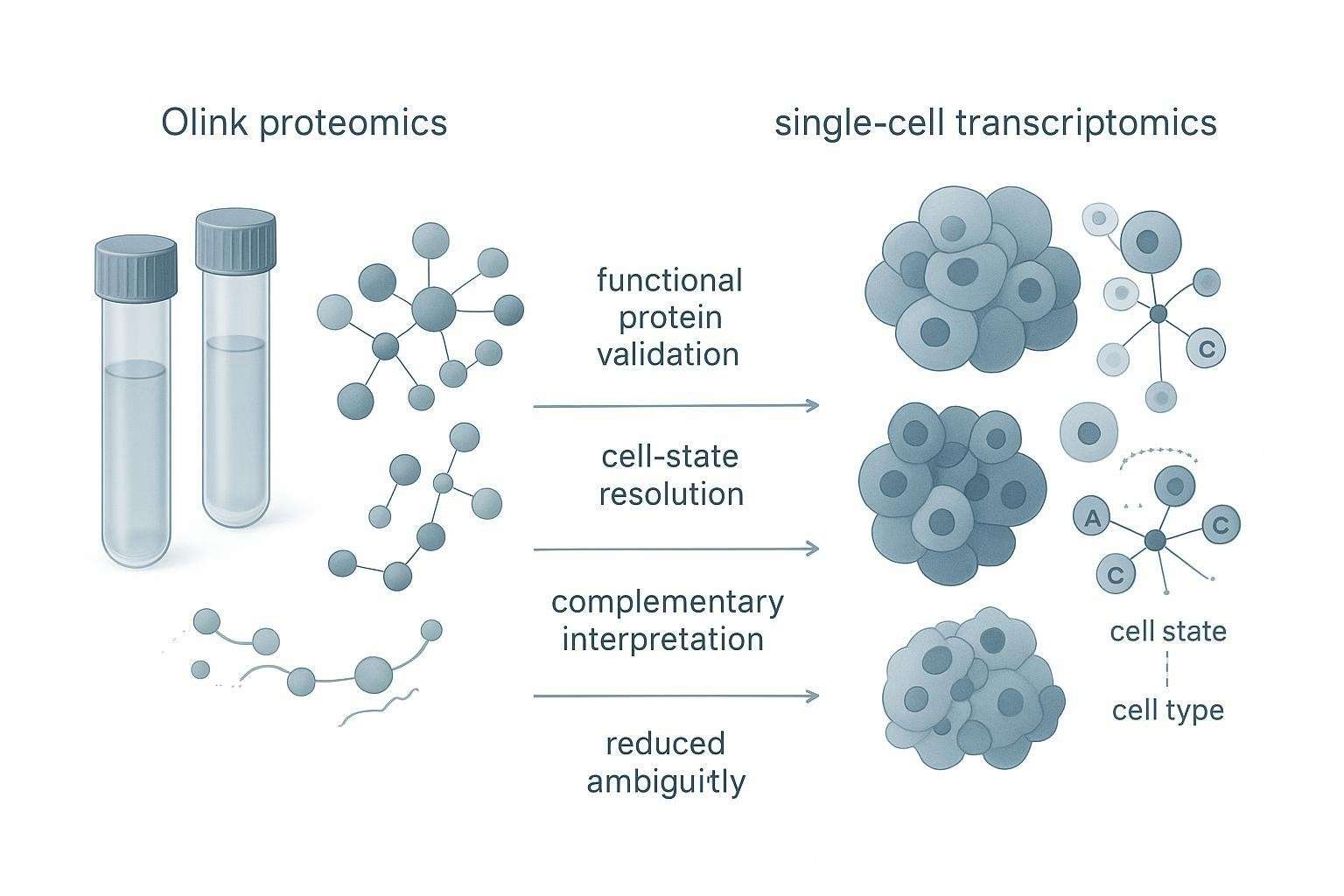 Figure 2. Olink proteomics and single-cell transcriptomics are most informative together when each resolves a different part of the biological interpretation.
When pairing Olink proteomics single-cell transcriptomics is most justified
Heterogeneous tissues or mixed cell populations are strong candidates for paired design
Pairing is most defensible when your biological system is heterogeneous and the decision you care about depends on resolving that heterogeneity.
Examples include injury models with immune infiltration, neuroinflammation, and immune activation studies where composition and state both shift. In these contexts, scRNA-seq clarifies what is changing, while Olink provides a functional readout that can be tracked across animals, timepoints, or cohorts.
Injury, immune activation, and treatment-response models often benefit from dual-layer interpretation
Return to the six-group study: sham vs injury vs drug-treated, split by sex (n=5/group). This design often raises two distinct uncertainties:
- Cellular uncertainty: Do males and females show different immune cell compositions or activation programs after injury? Does treatment reverse those programs or shift them?
- Protein uncertainty (often plasma/serum): Do the systemic protein signatures track injury severity or treatment response in a way that is stable enough to interpret across groups?
If you need both answers to make sense of treatment biology, pairing can be justified.
The best integrated studies are designed around biological uncertainty, not technology enthusiasm
A fast test: if either layer alone would already answer the primary comparison, pairing is optional. Pair when each layer removes a different ambiguity and you can define what "convergent evidence" means.
When pairing Olink with single-cell transcriptomics may be unnecessary or premature
A weak or vague biological question does not become stronger because it is multi-omics
If the question is "What changes after injury?" that's not a scoping-ready question for integrated design. It is a cataloging question. Cataloging can be useful, but pairing layers won't fix the core problem: the study doesn't yet define what the comparisons are supposed to decide.
If one omics layer already answers the decision-critical question, the second may add complexity more than value
A common example is early biomarker screening:
- If your primary goal is ranking a plasma/serum signature that tracks injury vs sham, a protein-first design may be sufficient.
- If your primary goal is identifying which cell subsets are altered by injury, scRNA-seq alone may be sufficient.
Pairing becomes valuable when you can articulate what the second layer changes about interpretation—not just what it adds.
Some studies should narrow first, then integrate later
A practical staged strategy: run one modality as a pilot to learn which comparisons matter, then add the second layer to resolve the remaining uncertainty.
Cohort, grouping, and sample strategy can determine whether integrated design is realistic
For many teams, the hardest part of an Olink single-cell multi-omics study design is aligning samples and comparisons so the two layers can be interpreted together.
Group structure matters more in integrated studies because both layers must support the same comparisons
Integrated studies are not "two independent assays." They are one interpretation problem with two measurement layers. That means both datasets must support:
- the same primary comparison,
- the same subgroup structure (e.g., sex as a factor),
- and a coherent plan for how to interpret concordance and discordance.
In the six-group example, you should be explicit about whether sex is:
- a biological variable to stratify (powered comparisons),
- or a covariate to control for.
If sex-stratified conclusions are expected, the study must be scoped for that—otherwise integration becomes a story-telling exercise.
Sample type and biological source should match the question asked by each omics layer
Defaulting to plasma/serum makes sense when you care about systemic readouts, but scRNA-seq requires a tissue or cellular source that matches your mechanism question.
A common failure mode is pairing mismatched sources (e.g., scRNA-seq from a compartment that doesn't plausibly drive the plasma signature). The right pairing is the one where both layers describe the same biological story from different angles.
The project should be designed around comparability, not just data richness
Integrated interpretability depends on comparability:
- Are timepoints aligned across both layers?
- Are batches and processing steps controlled enough to keep group comparisons valid?
- Is the number of meaningful comparisons limited enough to avoid story inflation?
Reviews of single-cell multiomics emphasize that multimodal power is constrained by practical noise sources and integration choices rather than raw data volume (see broad discussions in Advances in single-cell omics and multiomics (2024)).
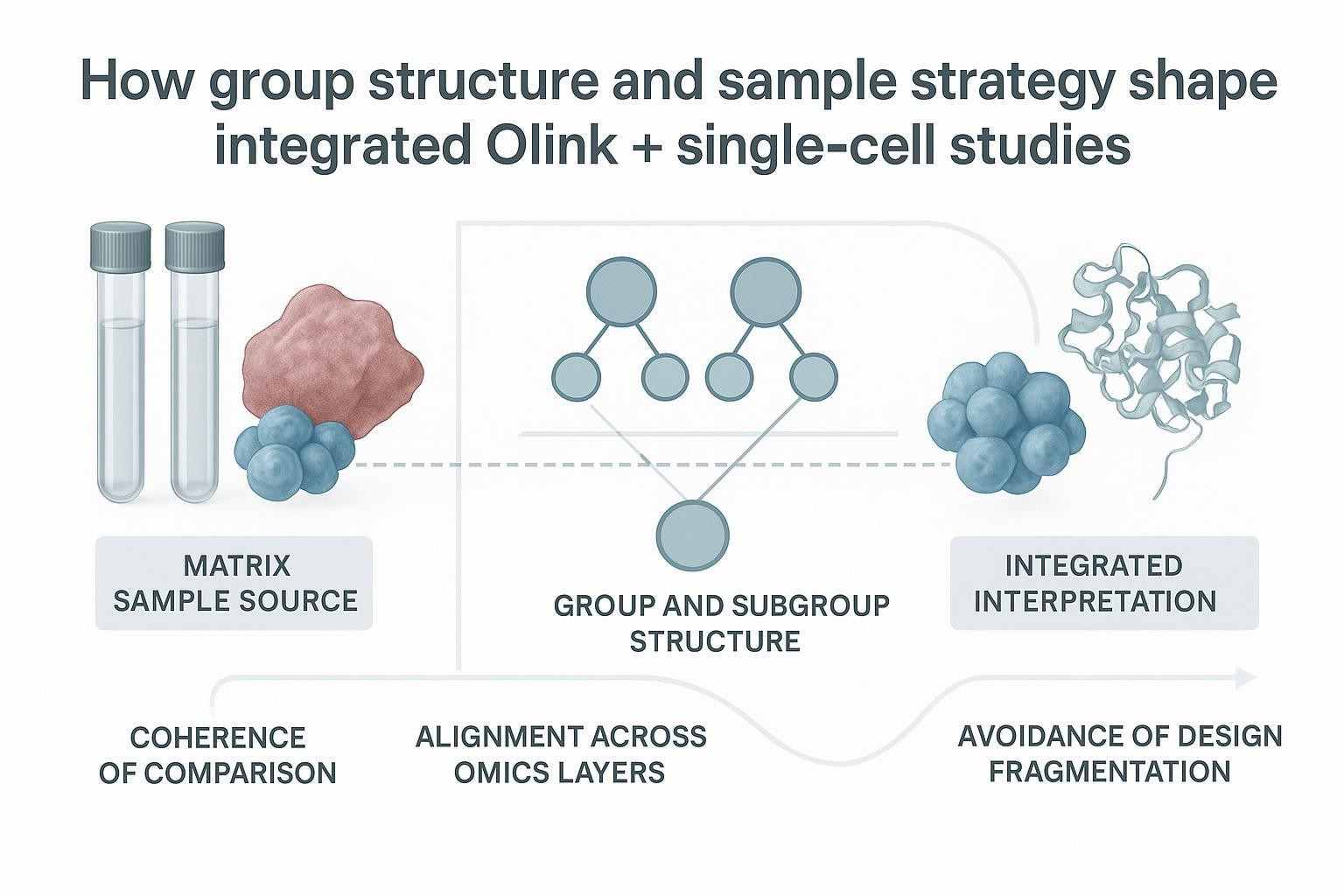 Figure 3. Integrated Olink and single-cell studies are strongest when group structure, matrix strategy, and interpretation goals are aligned across both omics layers.
Integrated studies should be planned for interpretation, not just data generation
The value of pairing omics lies in cross-layer biological logic
If integration is treated as "overlay two heatmaps," the result is usually descriptive rather than explanatory. Integration becomes useful when you decide in advance what agreement and discordance would mean for your conclusion.
The central planning question is: What would we do differently after seeing convergent vs divergent evidence?
A strong integrated project should define what constitutes convergent evidence
Convergent evidence does not require one-to-one gene/protein matching. Practical definitions include:
- cell-state programs that plausibly explain a plasma/serum protein module,
- treatment effects that shift both a cellular program and a protein signature in the same directional pattern,
- subgroup patterns (e.g., sex differences) that are consistent across layers.
More data is only useful if the integration question is already explicit
Integration methods vary and can change conclusions, so it helps to treat 'integration' as an analysis objective that should be evaluated—not an automatic outcome.
| Design feature | Why it adds value | What it helps clarify | What it does not solve alone |
| Explicit integration objective | Prevents narrative sprawl | What the combined data is supposed to decide | Technical noise or batch effects |
| Shared primary comparison | Keeps both layers interpretable | Whether both layers support the same biology | Underpowered subgroups |
| Pre-defined "convergent evidence" | Makes discordance informative | How to interpret RNA–protein divergence | Lack of biological grounding |
| Limited number of key contrasts | Reduces multiple-story temptation | What matters most across groups | The need for QC and comparability |
| Matrix-to-mechanism logic | Links systemic proteins to tissue/cell states | Source plausibility for plasma/serum signals | Definitive causal attribution |
Table 2. What makes an Olink + single-cell study more useful—not just larger?
How to describe an Olink + single-cell transcriptomics project clearly when requesting support
Define the biological question and main comparison first
Start with the comparison that drives the study:
- injury vs sham
- treated vs injured
- responder vs non-responder
Then state the biological uncertainty behind that comparison: composition/state ambiguity, systemic protein ambiguity, or both.
Then explain group structure, matrix, and what each omics layer is expected to contribute
Be explicit about:
- matrix (default plasma/serum) and why it's decision-relevant,
- tissue/cell source for scRNA-seq and why it matches the mechanism,
- what each layer is expected to resolve.
For readers looking for relevant service workflow context, the following pages can serve as references:
Finally clarify what the integrated analysis is supposed to help decide
The most scoping-ready questions end with a decision:
- "Does treatment reverse injury biology via immune-state modulation?"
- "Which protein modules best track response across groups?"
- "Are sex differences driven by composition shifts or state changes?"
Before submitting your inquiry, clarify:
- matrix or biological source
- group and subgroup structure
- whether the main goal is mechanism, biomarker interpretation, or both
- what Olink is expected to contribute
- what single-cell transcriptomics is expected to contribute
- what decision the combined data should support
Common scoping mistakes in Olink + single-cell study design
Starting with the technology pair before defining the biological problem
If the study begins with "We want Olink + scRNA-seq," you risk building two datasets that are adjacent but not mutually informative.
Expecting both omics layers to answer the same question
Olink is not a substitute for cell-state resolution, and scRNA-seq is not a substitute for protein-level functional readouts in plasma/serum.
Building a complex study without a clear integration objective
If no one can explain what "integration" will decide, the outputs become descriptive and the conclusions become negotiable.
Confusing data volume with explanatory power
More features and more cells do not automatically create a clearer story. Interpretability is designed.
FAQ
1) When does it make sense to combine Olink proteomics with single-cell transcriptomics?
It makes sense when your uncertainty splits into two parts: you need cell-type/state resolution to explain heterogeneity and you need a protein-level readout (often plasma/serum) to validate functional or systemic biology for the same key comparison.
2) What does Olink add that single-cell transcriptomics alone cannot provide?
A protein layer can test whether transcript programs translate into measurable plasma/serum signals and can constrain interpretation when RNA and protein diverge.
3) What does single-cell transcriptomics add that Olink alone cannot resolve?
Single-cell data can show which cell types/states are changing—key context for interpreting protein signatures.
4) Can every biomarker project benefit from pairing these two omics layers?
No. If the decision-critical question is already answered by a protein-first design (e.g., ranking plasma/serum biomarkers for a single contrast), scRNA-seq may add complexity without changing conclusions.
5) How should I think about grouping and sample strategy in an integrated study?
Design around comparability: both layers must support the same contrasts. Be explicit about subgroups (e.g., sex). Align matrix choice (plasma/serum) and scRNA-seq source to the same biological story.
6) What kind of biological questions justify a dual-omics design?
Questions that require both: (a) identifying which cell programs are changing and (b) confirming a functional protein-level signature that can be tracked across groups, timepoints, or cohorts.
7) What information should I provide before asking about an integrated Olink + single-cell project?
Provide the matrix, group structure, primary comparison, the integration objective, and what each layer is expected to resolve. The clearer the "what decision will this support," the more interpretable the design becomes.
8) What is the biggest scoping mistake in this kind of multi-omics study?
Treating "integration" as automatic. Integration is only valuable when the objective is explicit and the design supports shared comparisons.
Conclusion
A strong Olink proteomics + single-cell transcriptomics study starts with a clear biological reason for needing both layers. The combination is most useful when both uncertainties are decision-critical and the design supports aligned comparisons.
If you can define what convergent evidence looks like before you generate data, the paired design has a much higher chance of producing interpretable biology.
CTA: Planning an integrated Olink proteomics and single-cell transcriptomics study? Send us your sample type, group structure, and main mechanistic or biomarker question for a preliminary multi-omics scoping discussion.
Disclaimer
For research use only. Not for use in clinical procedures.
Author bio
Author: CAIMEI LI*, Senior Scientist at Creative Proteomics*
LinkedIn: https://www.linkedin.com/in/caimei-li-42843b88/
Caimei Li is a Senior Scientist at Creative Proteomics, supporting Olink proteomics study planning for translational research, biomarker discovery, and integrated multi-omics workflows. Her work focuses on helping research teams align biological questions, sample strategy, and analytical scope before multi-layer studies begin.