Submit Your Request Now
Key takeaways
- In an Olink longitudinal cohort, time points are design variables, not a simple multiplier of sample count.
- The fastest ways to lose interpretability are predictable: unclear pairing, matrix drift across visits, and an unbalanced batch plan.
- Treat Olink time points study design and Olink batch structure as one problem. Your timeline decisions shape what "balanced" batching even means.
- Field-friendly collection (e.g., DBS) can enable repeated sampling, but only if you standardize workflow and metadata across time points.
- If you can't describe baseline/follow-up/repeated measures clearly in your inquiry, you'll struggle to analyze the study cleanly later.
Longitudinal cohorts are appealing because each participant can serve as their own reference. In practice, the advantage comes from paired samples and stable measurement conditions, not from having more rows in a spreadsheet.
Here's the pattern we see most often in real inquiries:
- A birth cohort team wants to profile inflammatory trajectories across early-life time points to study immune programming and later asthma development.
- A trial team has baseline and follow-up samples in heart failure and wants to interpret treatment response.
- A cohort uses dried blood spots (DBS) for four repeated collections (e.g., 100 participants × 4 time points) and needs to know what changes in project setup.
This guide focuses on what to decide before you lock your schedule, ship kits, or request a quote.
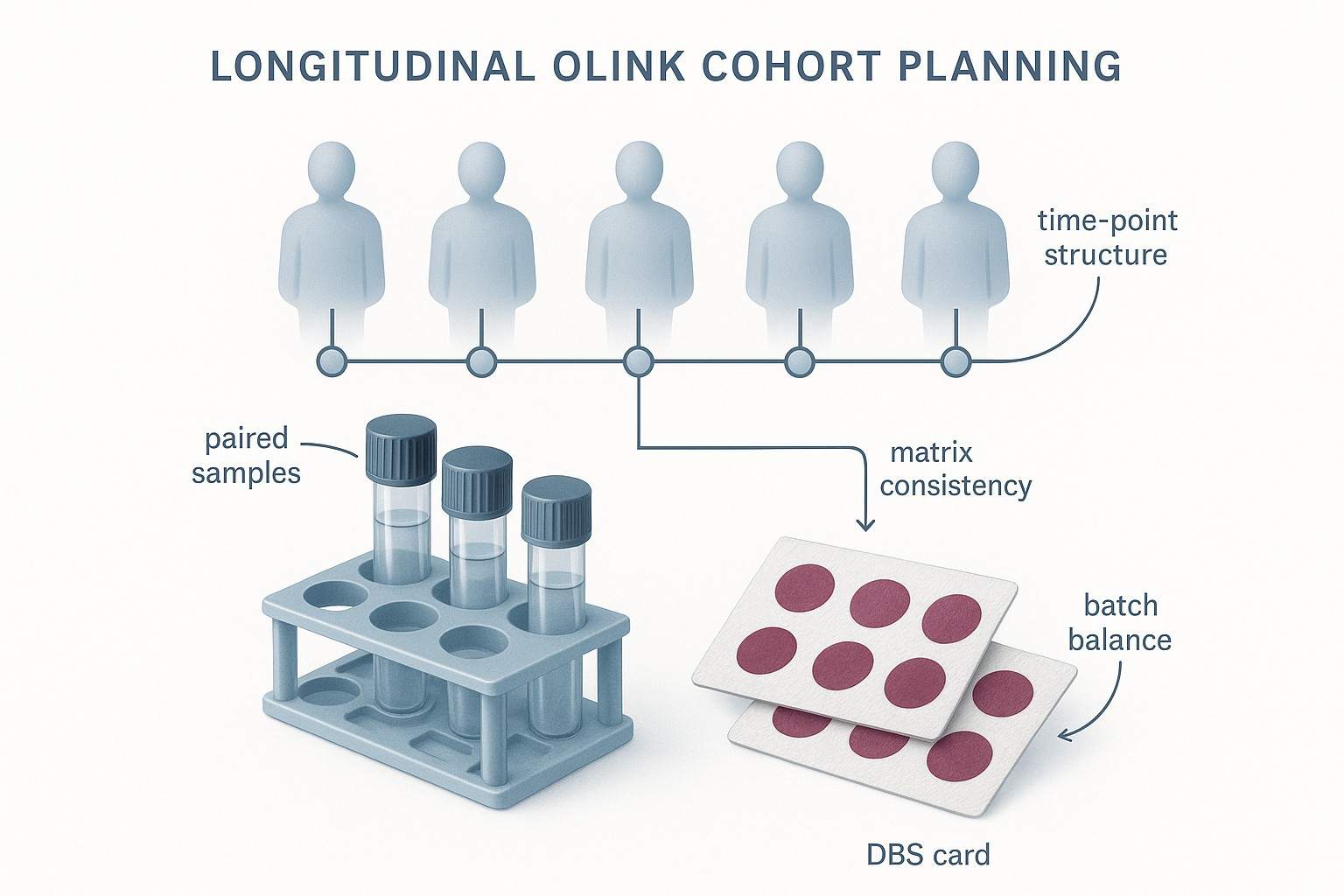 Figure 1. In longitudinal Olink studies, repeated sampling introduces design variables beyond simple sample count, including time-point structure, matrix consistency, and batch balance.
How to plan an Olink longitudinal cohort: why this isn't just a bigger project
This is the mindset shift: a longitudinal Olink study is not a scaled-up cross-sectional study. The repeated-measures structure changes what can bias your conclusions.
Why longitudinal cohort studies are not just "bigger" Olink projects
Repeated sampling changes the design logic
A single time point study asks, "How do groups differ?" A longitudinal study asks, "How do individuals change, and is that change different by group?"
That shift is why Olink repeated measures projects fail in ways single-time-point projects don't. Anything that changes systematically over time (collection method, matrix, shipping workflow, sites joining mid-study) can look like biology.
Time points affect more than sample count
More time points expand your analysis space faster than your sample count.
Baseline vs follow-up is one contrast. Add two more visits and you may end up with early predictors, slopes, responder trajectories, and subgroup interactions. If your design doesn't protect interpretability, you'll spend the back half of the project trying to explain why signals don't replicate across visits.
Define the biological question before you define the timeline
Are you tracking trajectories, treatment response, or baseline-to-follow-up change?
Write the primary repeated-measures question in one sentence, then design around that sentence.
- Trajectory: "Do protein trajectories differ between outcome groups?" (common in birth cohorts)
- Treatment response: "What changes after intervention, and in whom?" (common in trials)
- Baseline-to-follow-up change: "How much does each participant change between two defined windows?"
If someone says "baseline and follow-up," ask for the missing qualifiers: baseline relative to what event, follow-up at what window, and whether participants are truly paired. This is the difference between a clean Olink baseline follow-up study and a design that needs weeks of post-hoc interpretation work.
Not every longitudinal study needs the same time-point density
More visits don't automatically mean better inference.
A four-time-point schedule can be excellent when the workflow is stable and retention is realistic. The same schedule can be worse than two time points when later visits have high missingness or when collection drifts over time.
A quick stress test:
- If the last time point loses 25–30% of participants, does your primary question still stand?
- If budget forces you to drop one visit, which one drops with the least damage?
- Are your windows defined tightly enough that "follow-up" is comparable across participants?
The panel decision should follow the biological question
In longitudinal proteomics study design, panel choice is not only "what biology do we care about?" It's also "what biology is expected to move at our chosen time scale, and what design choices could fake that movement?"
If your primary question is early-life immune programming, time-point spacing and sample consistency will drive interpretability as much as panel breadth.
How to decide whether your time-point structure is analytically realistic
Longitudinal datasets are often analyzed with models that explicitly handle repeated measures (e.g., mixed models). Those models depend on clear pairing, accurate time stamps, and stable measurement conditions.
Use the checklist below before committing to your schedule.
| Design question | Why it matters | What to clarify before assay planning |
| What is the primary repeated-measures endpoint? | Prevents analysis sprawl | Baseline-to-follow-up, slope, responder trajectory, early predictor |
| Are samples truly paired across time points? | Pairing is the advantage | IDs, visit windows, and rules for late/early visits |
| What missingness is expected per visit? | Missingness changes what's analyzable | Retention assumptions and how you'll handle missing data |
| Which time points are "must-have" vs "nice-to-have"? | Protects power and budget | Pre-commit to a minimal viable schedule |
| Will procedures change mid-study? | Changes create artificial signals | Document protocol transitions and their scope |
Olink's own guidance on multiplex immunoassay planning emphasizes matching randomization and planning choices to study type (including longitudinal designs), and minimizing preanalytical variability through consistent collection and storage (see Olink's practical tips for planning a multiplex immunoassay experiment).
Matrix consistency is one of the most underappreciated issues in longitudinal Olink studies
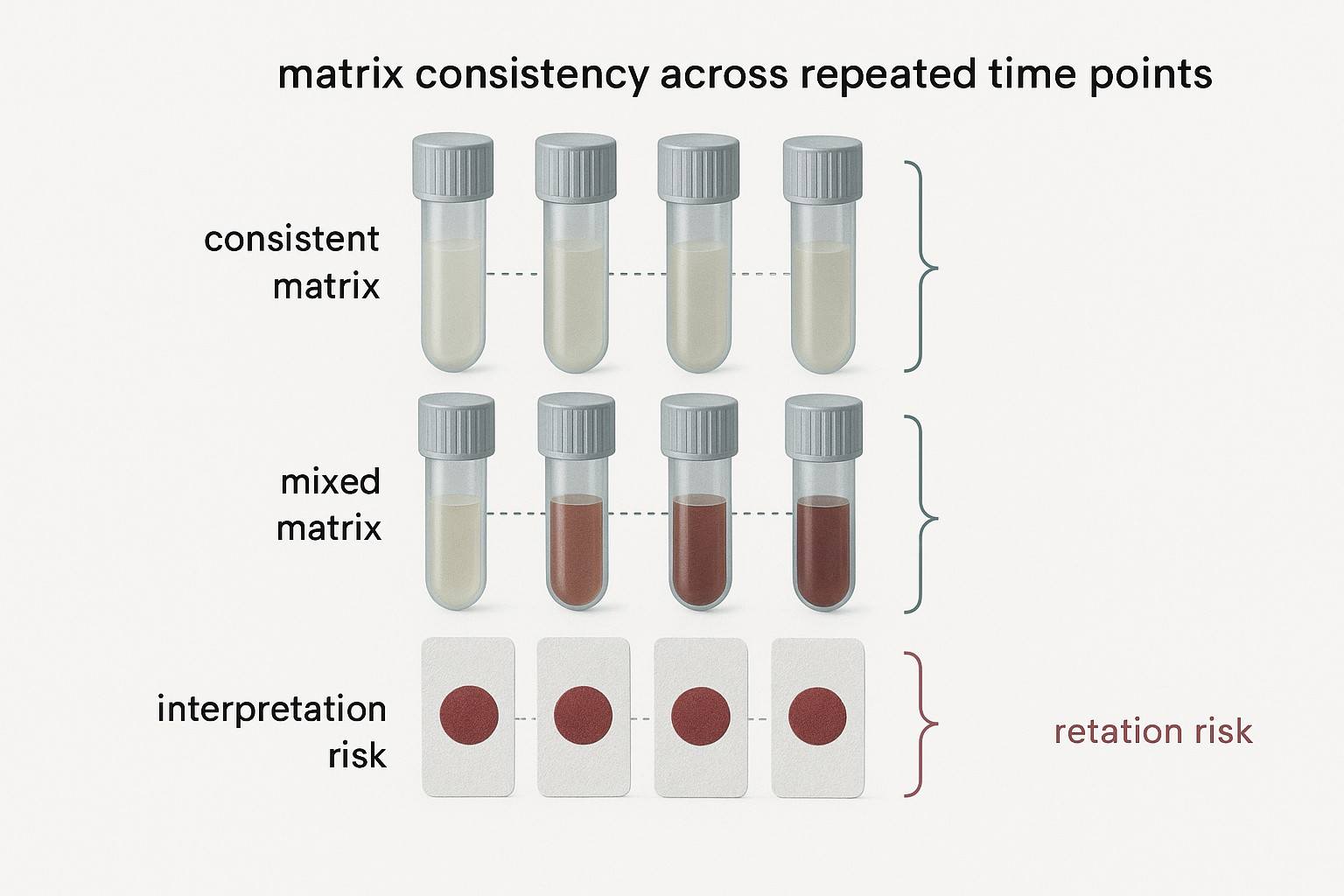 Figure 2. Consistent matrix use across repeated time points improves interpretability in longitudinal Olink study design.
Standard matrices reduce avoidable variation
If your primary analysis is within-person change, keep the matrix the same across visits whenever possible.
Decide early:
- plasma vs serum
- if plasma, anticoagulant type (and keep it consistent)
- whether any site-specific practices must be harmonized
This is one of the most direct ways to protect Olink cohort sample consistency across repeated collections.
Non-standard formats require even more discipline
DBS makes repeated collection practical in birth cohorts and decentralized settings, but it moves risk into workflow consistency.
Peer-reviewed evaluations support feasibility of multiplex protein measurement in DBS with PEA while highlighting storage effects. In Molecular & Cellular Proteomics (2017), Björkesten and colleagues reported that drying only slightly influenced detectability (average correlation ~0.970) and examined long-term storage effects (see Björkesten et al. (2017) on protein stability in dried blood spot biobanks).
The planning takeaway isn't "DBS works." It's "DBS works when the collection and storage workflow stays stable across time points."
Mixing matrices across time points should never be an afterthought
Mixing plasma at baseline and serum at follow-up changes your question. You're no longer estimating clean within-person change.
If matrix mixing is unavoidable, treat it as a design event:
- document the change point and scope
- decide whether to restrict analysis to consistent subsets
- decide whether you will model the matrix change as a covariate (and accept the interpretation limits)
For a practical checklist on non-standard formats, see what to check before using DBS in Olink studies.
Batch structure can quietly shape your results if you do not plan early
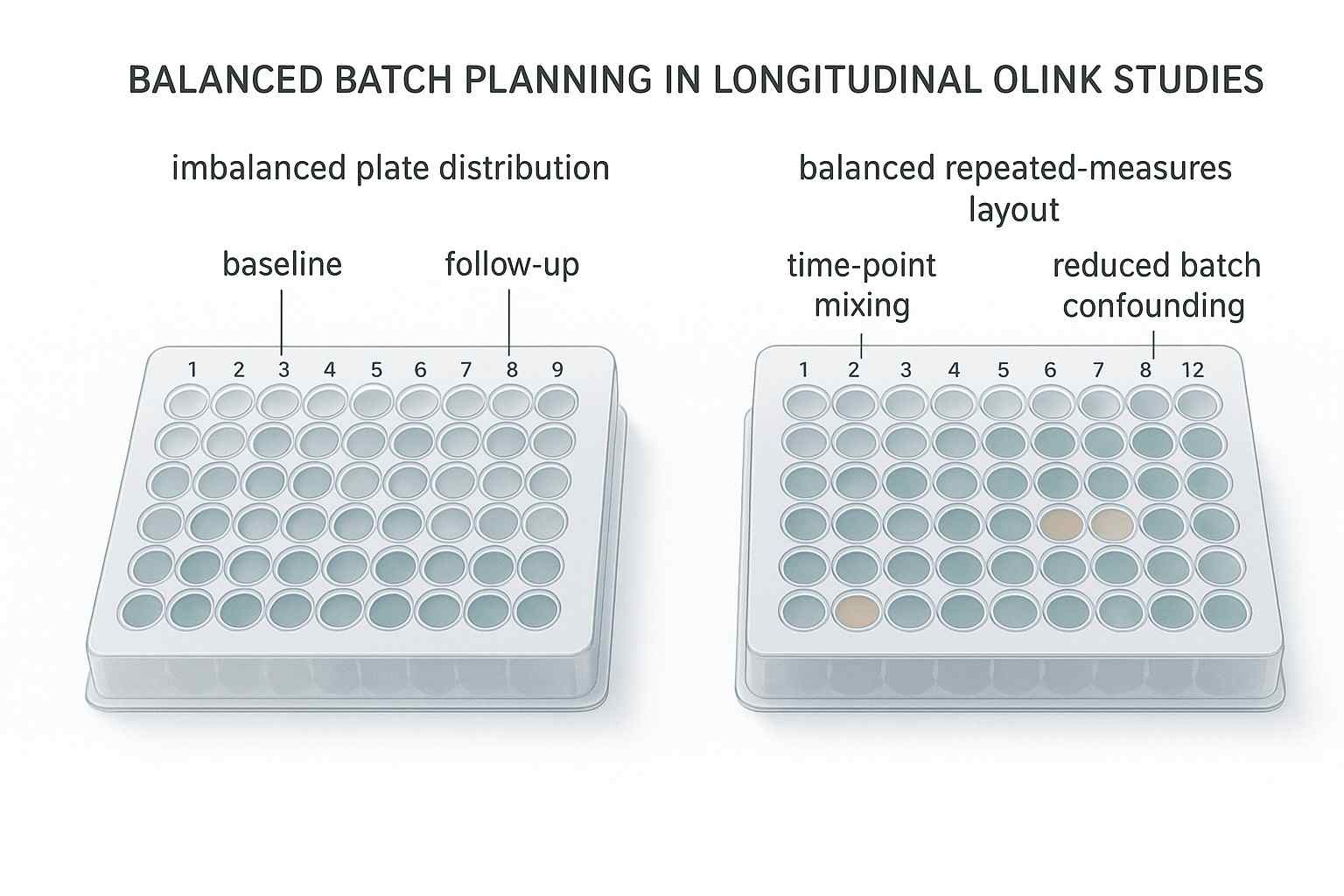 Figure 3. Balanced plate and batch structure can reduce avoidable bias in longitudinal Olink cohort studies with repeated measures.
Longitudinal studies must think beyond total sample number
Batch planning is where logistics and statistics collide.
A longitudinal cohort is not just N × T samples. It's a set of samples that will be processed across days, plates, and runs, under real operational constraints. If time point and batch align, batch can masquerade as longitudinal change.
Proteomics workflows address this problem explicitly at scale. Sajic and colleagues describe diagnostics and correction steps for batch effects in large proteomics studies (see Sajic et al.'s 2021 protocol on batch effects in large-scale proteomics). Your goal as a study planner is to avoid designing a dataset where batch and biology are inseparable.
Why balanced distribution matters across time points and groups
A balanced plan aims for each batch to include a mix of:
- time points
- groups/arms
- sites (when feasible)
- key covariates you already know matter (sex, age strata, baseline severity)
This doesn't eliminate batch effects. It reduces the chance that batch perfectly tracks your biology.
Processing all baseline samples first is not always the best idea
Running all baseline first and follow-up later is operationally neat and analytically risky. You increase dependence on post-hoc correction because time point becomes partially encoded as run date, lot changes, or operational drift.
A safer default is time-point mixing across batches when feasible, and explicit documentation when it is not.
| Design element | Risk if ignored | Planning goal |
| Time points aligned to batches | Batch confounding mimics longitudinal change | Mix time points across batches where feasible |
| Sites aligned to batches | Site effects become batch effects | Distribute sites across batches or plan bridging |
| Arms aligned to batches | Differential bias between groups | Balance groups within each batch |
| No rerun buffer | QC failures cluster in one visit/group | Reserve capacity and define rerun rules |
| Weak metadata | Can't explain drift or outliers | Standardize metadata capture across sites and visits |
**Key Takeaway**: In repeated-measures projects, your batch plan is part of your study design. If you don't design it, you still have one.
What to clarify if your longitudinal study uses DBS or other field-friendly formats
DBS longitudinal studies are usually motivated by feasibility: easier repeat collection, better compliance, and simpler shipping.
The trade-off is that decentralized collection can amplify variation if you don't control the workflow.
Practical items to standardize across time points:
- collection device and lot tracking
- drying time and humidity exposure
- shipping time and packaging
- storage temperature and transitions
- punch strategy and documentation
If you're planning an Olink DBS longitudinal study, include your collection SOP summary and metadata plan in the first project discussion.
How to describe your longitudinal cohort clearly when requesting project support
A useful inquiry makes the cohort analyzable on paper.
1) State the cohort structure
- participants
- groups/arms
- sites/centers (and whether protocols differ)
2) Define the time-point logic and sample format
- number of time points and visit windows
- whether repeated samples are paired
- matrix per time point (and anticoagulant if plasma)
- whether collection is complete or ongoing
Use unambiguous language. If you mean two visits, say baseline and follow-up. If you mean more, call it repeated measures and list the schedule.
3) List constraints that may affect design
- limited volume per visit
- expected missingness at later visits
- known protocol changes
- regulatory or data-transfer constraints
If you want a structured template, start with an Olink quotation checklist and add longitudinal specifics.
Before submitting your inquiry, clarify: number of participants; number of time points; matrix per time point; paired structure; collection status; site differences.
CTA (technical, mid-funnel)
If you want to pressure-test your design before sample collection locks in avoidable confounding, you can discuss your cohort structure, time-point logic, and batch plan with Creative Proteomics. The goal is to align sample strategy, assay setup, and QC deliverables to the repeated-measures question.
Common mistakes in longitudinal Olink planning
- Treating time points as multipliers: you get extra samples but no extra clarity.
- Letting matrix drift accumulate: a small protocol change becomes the dominant longitudinal signal.
- Finalizing batching too late: convenience batching is how confounding enters.
- Choosing assay details before the endpoint is pinned down: you can't optimize a panel around a moving target.
For teams scaling up, the strategic framework for large Olink cohorts can help you think through power, QC, and operational complexity without turning the study into a throughput-only exercise.
FAQ
How many time points should a longitudinal Olink study include?
Start from the primary endpoint, then add only the visits that materially improve inference. Two time points can be enough for baseline-to-follow-up change. Trajectory questions may need more, but only if you can keep collection consistent and retention realistic.
Do all repeated samples need to use the same matrix?
If the primary analysis is within-person change, yes, that's the safest default. Mixing matrices across time points turns "change" into "change plus matrix effect," which may be hard to interpret cleanly.
Can DBS be used in a longitudinal Olink cohort?
Yes. Peer-reviewed work supports feasibility while emphasizing workflow and storage effects (see Björkesten et al., 2017 on DBS protein stability). The practical requirement is consistency across time points plus metadata you can trust.
Should baseline and follow-up samples be processed together?
When feasible, mixing time points across batches reduces confounding. If baseline and follow-up must be separated operationally, plan how you will monitor and mitigate cross-batch effects up front.
How should I think about batch structure across repeated measures?
Aim for balance: each batch should include a mix of time points and groups when possible, and you should document decisions that force separation. Batch effects are a known risk in large proteomics studies, and protocols exist for diagnosis and correction; planning reduces how much you need to rely on post-hoc fixes.
What information should I include when requesting support for a longitudinal cohort study?
Provide cohort structure, time-point windows, pairing logic, matrix per visit, collection status, and constraints. If your team uses an Olink quotation checklist internally, it's a good starting structure.
What is the most common design mistake in longitudinal Olink planning?
Assuming interpretability is automatic once the assay is selected. In reality, pairing clarity, matrix consistency, and batch balance determine whether longitudinal comparisons are meaningful.
Conclusion
Longitudinal studies can be among the most informative Olink projects because they turn each participant into their own baseline.
But the advantage depends on decisions you make before the first shipment: define the repeated-measures endpoint, lock a time-point schedule you can analyze, keep the matrix consistent, and design a batch structure that doesn't encode time point as "run date."
If you want to move from "we have samples" to a launch-ready plan, start by sharing your cohort structure using an Olink quotation checklist.
---
About the Author
CAIMEI LI
Senior Scientist at Creative Proteomics
LinkedIn: Caimei Li
Caimei Li is a Senior Scientist at Creative Proteomics, with experience supporting proteomics study planning for translational research, biomarker discovery, and complex multi-time-point cohort projects. Her work focuses on helping research teams align sample strategy, assay design, and data-readiness before project launch.