

 Submit Your Request Now
Most first-time Olink inquiries start the same way: a sample count and a panel name. But a fast, accurate quotation depends on more than those two inputs. In early project discussions, researchers often omit details that directly shape assay setup, batch strategy, and downstream analysis scope—leading to multiple rounds of emails and lost time.
Consider two real-world scenarios. A cardiovascular group planning an inflammation study with roughly 500 participants had already shortlisted an Olink workflow. Even so, the team needed to clarify cohort structure, matrix consistency, and analysis expectations before a meaningful quotation could be prepared. In another case, a translational team collecting dried blood spots at four time points realized that sample format and longitudinal design would change the scope of planning well before shipment.
This article provides a practical, auditable Olink quotation checklist—what to gather before you hit "submit" on a web form or email. It's written for academic PIs, postdocs, and research scientists running their first Olink project, with added guidance for longitudinal or multi-center cohorts and for teams working with non-standard matrices such as DBS, bone marrow plasma, or conditioned media. Use it to reduce back-and-forth, protect precious specimens, and move from inquiry to pre-study consultation with momentum.
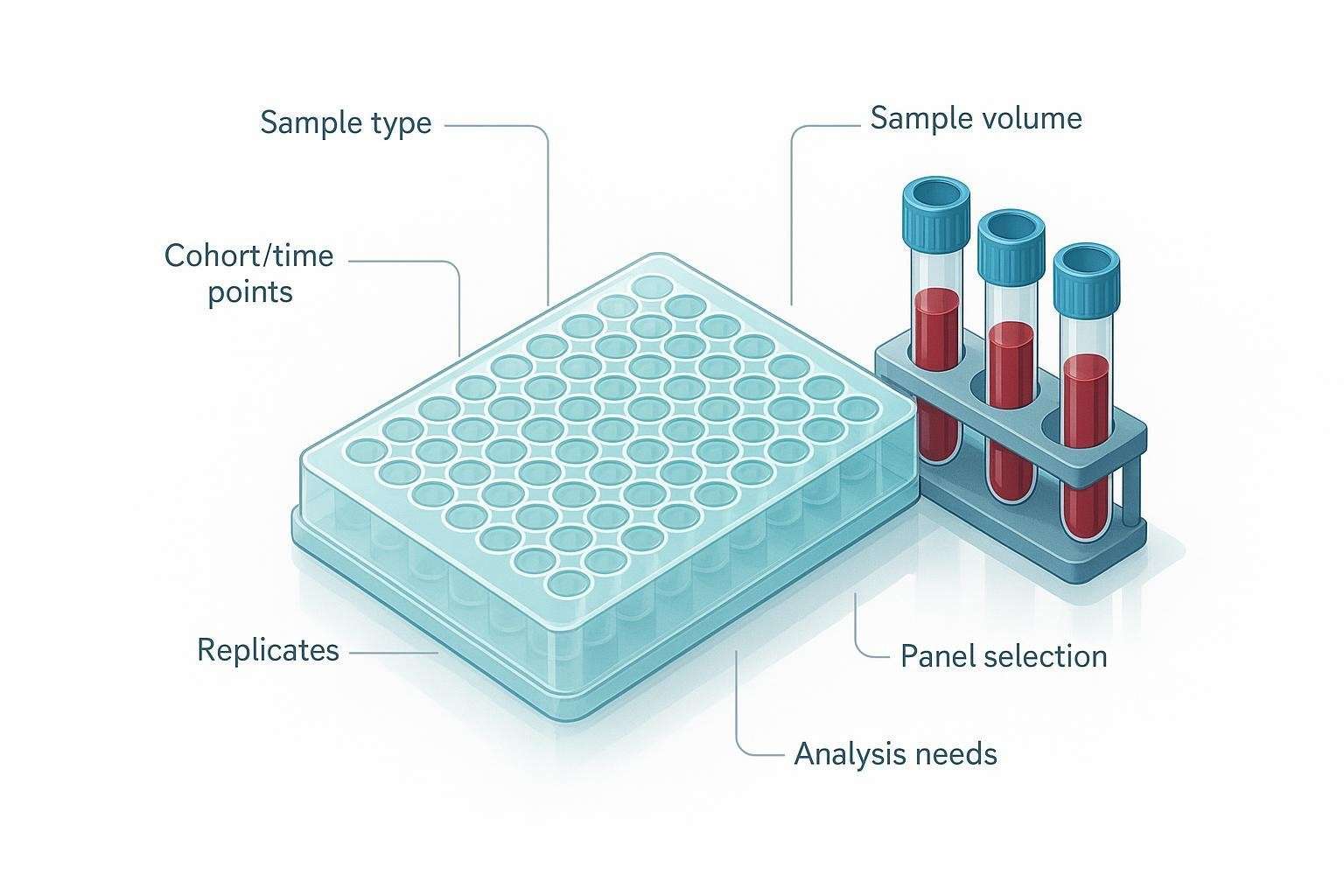 Figure 1. Key project inputs that shape a meaningful Olink quotation before sample shipment.
Why sample count alone is not enough for an Olink quotation
A quote depends on study design, not just the number of samples. Whether you are running discovery or targeted validation, single time point or longitudinal, and whether you're using a standard panel or a custom request, these choices determine feasibility, plate layout, and analysis scope. Matrix matters too—EDTA plasma and serum are common baselines in Olink documentation, while other biofluids and alternative matrices can be compatible but may warrant additional feasibility checks and planning according to the product family pages for the Target and Explore series on the official site. See, for example, the guidance on recommended matrices in the Target portfolio described on the Olink site in 2026 under the Target 96 and related product pages.
Before assay setup, service teams typically confirm the essentials: pre-study consultation topics, design and assay setup parameters, shipping needs, analysis/QC expectations, and data delivery format. Olink describes this multi-step flow—pre-study consultation to quotation and contract, then shipping, analysis/QC, and data delivery—on its official services page, which underscores why quotations rely on more than sample count alone (see Olink's description of Analysis Services in 2026).
A quote depends on study design, not just the number of samples
Sample count is only a starting point. Discovery vs. validation, longitudinal vs. single time point, panel vs. custom content, and standard vs. non-standard matrices all influence whether your project proceeds as a straightforward plate map or requires staged runs, bridging, or pilot feasibility. When teams surface these inputs up front, providers can right-size the scope and avoid downstream rework.
What service teams usually clarify before assay setup
Expect questions aligned to the official workflow: pre-study consultation, design and assay setup, shipping confirmation, analysis/QC, and data delivery. Teams will probe matrix type and consistency, time-point structure, replicates and controls, and what analysis support you expect beyond QC and normalized output. This quick table shows why sample count alone doesn't define the project scope.
| Input the researcher provides | What it helps determine | Why it affects quotation readiness |
| Matrix type (e.g., EDTA plasma, serum, CSF, DBS) | Assay feasibility, potential interferents, pilot need | Non-standard or challenging matrices may require validation steps and alter timelines. Based on recurring guidance on Olink product pages and blogs in 2026. |
| Cohort structure and time points | Plate layout, batch strategy, randomization | Minimizes batch confounding and guides staged runs or bridging where appropriate, supported by Olink's software materials for combining studies and peer-reviewed batch-effect literature (Čuklina 2021; Yu 2024). |
| Panel preference vs. custom interest | Assay selection or custom Flex/Focus path | Cross-panel or custom designs influence throughput, pricing, and feasibility (Olink Flex and Olink Focus pages). |
| Replicates and controls plan | Consumption, plate map, statistical power | Olink integrates per-sample and run controls; technical duplicates may be de-emphasized when QC passes, prioritizing biological replicates (see Olink Target pages and FAQs). |
| Analysis expectations | Scope of downstream reporting/support | Pathway analysis or cohort stratification support increases level-of-effort (Olink Data Science Services). |
The Olink quotation checklist: the 7 pieces of information to prepare before you contact a provider
This is the core checklist. Capture these seven categories before you submit your first message. Clear, structured inputs speed up feasibility assessment and reduce email loops.
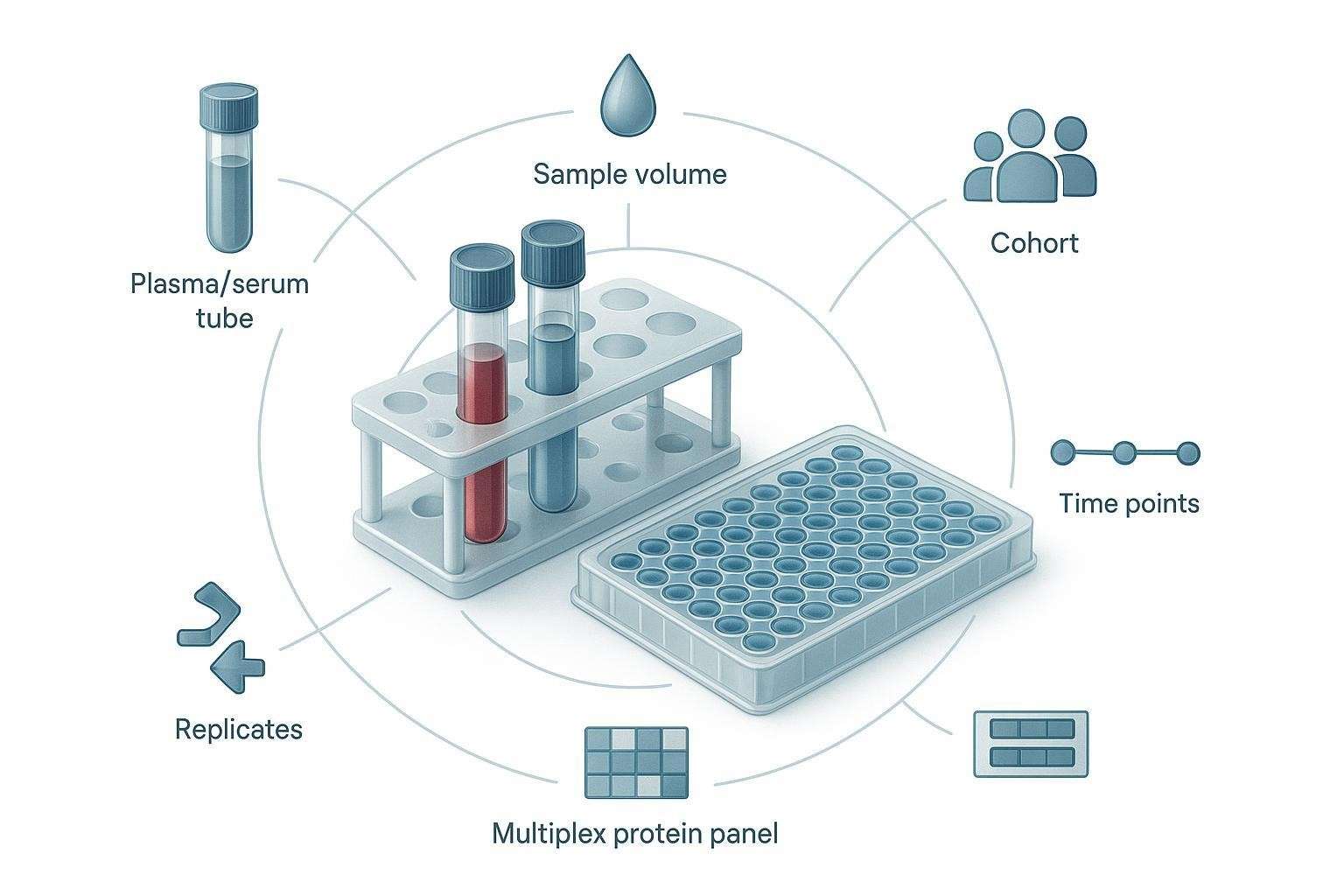 Figure 2. A structured checklist for preparing an Olink inquiry, from research objective and matrix type to replicates and analysis expectations.
1. Research objective and decision stage
Start with the question you're trying to answer and where you are in the decision process. Common frames include exploratory biomarker discovery, hypothesis-driven testing around a focused mechanism, feasibility or pilot work to assess signal windows, or targeted validation of previously observed signatures. Stating the decision stage helps calibrate assay choice, QC tolerance, and the depth of analysis support required.
2. Sample type and matrix consistency
Specify the matrix clearly and aim for consistency within a project. EDTA plasma and serum are widely referenced as recommended sample types across Olink product information; additional matrices such as CSF, urine, saliva, synovial fluid, cell culture media/supernatant, and some alternative biofluids can be compatible depending on the assay and context, as described across Olink's Target and Explore pages in 2026. If you plan to submit non-standard matrices—such as dried blood spots, conditioned media, or bone marrow plasma—flag this early, describe collection context and processing, and be open to a small pilot or feasibility step. Mixing matrices within one analysis can inflate variability and complicate interpretation; if your study design requires multiple matrices, specify why and how they'll be analyzed.
3. Sample volume, aliquots, and freeze–thaw history
Report available volume per sample, aliquot format (96‑well plate or individual tubes), whether you can provide a backup aliquot, and the freeze–thaw history. Minimizing repeated freeze–thaw improves proteome stability; this principle is supported by proteomics literature (e.g., Halvey 2021) even if not always stated verbatim in Olink FAQs. As a neutral, concrete example, some service guidelines advise submitting approximately 40 µL per sample for certain Explore formats (and around 80 µL for higher-throughput formats), shipping on dry ice, and avoiding repeated freeze–thaw, with extra microliters to accommodate QC or repeat injections—see the Creative Proteomics Olink submission guidelines (Knowledge Base Source) for an example of how such requirements are documented.
Mini‑case: A postdoc planning to compare patient plasma with bone marrow plasma requested four panels with technical duplicates. Before quoting, the intake team asked for matrix specifics (anticoagulant, handling), true per‑sample volumes and aliquot formats, and whether duplicates were realistic given limited volume. Clarifying these points led to a revised plan prioritizing biological replicates while keeping a small reserve for QC contingencies.
4. Cohort structure, groups, and time points
Define groups and arms, case/control or stratification variables, target n per group, and the schedule of sampling time points. State whether all samples will arrive together or in waves, since staged submissions influence plate randomization and batch planning. Longitudinal designs should show the number and timing of repeated measures per participant. For multi-center cohorts, flag collection/site differences that could drive pre-analytical variability and consider a plan for randomizing across plates and centers.
Mini‑case: A longitudinal DBS cohort with 100 participants sampled at baseline plus three follow-ups needed early discussion of extraction approach, expected eluate volumes, and a plate layout that preserved time‑series integrity while balancing groups across plates.
5. Panel preference or whether you need help choosing one
If you already know the panel(s), list them and why they map to your biological question. If you only know the biology—say, cardiometabolic inflammation—say so, and request guidance. When your proteins of interest are scattered across multiple panels, provide a concise shortlist and note whether you are open to a small custom set.
Mini‑case: A metabolic disease group prioritized 5–6 adipokines distributed across several panels. Sharing this shortlist allowed a targeted discussion of combining panels versus pursuing a small custom build.
6. Replicates, controls, and precious-sample constraints
Clarify whether you expect technical duplicates or will prioritize biological replicates given limited volume. Olink workflows incorporate extensive internal and external controls, and software like Olink Analyze supports QC-driven decisioning; in many routine scenarios, technical duplicates add less value than additional biological n once QC passes. Also disclose constraints: infectious materials, irreplaceable specimens, single-use aliquots, and any prohibition on re‑aliquoting.
7. Analysis expectations and deliverable priorities
State what you expect beyond the standard QC and normalized output. Do you need differential analysis with statistics, pathway enrichment, cohort stratification, or support interpreting signatures? Indicate whether you want a results review meeting. Olink's Data Science Services emphasize early involvement on power, balance, and analysis planning; surfacing this need up front ensures that the quotation includes appropriate analyst time and deliverables.
Title: Pre‑Quote Olink Project Checklist: What to Gather Before You Submit an Inquiry
| Information category | What to specify | Why it matters | Common omission |
| Research objective and decision stage | Discovery vs. validation; hypothesis‑driven vs. feasibility/pilot; translational follow‑up | Aligns panel/custom choice and QC thresholds to the decision you need to make | Only stating "biomarker study" without the decision point |
| Sample type and matrix consistency | Matrix (EDTA plasma, serum, CSF, DBS, conditioned media, bone marrow plasma), anticoagulant, plan for single‑matrix consistency | Matrix impacts assay performance; consistency reduces variability | Listing "plasma" without anticoagulant or mixing matrices unintentionally |
| Volume, aliquots, freeze–thaw history | Per‑sample volume, aliquot format (plate/tubes), number of freeze–thaw cycles, backup aliquots | Secures feasibility and protects precious samples | Reporting only a minimum volume without aliquot reality or F/T record |
| Cohort structure, groups, time points | Groups/arms; case/control; n per group; time‑point schedule; whether all samples ship together | Drives plate randomization and batch mitigation strategy | Omitting time‑point structure, inviting batch confounding |
| Panel preference or help choosing | Named panel(s) vs. biology-only brief; small custom set or cross‑panel shortlist | Accelerates correct assay selection or custom path (Flex/Focus) | Asking for the "most complete panel" without stating the question |
| Replicates, controls, constraints | Technical duplicates vs. biological n; infectious/irreplaceable status; limits on re‑aliquot | Shapes layout, safety, and QC planning | Forgetting to disclose infectious or irreplaceable status |
| Analysis expectations and deliverables | QC + normalized output only vs. pathway/differential/stratification; need for results review | Clarifies scope and analyst time | Asking for "full analysis" without outputs defined |
How to describe your samples clearly so the quote process moves faster
Before moving to assay selection, describe your materials precisely. Think of it this way: your first message should read like an abridged sample manifest that a lab can immediately reason about.
For plasma and serum studies
Name the anticoagulant (e.g., EDTA), storage temperature, and aliquot format. Confirm that handling is consistent across the cohort (collection tubes, centrifugation, storage time before freezing). Olink's product pages commonly emphasize EDTA plasma and serum as recommended matrices and encourage consistent pre-analytics and documentation across samples, which helps QC and normalization.
For DBS, conditioned media, bone marrow plasma, or other non-standard matrices
Do not select "other" and leave it at that. Provide collection context (e.g., finger‑prick DBS card type; cell line and culture conditions for conditioned media; anatomical source for bone marrow plasma), processing method, expected available volume or eluate per sample, and whether a pilot validation step is acceptable. The clearer you are, the faster feasibility can be assessed. As a practical reference for handling fundamentals and expectations, see the internal overview on Olink sample preparation guidelines (Knowledge Base Source).
For infectious, limited, or irreplaceable samples
Disclose these constraints up front, including biosafety classification, shipping needs, and any limits on re‑aliquoting. When volume is tight, state whether technical duplicates can be traded for higher biological n under appropriate QC.
Mini‑case: A postdoc comparing patient plasma with bone marrow plasma needed to clarify anticoagulant choice, aliquot handling, and whether duplicates were realistic before asking for a four‑panel quote.
Mini‑case: A cell-based inflammation project using conditioned media from cultured fibroblasts specified collection volume, well format, and whether a single‑well setup would leave enough material for repeat analysis. That information enabled realistic planning for plate layout and back‑up volume.
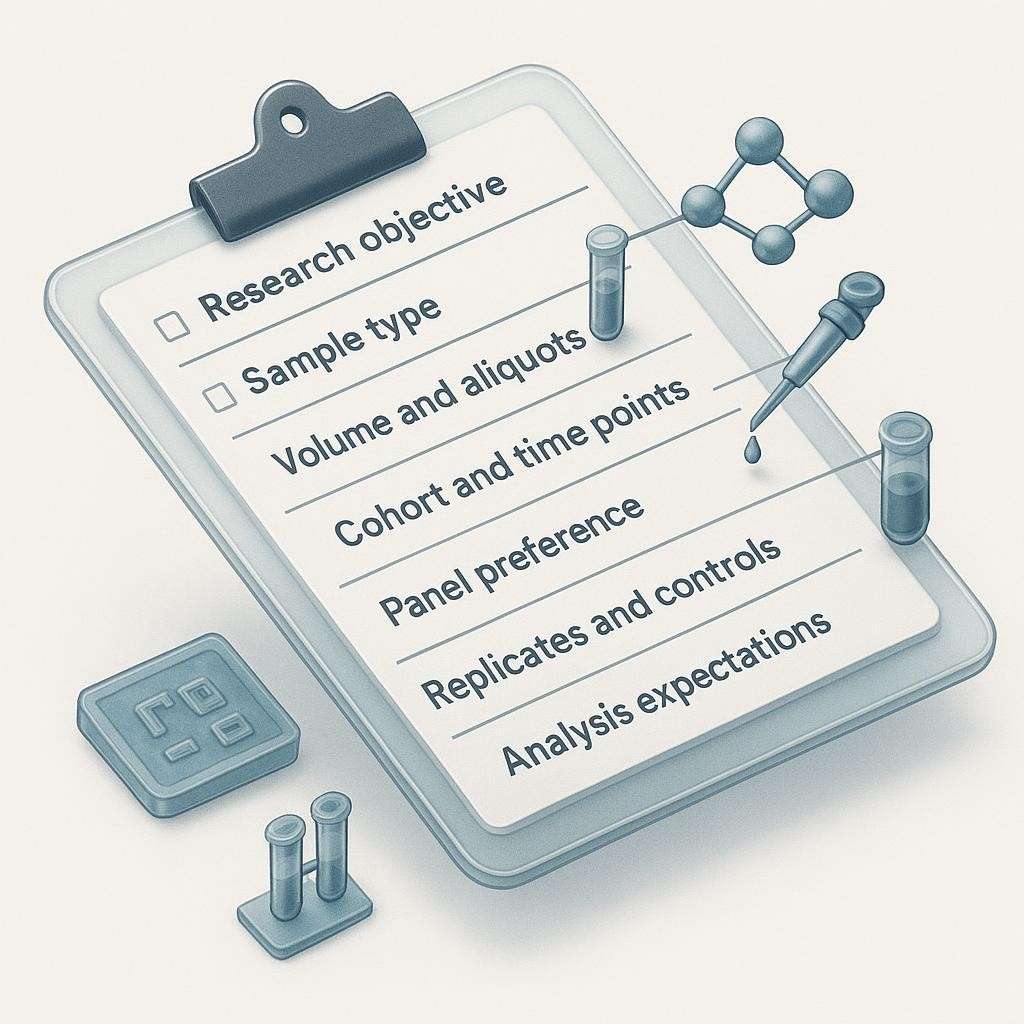 Figure 3. Why project context matters: matrix type, time‑point structure, and sample constraints can all change how an Olink study is scoped before submission.
How to explain study design in a way that helps assay planning
A clear design summary tells the intake team how to randomize across plates, how to mitigate batch effects, and whether staged submissions or bridging samples might be warranted. Olink's software materials describe tools for combining studies and adjusting batch effects; peer‑reviewed proteomics literature provides general best practices for diagnosing and correcting batch confounding in large cohorts (Čuklina 2021; Yu 2024).
State the biological question first
Lead with a short statement: broad inflammation screen, cytokine‑focused follow‑up, cardiometabolic biomarker discovery, or translational validation. This keeps the rest of your inputs anchored to the decision you need to make.
Then define the study structure
List total n, groups/arms, time points, and matching, and say whether all samples will ship together. For longitudinal designs, include the cadence (e.g., baseline, 3 months, 12 months) and expected completeness per time point.
Finally, flag any design constraints
Name limited volume, no repeat collection, mixed matrices, urgent timelines, or custom target requests. These details inform plate layout, potential staged runs, and the level of analysis support to include.
Title: A simple way to summarize study design in your first inquiry
| Study element | Example answer | Why the provider needs it |
| Biological question | Broad inflammation screen in cardiometabolic risk | Anchors panel selection or custom path |
| Structure and size | 240 participants, 2 arms (case/control), 1:1 match | Drives plate randomization and balanced layout |
| Time points | Baseline and 12‑month follow‑up for all participants | Informs longitudinal planning and staged shipments |
| Matrix and consistency | EDTA plasma only, uniform processing | Reduces variability; clarifies feasibility |
| Volume and aliquots | 60 µL per sample in 96‑well plate; one backup aliquot | Confirms feasibility and QC reserves |
| Replicates and controls | No technical duplicates; prioritize biological n | Shapes plate map and consumption |
| Analysis deliverables | QC + normalized output + differential analysis with review | Scopes analyst time and deliverables |
When standard panel names are not enough: how to frame custom or cross-panel requests
If you already know the panel
State the panel name(s), the biological rationale, and matrix/time‑point context. Note any constraints that might force staged runs or alternative formats.
If you only know the biology, not the panel
Provide your biological question, matrix, cohort size and structure, and decision stage. Invite guidance on panel choice. This is often faster than guessing and requesting revisions later.
If your targets span multiple panels or you need a small custom set
Share a short ranked list of proteins and your tolerance for a small custom set or combining panels. Olink offers custom content routes such as Flex and Focus (public pages describe small custom sets via Flex and custom‑made panels up to roughly a couple dozen proteins for Focus; exact caps evolve, so confirm during scoping). Describing your shortlist and decision goal is more valuable than asking for "the most complete panel." For context, see Flex and Focus in 2026.
Common mistakes that slow down Olink quotation and project setup
Asking for price without describing the matrix
A common source of delay is the missing matrix and anticoagulant. "Plasma" isn't enough—EDTA, citrate, or heparin can behave differently, and non‑standard matrices may need pilot validation.
Listing sample count without time‑point structure
When longitudinal or multi‑arm designs aren't stated, plate layout and batch strategy cannot be scoped. Share the schedule and whether samples ship together.
Forgetting to mention replicate expectations
If you plan technical duplicates, state it and confirm volume. Many teams ultimately prioritize biological replicates once they account for Olink's integrated controls and QC policies.
Treating special samples as if they were standard plasma
DBS, conditioned media, and bone marrow plasma benefit from early feasibility checks. Provide collection context, processing, and expected volumes so your provider can recommend a fit‑for‑purpose plan.
A practical template for your first inquiry email or web form submission
A concise structure researchers can follow
- Project goal and decision stage
- Sample type and anticoagulant; storage and aliquot format
- Sample count with groups and time points; whether all samples will ship together
- Candidate panel name(s) or biology to guide selection; shortlist if cross‑panel or custom is likely
- Available volume per sample; freeze–thaw history; backup aliquots
- Replicates and controls plan; infectious or irreplaceable constraints
- Analysis support needed beyond QC + normalized output; request for a results review meeting
What to leave optional for later discussion
- Randomization details and plate map drafts (the provider can propose a plan)
- Pilot feasibility design for non‑standard matrices
- Specific pathway databases or visualization preferences for analysis
FAQ
Is sample count enough to request an Olink quote?
No. Providers also need matrix information, cohort structure and time points, panel selection or custom interest, replicate plans, and analysis expectations. Olink describes a pre‑study consultation and design phase before quotation and contract on its Analysis Services page, which explains why sample count alone is insufficient.
Do I need to know the exact panel before contacting a provider?
Not necessarily. If you can articulate the biological question, matrix, cohort structure, and decision stage, an intake team can recommend suitable panels or discuss custom options such as Olink Flex or Olink Focus.
What sample details should I include for plasma or serum projects?
State the anticoagulant (often EDTA for plasma), storage temperature, aliquot format, and whether handling is consistent across the cohort. Olink's product pages commonly highlight EDTA plasma and serum as recommended matrices and emphasize consistent pre-analytics.
Can I ask for a quote if I am working with DBS, bone marrow plasma, or conditioned media?
Yes—provide collection context, processing method, expected volume or eluate, and indicate if a small pilot is acceptable. Clarity enables rapid feasibility assessment. For a high-level handling overview, see the internal sample preparation guidelines (Knowledge Base Source).
Should I mention duplicates or technical replicates in the first inquiry?
Yes, especially if volume is limited. Because Olink integrates extensive controls and QC flags, many studies favor additional biological replicates once QC passes. If you still want technical duplicates, confirm that volume and plate layout can accommodate them.
What if my samples are limited or cannot be recollected?
Say so immediately and include volume and aliquot realities, plus freeze–thaw history. Providers can suggest strategies to conserve material, such as prioritizing biological n and reserving a small backup for QC.
Can I request a custom panel if my proteins of interest are spread across different Olink panels?
Yes. Share a short ranked list and your decision goal. Public pages describe custom content such as Flex (small custom sets) and Focus (custom‑made panels up to approximately a couple dozen proteins); confirm the latest limits with your provider during scoping.
What information helps a provider respond faster and more accurately?
A compact version of the seven-point checklist: objective and decision stage; matrix with anticoagulant; volume and aliquots with freeze–thaw record; cohort/groups/time points with shipping plan; panel preference or custom interest; replicate and constraint flags; and analysis deliverables.
Conclusion
Clear, complete inputs make quotations faster and more useful. When you specify matrix and anticoagulant, per‑sample volume and aliquots, cohort groups and time points, panel logic, replicate expectations, and analysis needs, you help the intake team right‑size scope from the outset. If you need a concrete example of how submission details are documented, review the Creative Proteomics Olink submission guidelines (Knowledge Base Source), then use the inquiry skeleton above to compose your first message.
References
- Olink Analysis Services, "Services overview and workflow" (accessed 2026), https://olink.com/services/olink-analysis-services
- Olink Data Science Services, "Study design, power, and analysis support" (accessed 2026), https://olink.com/services/olink-data-science-services
- Olink Target 48 and Target 96 product pages, "Recommended sample types and QC features" (accessed 2026), https://olink.com/products/olink-target-48 and https://olink.com/products/olink-target-96
- Olink Target Series overview (accessed 2026), https://olink.com/products/olink-target-series
- Olink Explore HT overview (accessed 2026), https://olink.com/products/olink-explore-ht
- Olink Flex custom content (accessed 2026), https://olink.com/products/olink-flex
- Olink Focus custom-made panels (accessed 2026), https://olink.com/products/olink-focus
- Olink Analyze software (accessed 2026), https://olink.com/software/olink-analyze
- Olink Insight software (accessed 2026), https://olink.com/software/olink-insight
- Olink FAQ, "QC and data interpretation" (accessed 2026), https://olink.com/knowledge/faq
- Olink blog, "Working with challenging samples for additional layers of biological insights" (accessed 2026), https://olink.com/blog/working-with-challenging-samples-for-additional-layers-of-biological-insights
- Čuklina J, et al. Diagnostics and correction of batch effects in large-scale proteomics. 2021. https://pmc.ncbi.nlm.nih.gov/articles/PMC8447595/
- Yu Y, et al. Assessing and mitigating batch effects in large-scale omics. 2024. https://pmc.ncbi.nlm.nih.gov/articles/PMC11447944/
- Halvey P, et al. Variable blood processing procedures contribute to plasma proteome variation. 2021. https://pmc.ncbi.nlm.nih.gov/articles/PMC7816468/
Author: CAIMEI LI — Senior Scientist at Creative Proteomics
LinkedIn: https://www.linkedin.com/in/caimei-li-42843b88/