Submit Your Request Now
If you're setting murine Olink Target 48 QC criteria for a study you must defend in review or audit, here's the playbook. Within the first 100 words you'll find the essentials: below-LLOQ handling, inter-plate CV acceptance, rerun rules for Olink PEA, audit-ready QC documentation, and murine matrix validation—organized so you can trust, defend, and reproduce your data. Guidance aligns to Olink's official QC language, RUO-adapted FDA/ICH bioanalytical principles, and journal-grade transparency.
Key takeaways
- Define plate-level, sample-level, and study-level QC gates up front; document outcomes at each gate.
- Use precision ranges plus actions, not absolute "promises": intra-plate median CV ≤15% (≤20% acceptable), inter-plate/bridge CV ≤20% (≤25% acceptable with low-signal justification).
- Default below-LLOQ policy: treat as missing (NA) and report per-protein detection rates; allow conservative imputation for visualization only; use censoring-aware models for inference with full disclosure.
- Matrix-specific rules matter: CSF and tissue homogenate often justify looser CV acceptance with stronger documentation; run dilution linearity/recovery to rule out interference.
- Build an audit-ready QC pack: plate maps, QC summaries, deviation logs, rerun rationale, and versioned analysis outputs.
What "good QC" looks like in murine Olink Target 48 studies
"Good QC" is data you can trust, defend, and reproduce. In practice, that means:
- Plate-level QC checks internal and external controls, drift, and plate metrics; failures here trump everything else.
- Sample-level QC inspects flags, duplicates (if used), and outliers; it drives repeat/re-test decisions.
- Study-level QC ensures cross-plate comparability with bridge samples and confirms reporting readiness.
This structure mirrors Olink's control philosophy and the run-acceptance logic of bioanalytical guidance like ICH M10 hosted by FDA, which sets acceptance ranges for precision/accuracy and run criteria that can be adapted to RUO contexts. See FDA's M10 hosting page in 2023–2024 for definitions of precision, accuracy, LLOQ, dilution integrity, and run acceptance in LBAs: the official page is at the FDA's site under M10 bioanalytical method validation and study sample analysis.
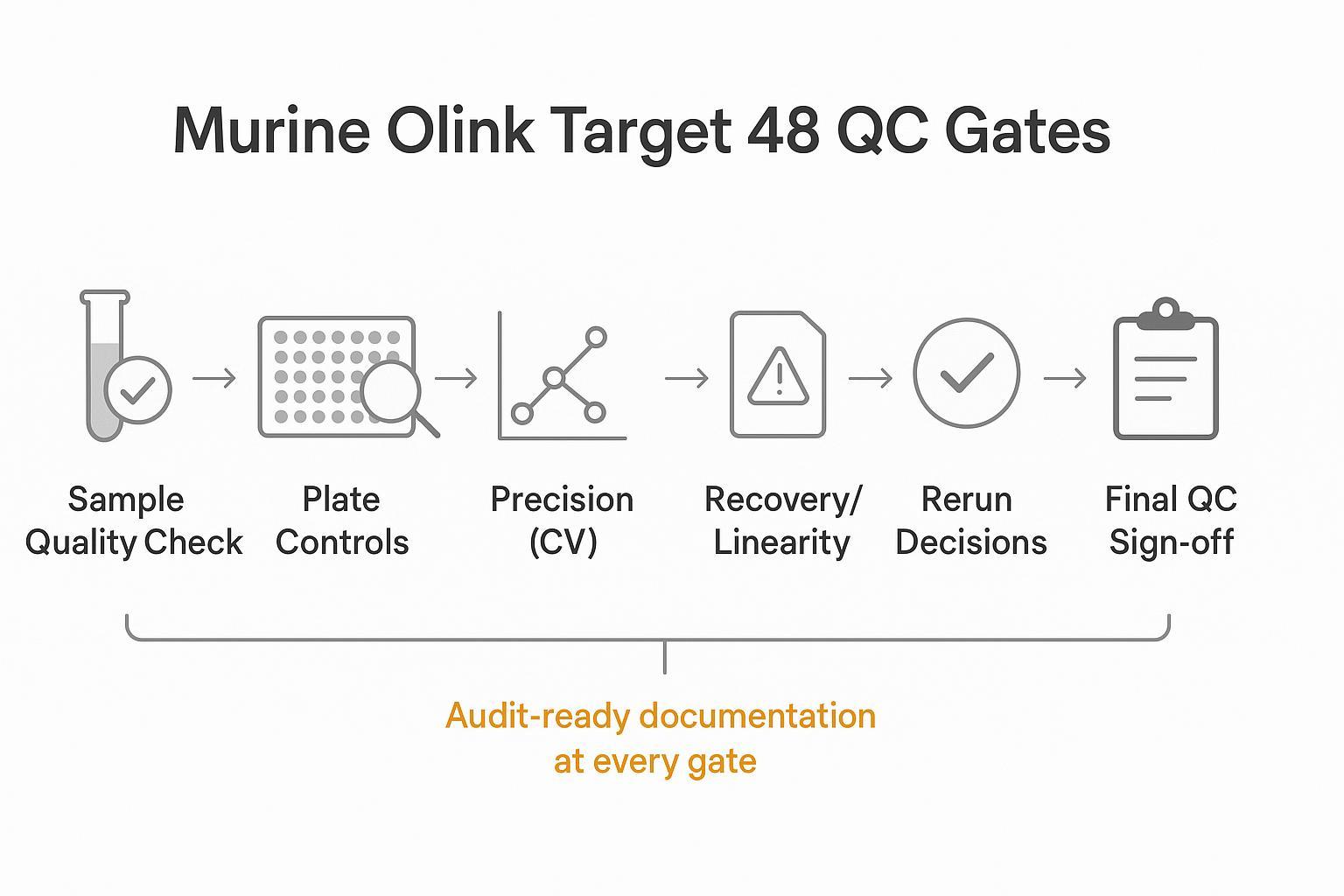
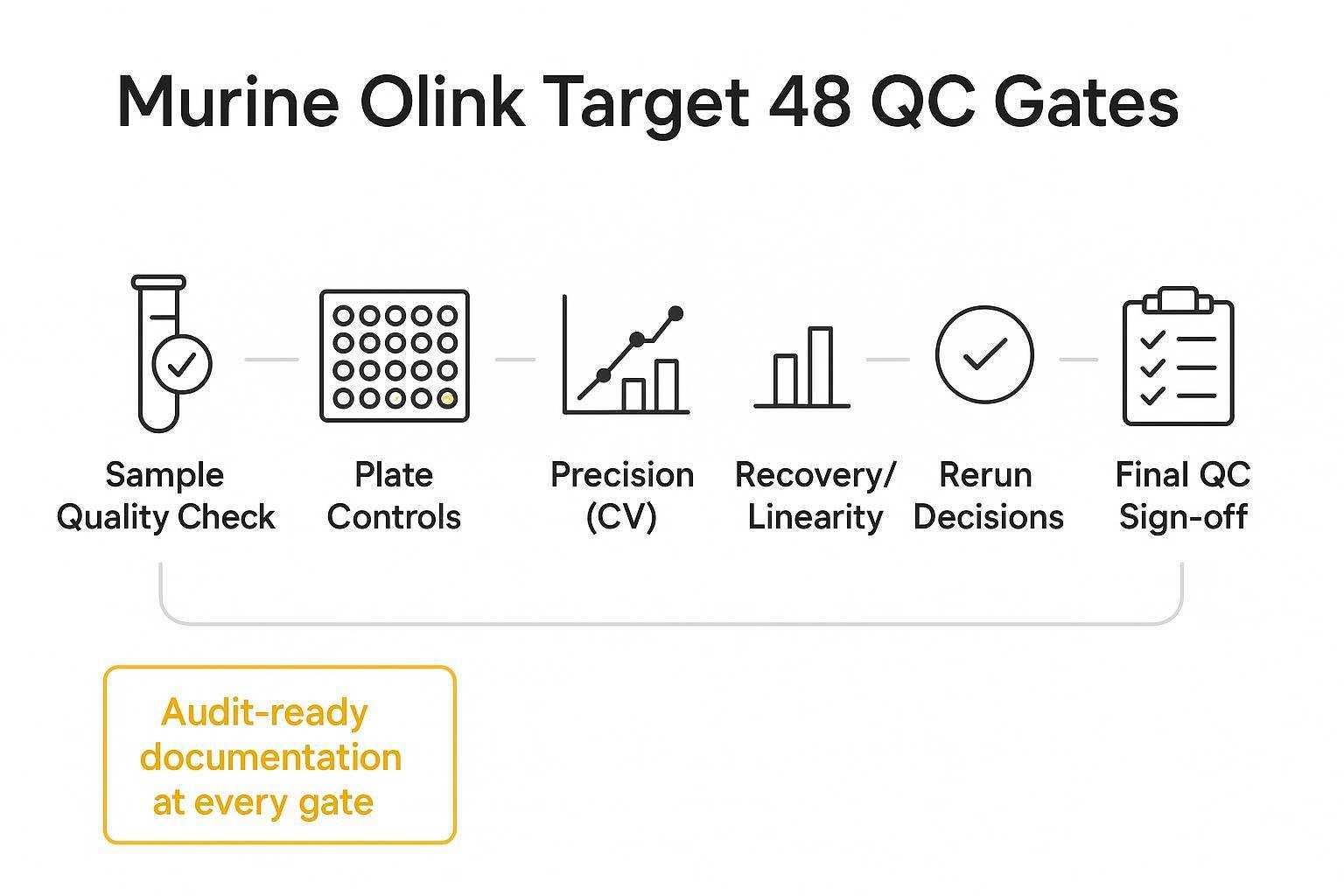 A practical QC gate system for murine Olink Target 48 studies, from sample receipt to final QC sign-off.
Start with the matrix: what changes in mouse plasma, serum, CSF, and tissue homogenate
Murine matrices are not interchangeable. Plasma and serum offer broader dynamic range and higher detection rates. CSF is low-volume and often low-signal. Tissue homogenate risks nonlinearity due to carryover and matrix effects. Before you choose, confirm volume constraints, expected interferences (hemolysis, lipemia, tissue debris), and whether dilution linearity is likely required. For handling details, see the Creative Proteomics guidance on Olink sample preparation, which summarizes collection, storage, and shipping considerations tailored to plasma/serum, CSF, and tissues.
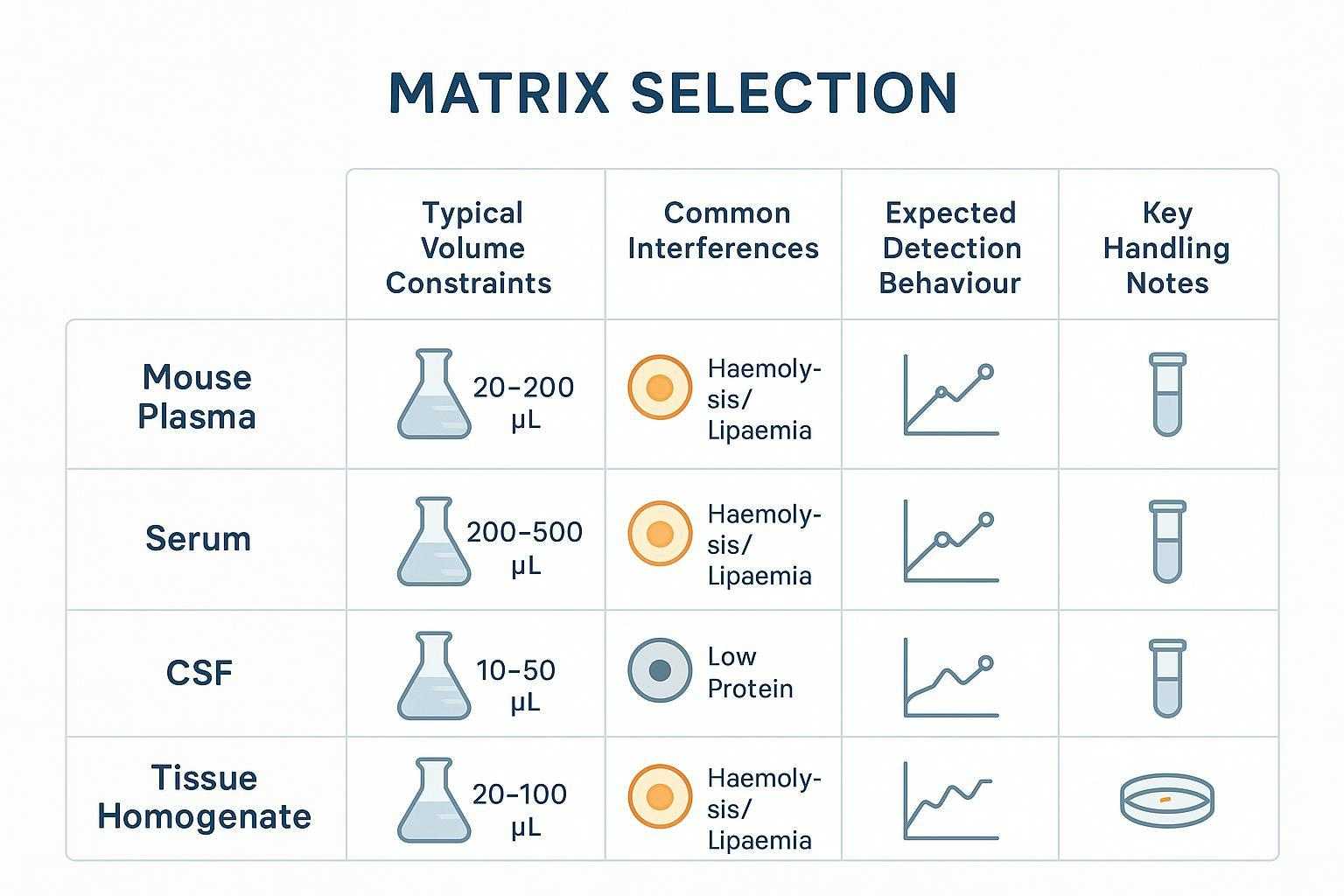 Matrix choice drives your QC plan: different murine matrices have different interference and variability profiles.
Define your QC hierarchy (plate-level → sample-level → study-level)
Write your rules before the first plate runs. In short:
- Plate-level gates: internal controls pass; external controls and plate metrics within acceptance; no unaddressed drift.
- Sample-level rules: if duplicates are used, median CV within range; if flags or outliers appear, decide on re-test based on remaining volume and impact.
- Study-level checks: bridge samples consistent across plates; any needed calibration documented; batch effect diagnostics completed.
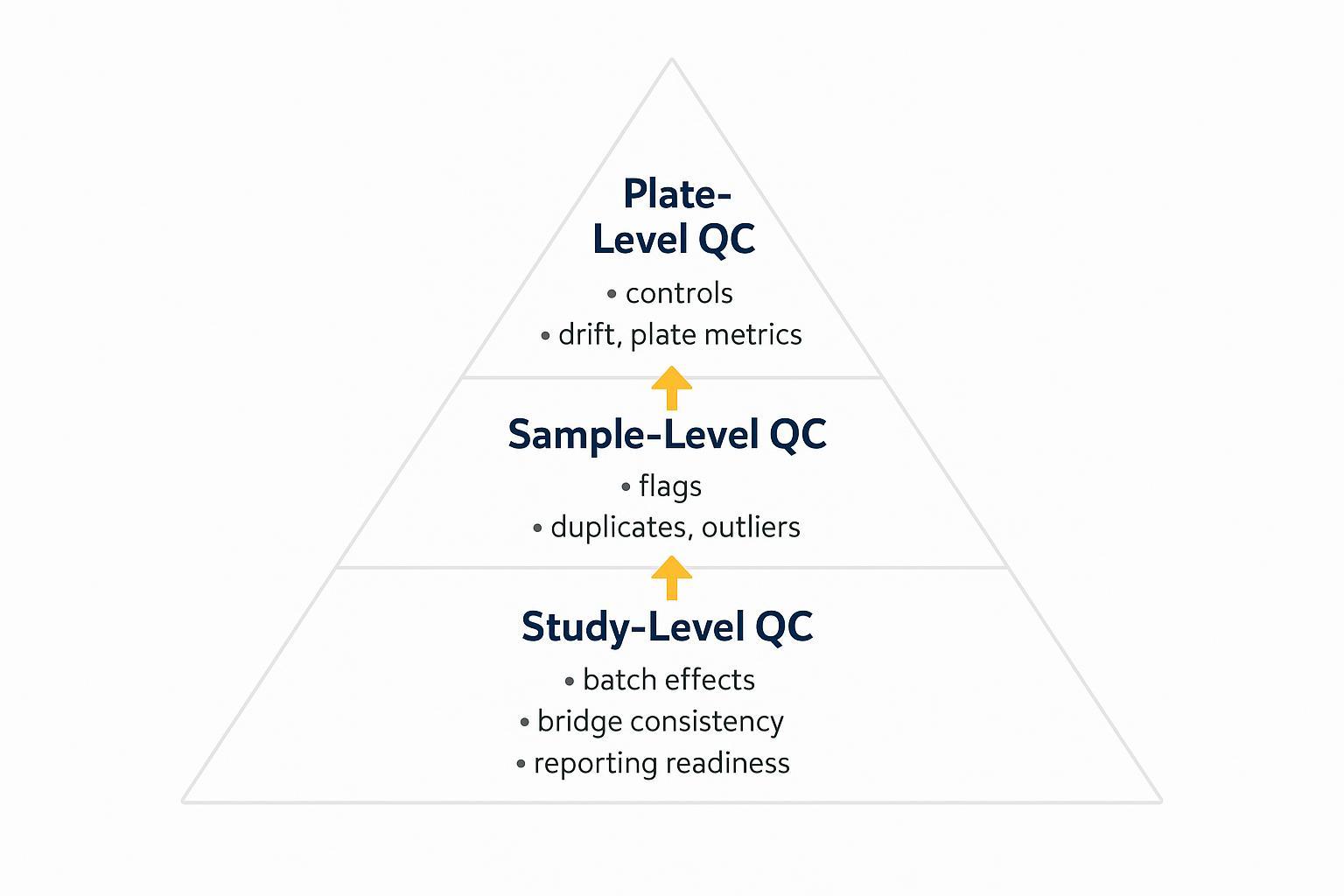 A QC hierarchy prevents ambiguity: plate gates first, then sample rules, then study-level comparability checks.
Precision criteria: murine Olink Target 48 QC criteria reviewers accept
Here are murine Olink Target 48 QC criteria for precision that align with Olink's control design and RUO-adapted ICH/FDA expectations:
- Intra-plate (technical duplicates, if used): target median CV ≤15%; acceptable ≤20% for low-volume/low-signal matrices (CSF, tissue homogenate). Action if exceeded: review sample integrity and outliers; re-test if volume allows.
- Inter-plate controls: target CV ≤20%; acceptable ≤25% with documented low-signal justification. Single anomaly: check placement/edge effects/pipetting. Systemic drift: repeat the plate or initiate batch diagnosis.
- Bridge samples (comparability across plates/batches): target CV ≤20%; acceptable ≤25% only with evidence of low signal and documented detection rates. If exceeded, run drift diagnostics (trend plots, PCA, median shift) and decide: calibrate, re-run, or exclude the affected batch.
These ranges reflect bioanalytical norms that specify ≤15% precision (≤20% at LLOQ) and the Olink emphasis on control-driven normalization; see FDA's page for ICH M10 and Olink's Analyze R Cheatsheet detailing bridging and normalization strategies in NPX space.
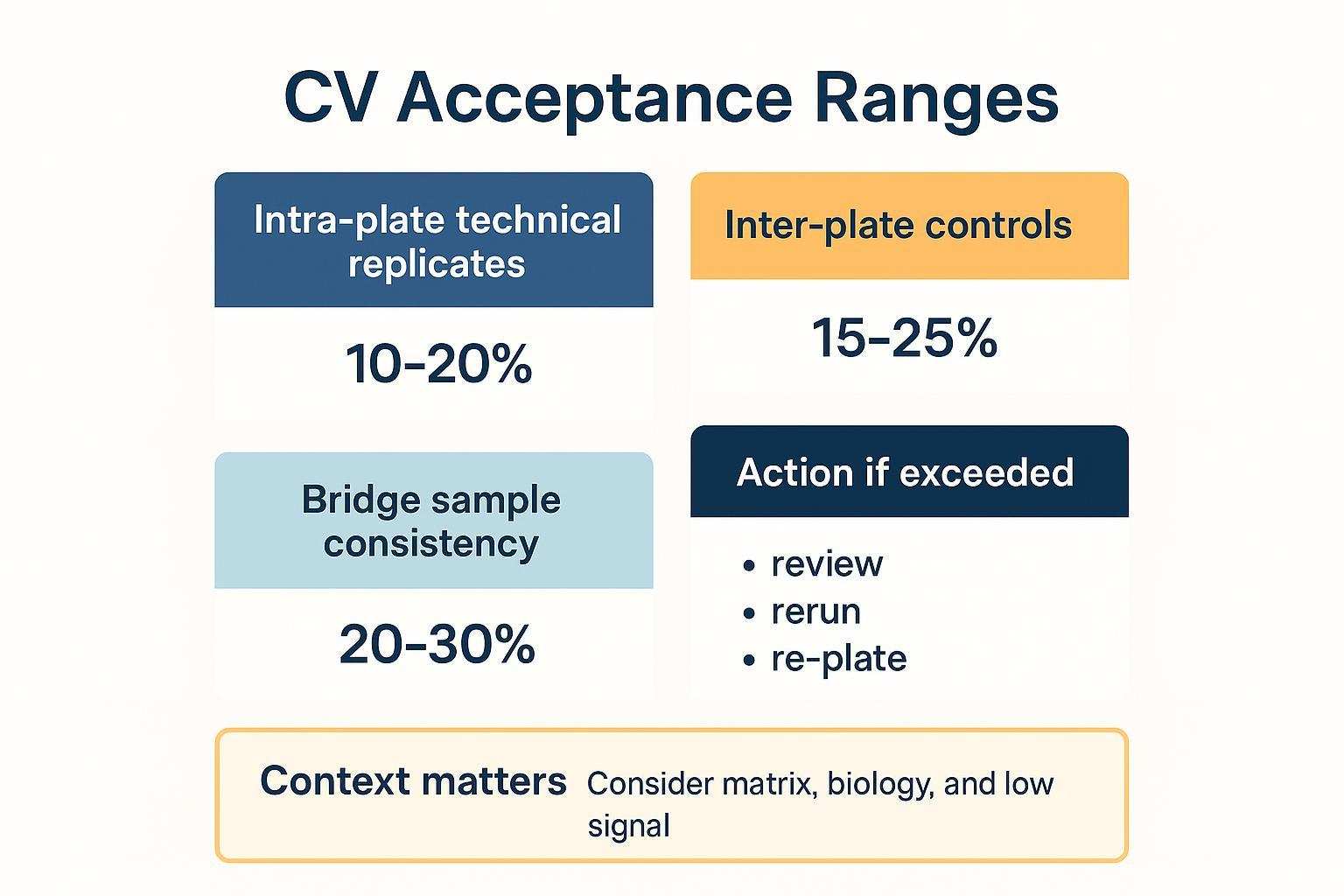 Practical CV acceptance ranges and actions—written to support review, rerun decisions, and audit trails.
Accuracy and recovery: spike-in and dilution checks without overcomplicating the study
You don't need a full validation to catch interference. Simple checks go a long way:
- Dilution linearity: run a small series (for example, 1×, 2×, 4×) on a pooled murine sample. Expect a proportional signal decrease on a log scale; curvature or plateauing suggests matrix effects.
- Spike recovery: add a known standard to a subset of samples; recoveries outside approximately 80–120% in RUO contexts warrant review and possibly reprocessing or dilution.
Olink's validation materials describe how LLOQ, accuracy, and precision interact; use those concepts in a lightweight way to justify decisions in murine work.
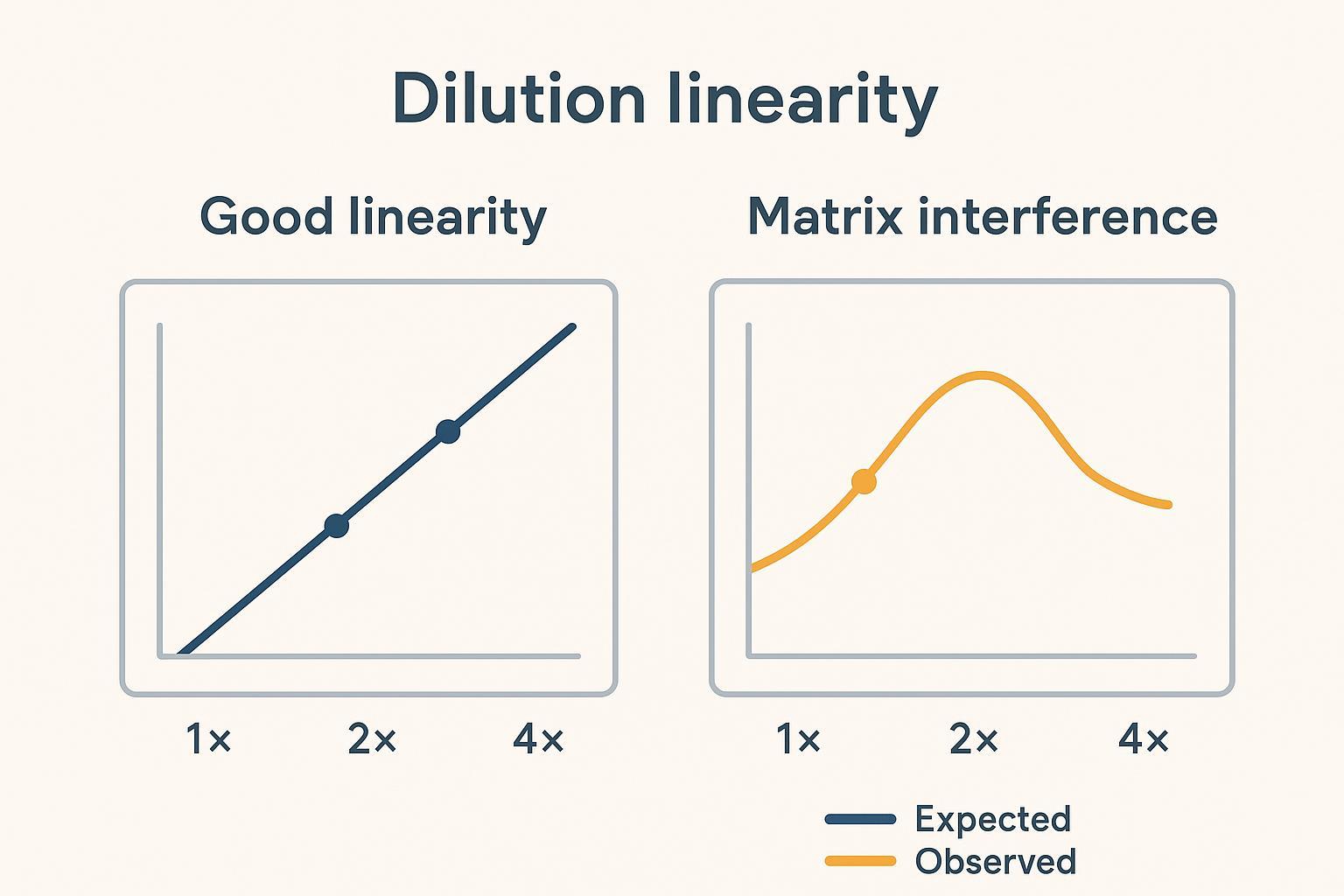 Dilution behavior can reveal matrix interference—even when plate controls look fine.
Plate controls you should never skip (and how to place them)
Plan to detect drift and edge effects, not just measure samples. Distribute Negative Controls, Plate Controls, and bridge samples across rows/columns. Internal controls in each well (e.g., incubation, extension, detection monitors) signal step-specific issues; external controls and bridges reveal cross-well and cross-plate variation. Olink manuals and validation data outline these roles, and the Analyze tools support downstream normalization when bridges are present.
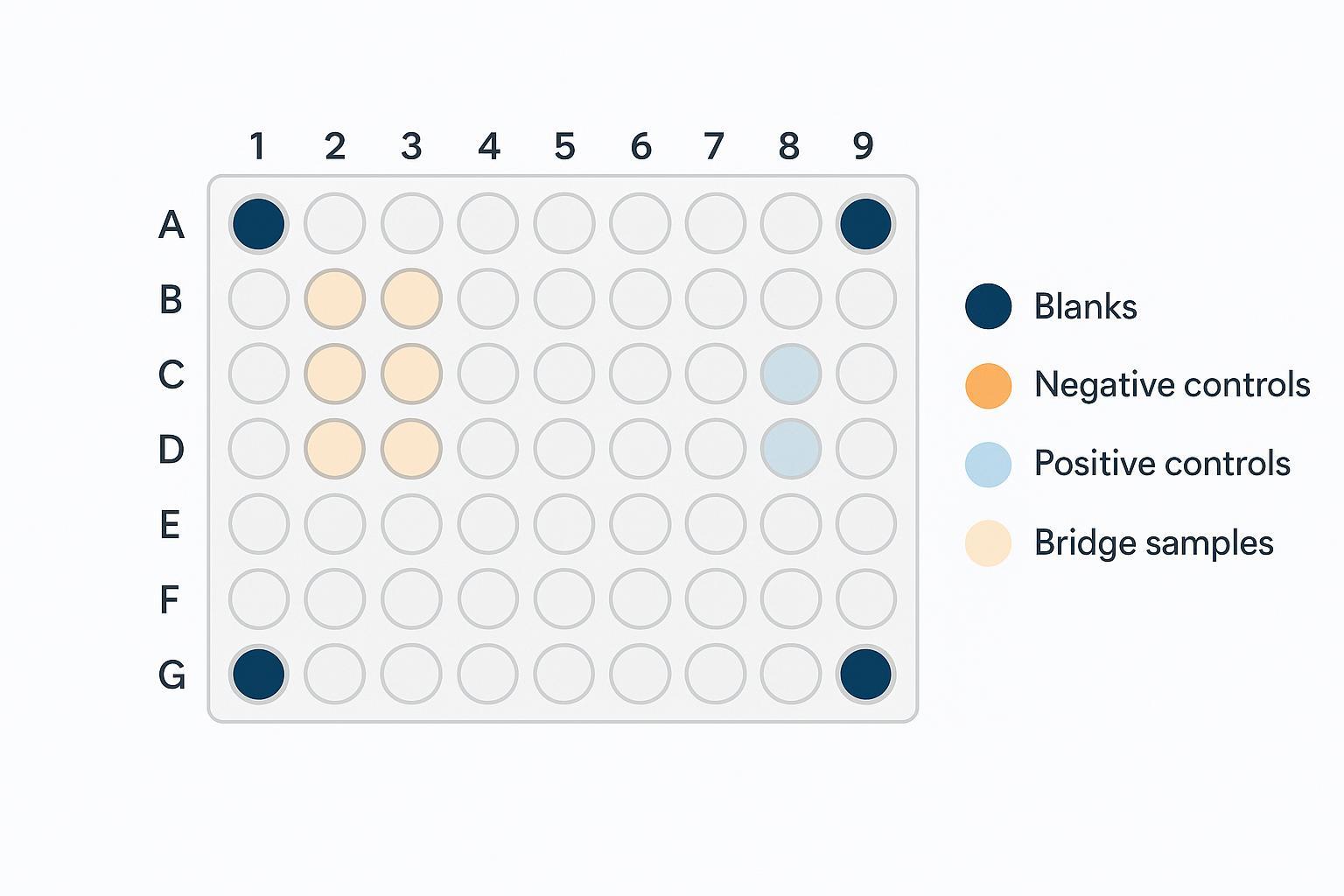 Control placement matters: distributed controls and bridge samples help detect drift and edge effects early.
Rerun rules: define "repeat", "re-test", and "re-plate" before you start
Tight timelines depend on clear rerun logic linked to QC gates:
- Sample QC fail (flags, poor duplicate CV, or evident outlier): re-test if volume allows; log rationale.
- Plate control fail (systematic): re-plate. If a single anomaly, review placement/pipetting first.
- Borderline metrics: proceed only with a documented rationale that cites matrix constraints or biological context.
- Repeated failures: exclude with justification; document impact downstream.
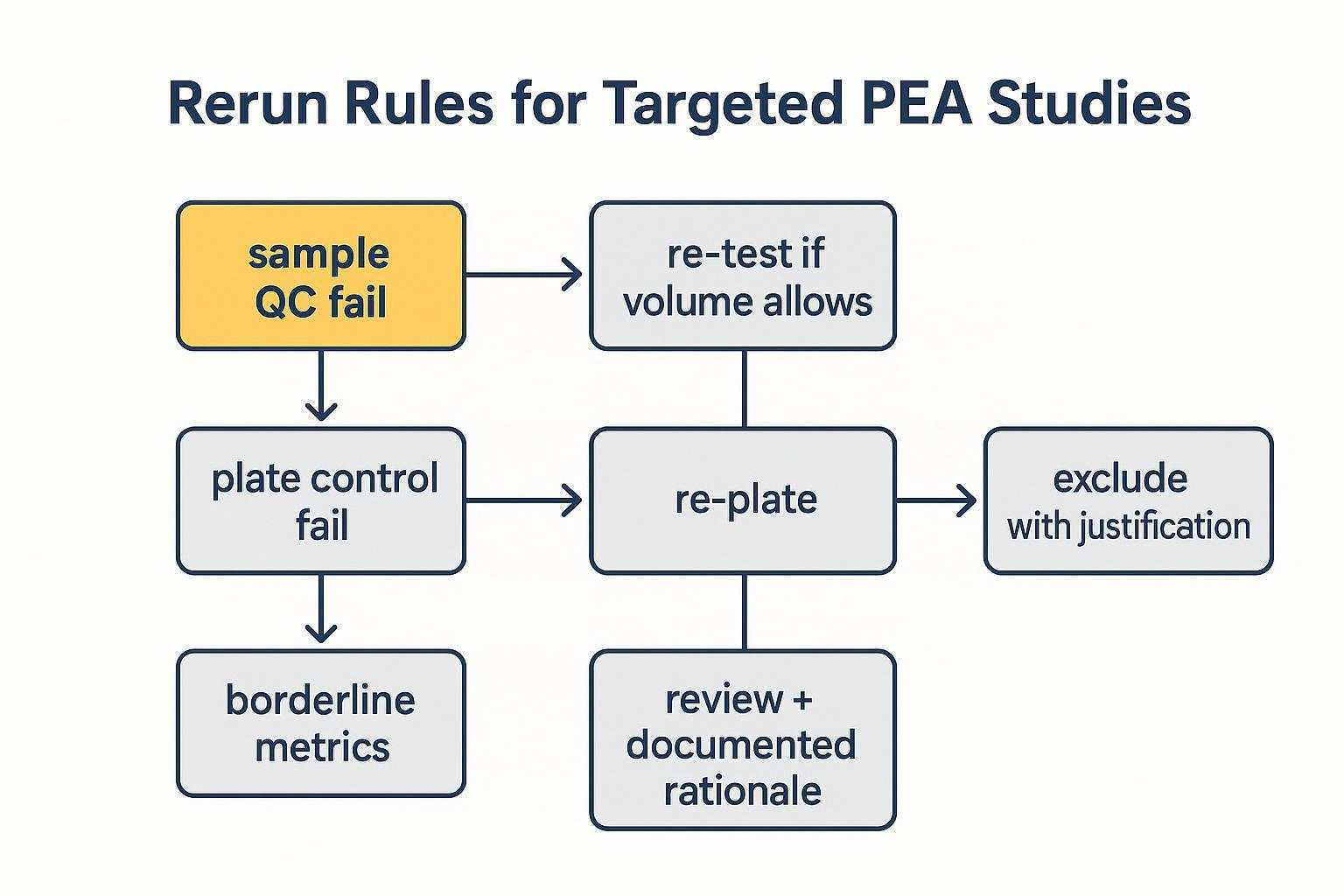 A pre-defined rerun decision tree keeps timelines predictable and documentation consistent.
Handling below-LLOQ values (the part that breaks publications)
Define LLOQ the same way regulators do: the lowest concentration that still meets acceptable precision and accuracy (typically ≤20% CV and ±20% accuracy). For murine Olink Target 48 QC criteria, the most audit-friendly policy is:
- Default: treat below-LLOQ as missing (NA) and report per-protein detection rates by group and plate.
- Optional: use LLOQ/2 as a conservative imputation for visualization or descriptive stats, but never for inferential modeling unless justified.
- Advanced: for inference, use censoring-aware models (for example, Tobit regression) and document assumptions, software, and version.
When detection rates are low or differ strongly between groups, downweight interpretability and state this plainly. Journals increasingly expect transparent reporting of thresholds, filters, and detection rates; see Nature's guidance on data and code availability for clarity on what to disclose.
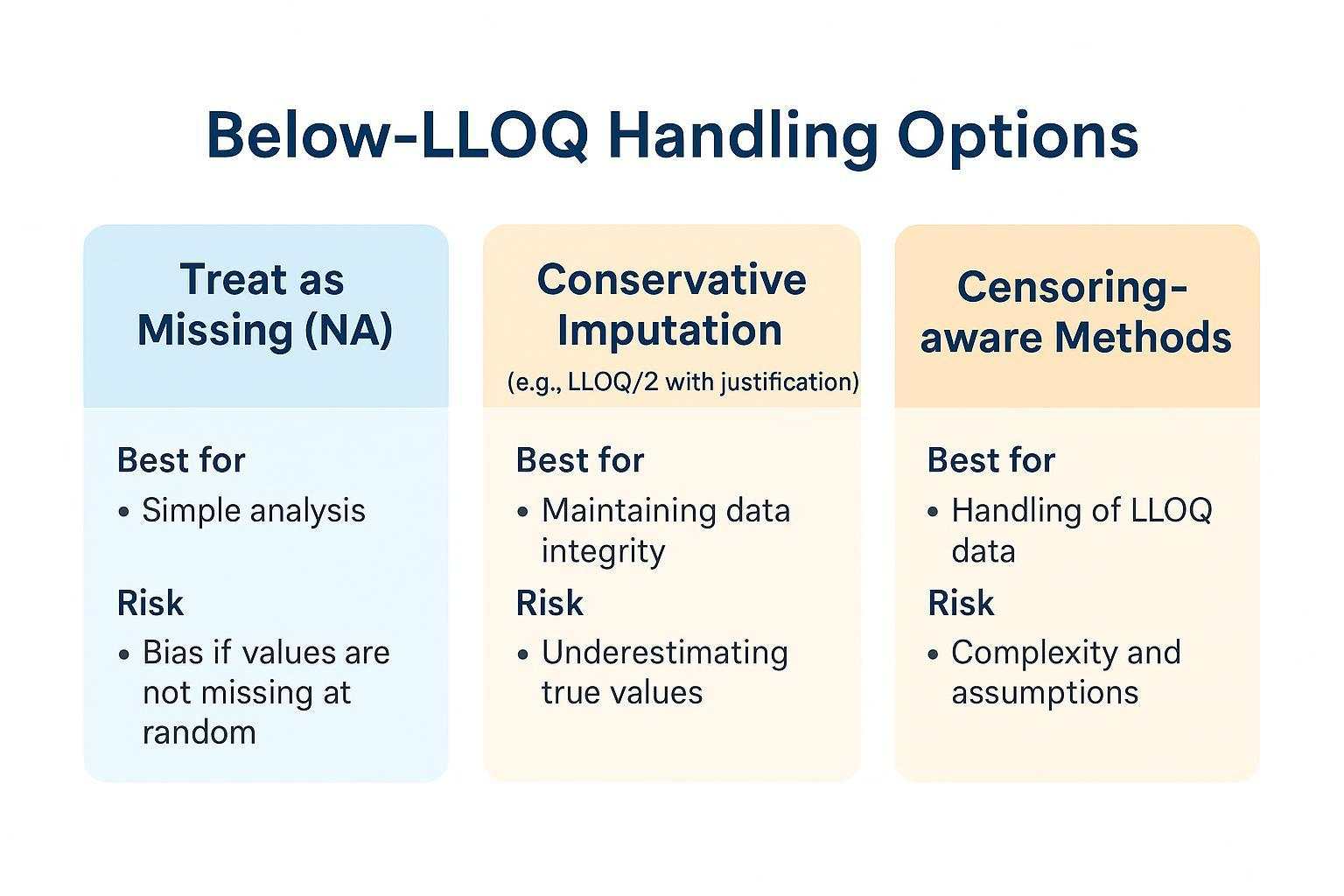 Below-LLOQ handling must be consistent and justified—choose a rule before analysis starts.
Batch effects and cross-plate comparability in longitudinal mouse studies
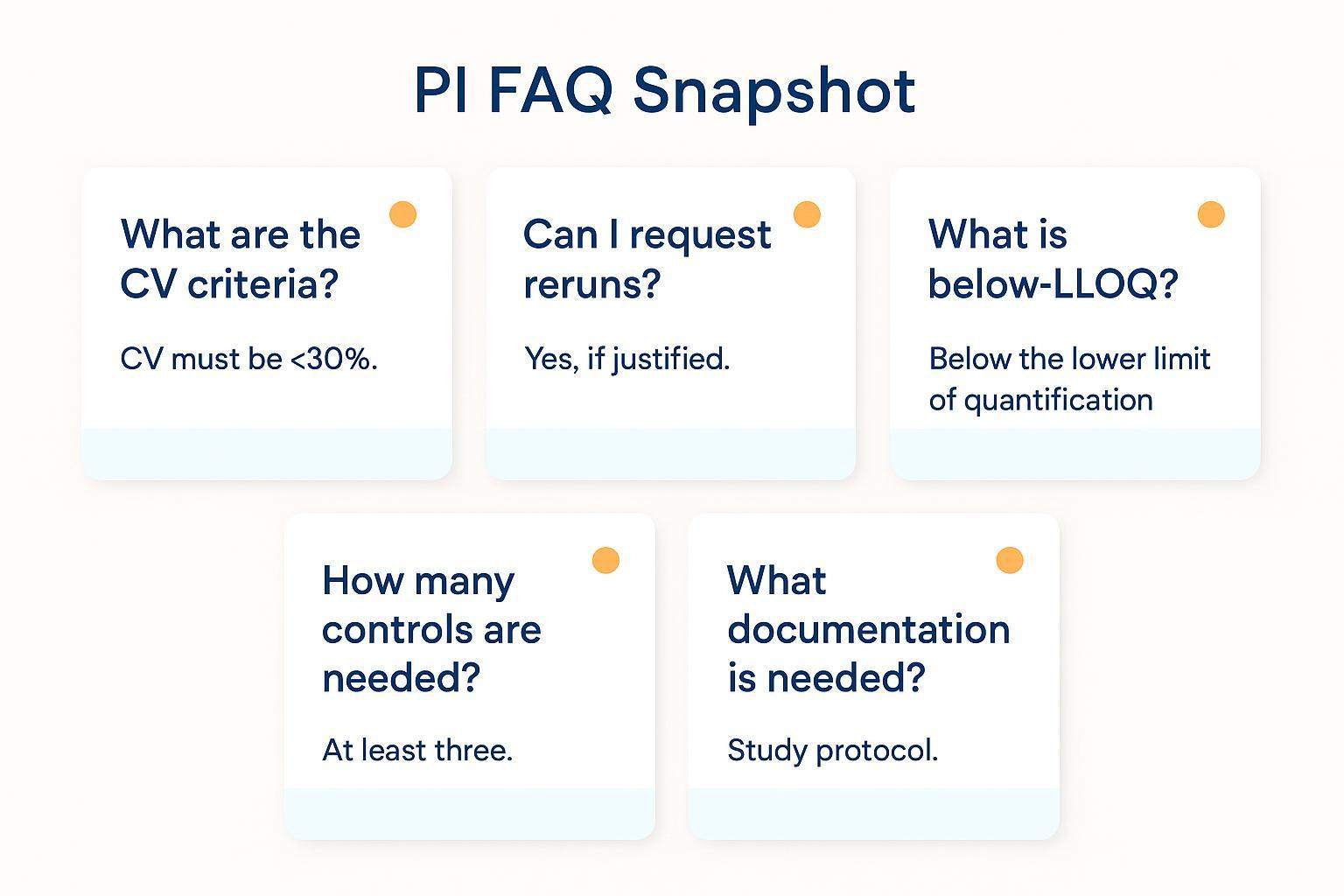
Longitudinal designs magnify drift risk. The simplest durable plan is bridge-first:
- Select one or two high-quality murine samples as bridges; repeat them across all plates.
- Inspect bridge consistency with trend plots and PCA; if drift emerges, either calibrate with project-level factors, re-run affected plates, or exclude with rationale.
- Keep a per-assay log of adjustment factors and decisions alongside NPX outputs.
Olink's Analyze Cheatsheet documents the bridging and normalization workflow in NPX space; align your study notes with that vocabulary so reviews see familiar terms.
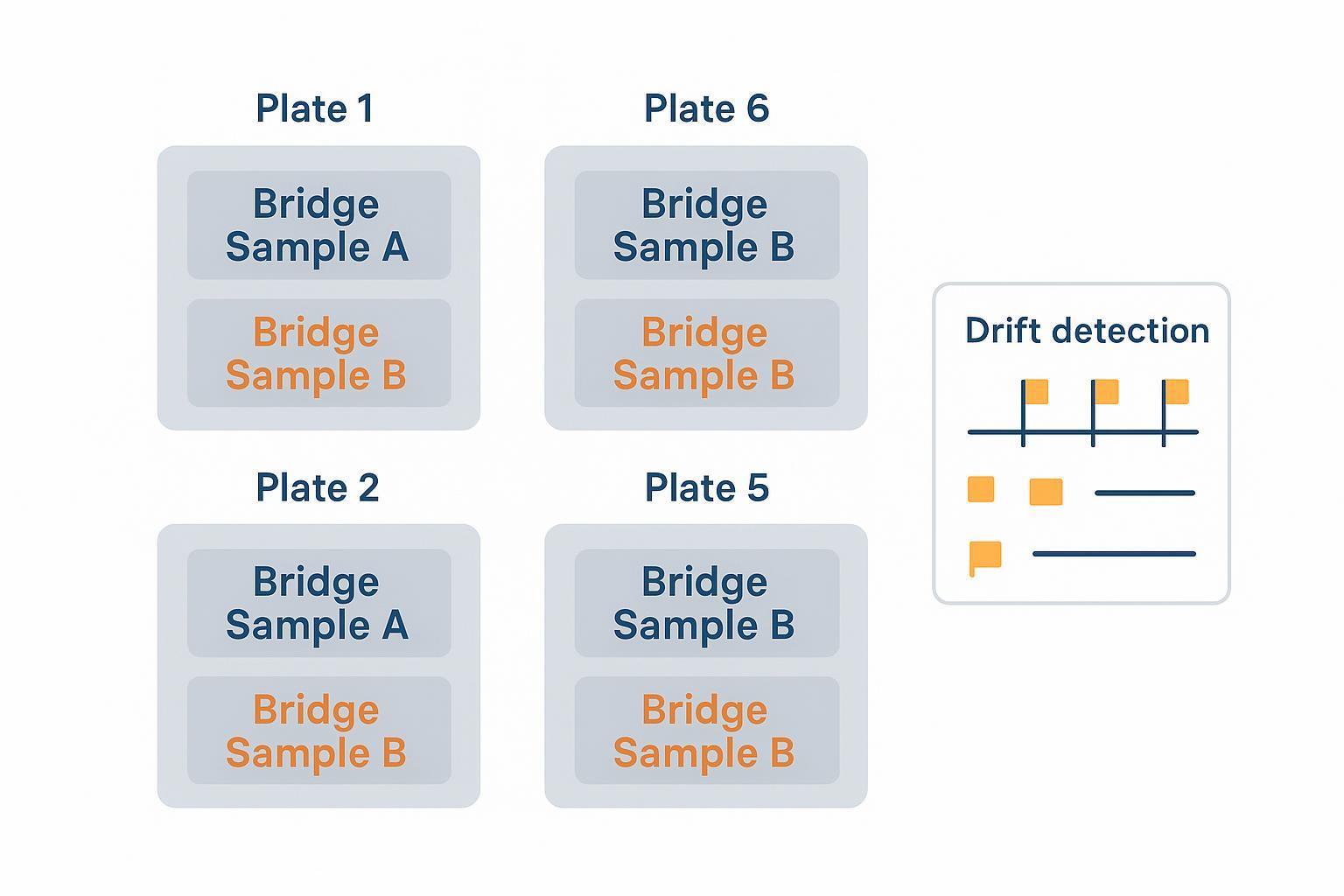 Bridge samples provide an auditable backbone for cross-plate comparability in longitudinal studies.
Documentation you'll need for audits, grants, and internal review
An audit-ready QC pack keeps everything defensible and saves time during peer review or funding checks. Include:
- Sample chain-of-custody and matrix/volume verification.
- Plate maps with control placement; run logs (including any deviations and environmental notes).
- QC summary tables (intra/inter-plate CVs, bridge consistency, detection-rate tables, below-LLOQ policy statement).
- Rerun rationales, corrective actions, and outcomes; versioned analysis outputs with software versions.
For practical prep and reporting vocabulary, see Creative Proteomics resources on Olink data analysis and interpretation for NPX normalization, flags, and summary outputs.
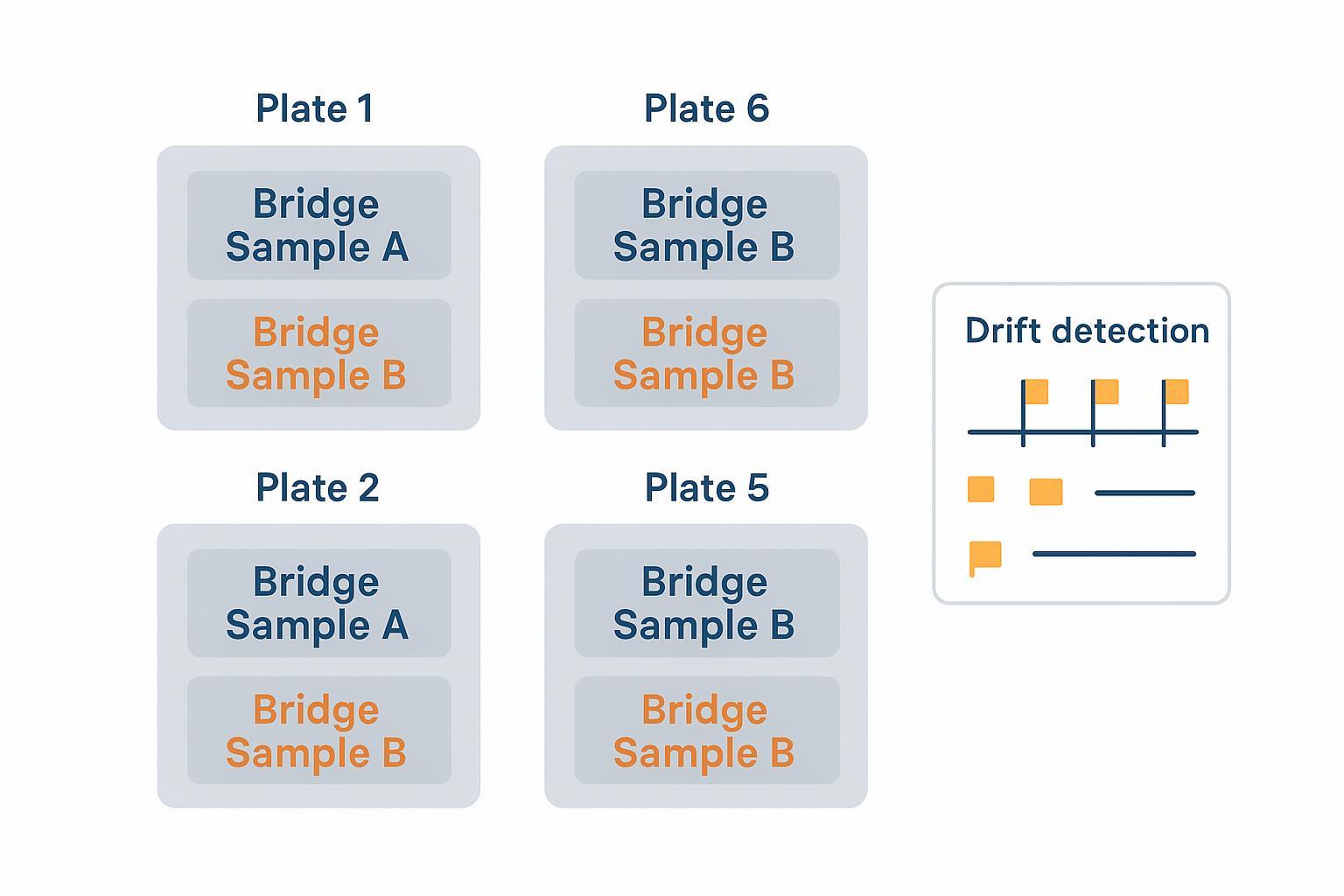 An audit-ready QC pack makes your study defensible in grants, internal review, and publications.
FAQ: high-intent questions PIs ask before committing
What CVs will reviewers accept?
Target ≤15% intra-plate; ≤20% inter-plate/bridge, with ≤25% acceptable when low signal is documented and justified.
When do we rerun?
Sample-level failures re-test if volume allows; plate-level control failures trigger re-plate; borderline metrics require a written rationale.
How should we handle below-LLOQ?
Default to NA and report detection rates; if using LLOQ/2 for visualization, say so; use censoring-aware models for inference.
Which controls are mandatory?
Internal per-well controls plus distributed Negative and Plate Controls and bridge samples to detect drift.
What does "audit-ready" look like?
A consolidated pack: plate maps, QC summaries, deviation logs, rerun rationales, and versioned analysis outputs.
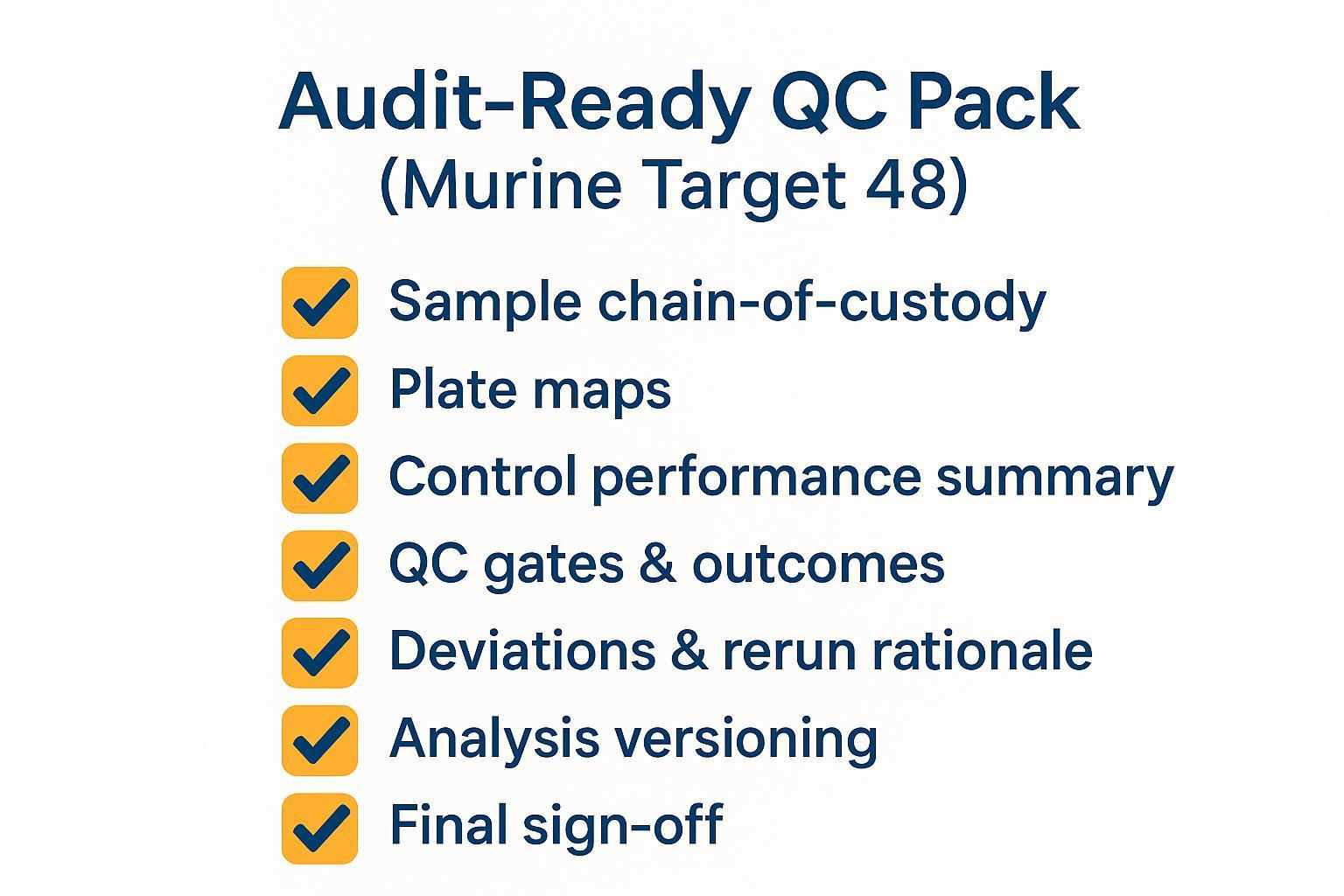 Fast answers to the QC questions that decide whether a murine Target 48 project is publishable.
Next step: request a QC ruleset + plate map template (conversion section)
If you need a ready-to-edit QC ruleset and a 96‑well plate map template for murine Target 48, request the package (RUO). You can also review the Target 48 Cytokine panel overview to align volumes and matrix compatibility before drafting your rules: /panel/olink-target-48-cytokine-panel.html
 A QC ruleset and plate map template turns "QC ideas" into auditable decisions your team can follow.
Methods appendix and references
- ICH M10 bioanalytical method validation and study sample analysis (FDA hosting page). Defines precision/accuracy, LLOQ, dilution integrity, and run acceptance for LBAs; adapt as RUO ranges with documentation.
- FDA hosting page: https://www.fda.gov/regulatory-information/search-fda-guidance-documents/m10-bioanalytical-method-validation-and-study-sample-analysis
- FDA M10 Q&A PDF (2023): https://www.fda.gov/media/179296/download
- Olink controls, normalization, and bridging language. The Olink Analyze R Cheatsheet describes NPX normalization and bridging with overlapping samples; validation/user materials outline internal/external controls.
- Olink Analyze Cheatsheet: https://7074596.fs1.hubspotusercontent-na1.net/hubfs/7074596/01-User-Manuals-for-website/1494-Olink-Analyze-Cheatsheet.pdf
- Target 48 validation data (example): https://7074596.fs1.hubspotusercontent-na1.net/hubfs/7074596/Validation-Data-Olink-Target-48-Cytokine-and-Olink-Target-48-Immune-Surveillance.pdf
Official panel documentation
- The Olink's 2022 Target 48 User Manual (PDF) details control placement, NPX normalization, and bridging with overlapping samples for Signature Q100—use this as the canonical reference for control terminology and run setup.
- Journal transparency (report detection rates, thresholds, decision logic; provide data/code availability statements where possible):
- Nature publisher guidance on data repositories: https://support.nature.com/en/support/solutions/articles/6000237609-publishing-data-in-a-repository
- Sample preparation guidelines (collection, storage, shipping across matrices): /knowledge/olink-sample-preparation-guidelines.html
- Olink data analysis process (NPX normalization, QC flags, summary outputs): /knowledge/olink-data-analysis-process.html
- All thresholds are RUO-friendly ranges aligned to community practice; tighten or relax with explicit justification, matrix notes, and audit logs.