Submit Your Request Now
Key takeaways
- Treat "inflammation" as a project category, not a study question. Start by defining the comparison and the decision the protein data must support.
- Broad profiling, focused cytokine studies, and IFN-response projects can use similar matrices—but they are scoped, analyzed, and interpreted differently.
- Matrix and cohort structure often determine interpretability more than marker count. If the comparison structure is weak, "more proteins" rarely fixes the problem.
- A standard inflammation-focused approach is often enough when the biology is still open-ended. Customized scope becomes realistic when your biological axis is already narrow (for example, an IFN program).
- The fastest way to get useful analysis support is to send an inquiry that clearly states: matrix + cohort structure + primary question + what decision the data will drive.
Introduction
Many translational teams can describe their work in one sentence: "We want to run an inflammation panel," or "We need cytokines."
That's a reasonable starting point—but it is not yet a study.
In practice, the interpretability of Olink cytokine data depends less on naming a panel and more on whether you have defined three upstream elements clearly enough to constrain the biology:
- A biological question that implies a comparison (not a marker wish list)
- A matrix and cohort structure that can answer that comparison
- An analysis path that matches the project type (broad profiling vs focused axis vs stimulation/response mapping vs translational prioritization)
This article is a decision-oriented guide for researchers planning an Olink inflammation project (or cytokine project) who want to scope it into something interpretable and inquiry-ready.
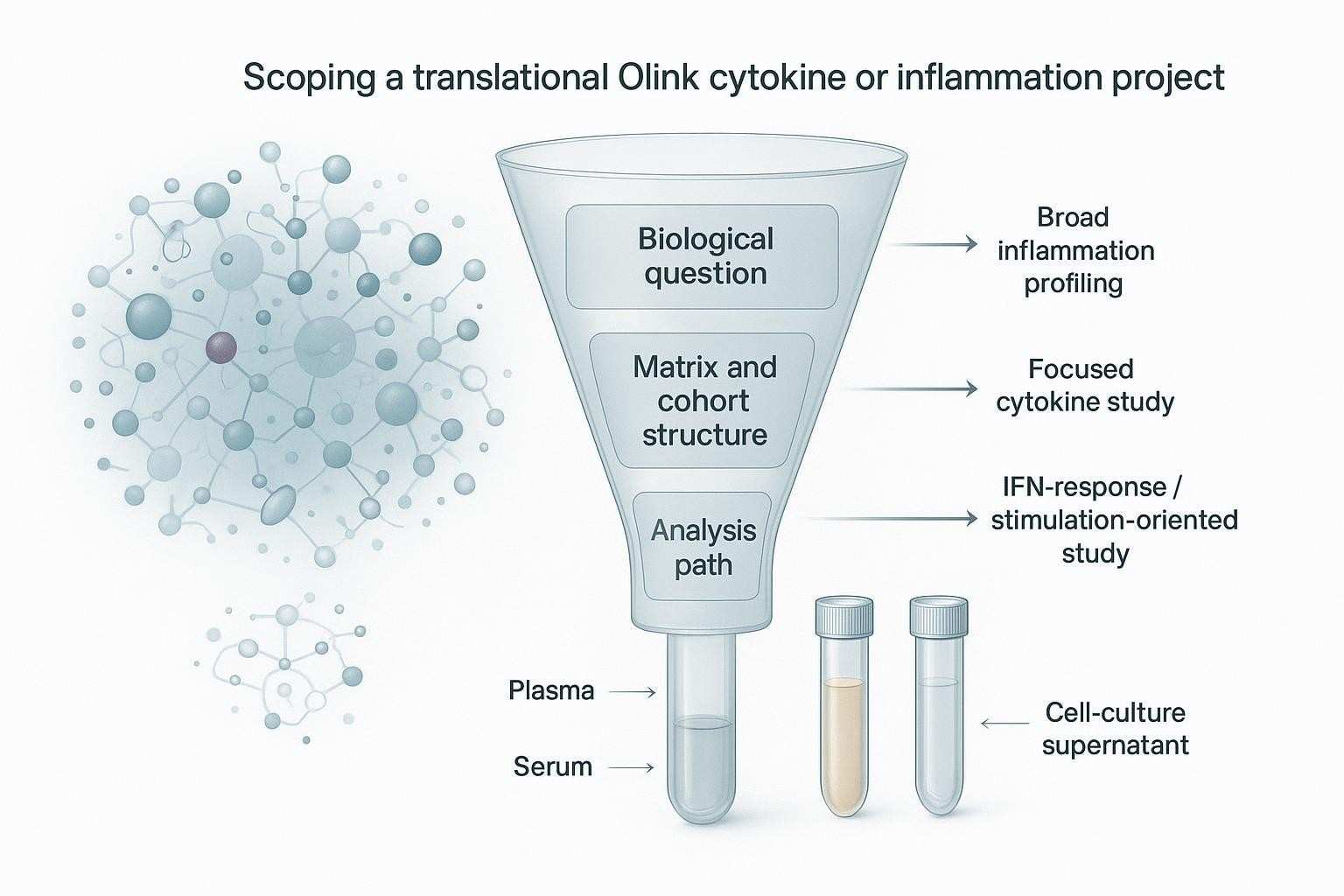 Figure 1. A translational inflammation study becomes more actionable when a broad biological idea is narrowed into a defined question, matrix context, and analysis path.
Olink inflammation project scoping starts with the comparison
The phrase "inflammation project" hides multiple study types that look similar operationally but differ in what "good data" means.
A discovery-style screen, an axis-specific hypothesis test, and a stimulation response map can all measure overlapping proteins. But they diverge in cohort design, covariate requirements, and analysis logic.
Broad inflammation profiling and focused cytokine studies are not interchangeable
Broad profiling is designed to answer: "What is changing, and what biological programs might explain it?" It is most useful when the dominant inflammatory axis is not yet known.
Focused cytokine studies are designed to answer: "Is this specific signaling axis active, suppressed, or stratifying the cohort?" They are stronger when the biology is already narrowed—because interpretability depends on whether the measured proteins are coherent enough to map onto a defined mechanism.
Translational studies often start broad but should not stay vague
Translational teams often begin broadly ("capture inflammation," "profile immune state") and then narrow toward a set of proteins that supports a decision: cohort stratification, mechanistic prioritization, or candidate biomarker selection.
Your scoping task is to decide where your study sits on that arc right now.
The first mistake is treating panel choice as the starting point
If the first sentence of the project is "we want the Inflammation panel," the study is already being constrained by the tool rather than by the question.
A better first sentence is:
- "We want to test whether an interferon-driven program explains a serum inflammatory network signal."
- "We want to know whether baseline plasma inflammation markers stratify progression in a PD cohort."
- "We want to prioritize a shortlist of inflammation proteins tied to a cardiology endpoint in a 500-patient cohort."
Start with the biological question before choosing an analysis path
Before you decide what to measure, define what you want the protein data to do. In scoping calls, the most productive turning point is usually when the team can say:
"When the data comes back, the decision we want to make is X."
That sentence forces a study to become interpretable.
Are you mapping pathways, ranking biomarkers, or testing a defined hypothesis?
These three intents can start with the same request ("measure cytokines") but have different success criteria:
- Pathway mapping: enough breadth to see coordinated changes across modules.
- Biomarker ranking/prioritization: cohort structure that supports stable effect estimates and controls confounding.
- Defined hypothesis testing: a coherent, pre-specified axis and a comparison that isolates it.
This distinction is one reason biomarker workflows emphasize staged validation and bias control; a useful high-level reference is the peer-reviewed review on biomarker discovery and validation statistical considerations (2021).
A broad cytokine screen and an IFN-response study may look similar, but they are not scoped the same way
A screening-style project expects heterogeneity and treats signals as hypotheses.
An interferon-response project expects directional coherence: if IFN signaling is the driver, multiple proteins should shift together in a way consistent with the axis you propose. It often helps to frame these as response mapping rather than "general inflammation."
Disease area matters, but it does not replace a clear analytical objective
Cardiology, neurodegeneration, autoimmunity, and developmental cohorts bring different confounders and expected effect sizes.
But disease context does not substitute for objective. "Inflammation in cardiology" can still be a discovery screen, a focused axis question, or a cohort stratification problem.
| Project type | Primary biological question | What the study should prioritize | Common scoping mistake |
| Broad inflammation profiling | "What inflammatory programs are active?" | Breadth, module-level coherence, covariate capture | Treating every significant protein as a biomarker hit |
| Focused cytokine axis study | "Is a specific signaling axis active or stratifying?" | Coherence, pre-specified comparisons | Measuring broadly but interpreting as if the axis were defined |
| IFN-response / stimulation mapping | "Is IFN driving a coordinated response, and in which context?" | Directionality, response context, timing definition | Calling it "general inflammation" and losing the response frame |
| Translational biomarker prioritization | "Which proteins best support a decision?" | Comparison structure, confounder control, reproducibility | Mixing discovery + stratification + pathway mapping in one run |
Table 1. What kind of inflammation question are you actually asking?
How to distinguish broad inflammation profiling from focused cytokine or IFN-response studies
A practical scoping heuristic is to ask whether your biology is still unresolved (broad) or whether you already have a narrowed mechanistic axis (focused).
Broad inflammation profiling works best when the biology is still unresolved
Broad profiling is appropriate when:
- you do not yet know which inflammatory programs matter most,
- you expect heterogeneity across the cohort,
- or you need an initial map of correlated modules before defining a shortlist.
In that setting, a broader inflammation-oriented analysis path—such as support built around the Olink Explore 384 Inflammation Ⅱ Panel—can be a sensible fit because it provides breadth for discovery-style questions.
Focused cytokine studies are stronger when the signaling axis is already narrowed
Focused cytokine projects are appropriate when:
- prior data points to a defined pathway,
- you need interpretable effect estimates for a specific axis,
- or you are using cytokines to stratify a cohort along a known immune program.
In these cases, a more constrained service path—such as support built around the Olink Target 96 Inflammatory Panel—may be more appropriate because interpretation can stay tighter.
IFN-response studies deserve a more specific project frame from the start
Interferon projects often fail in scoping because "IFN response" gets treated as a subset of "inflammation," rather than as a response program that must be defined by context.
A well-scoped IFN question makes the response frame explicit:
- What is the stimulus or upstream driver (if any)?
- What is the expected direction and timing?
- Is the goal to map a response module, stratify responders, or prioritize markers for follow-up?
When interferon signaling is central, it is usually better to discuss a dedicated IFN-oriented analysis pathway—such as the Olink Flex Customized IFN Stimulation Panel—because customization can improve axis-specific interpretability.
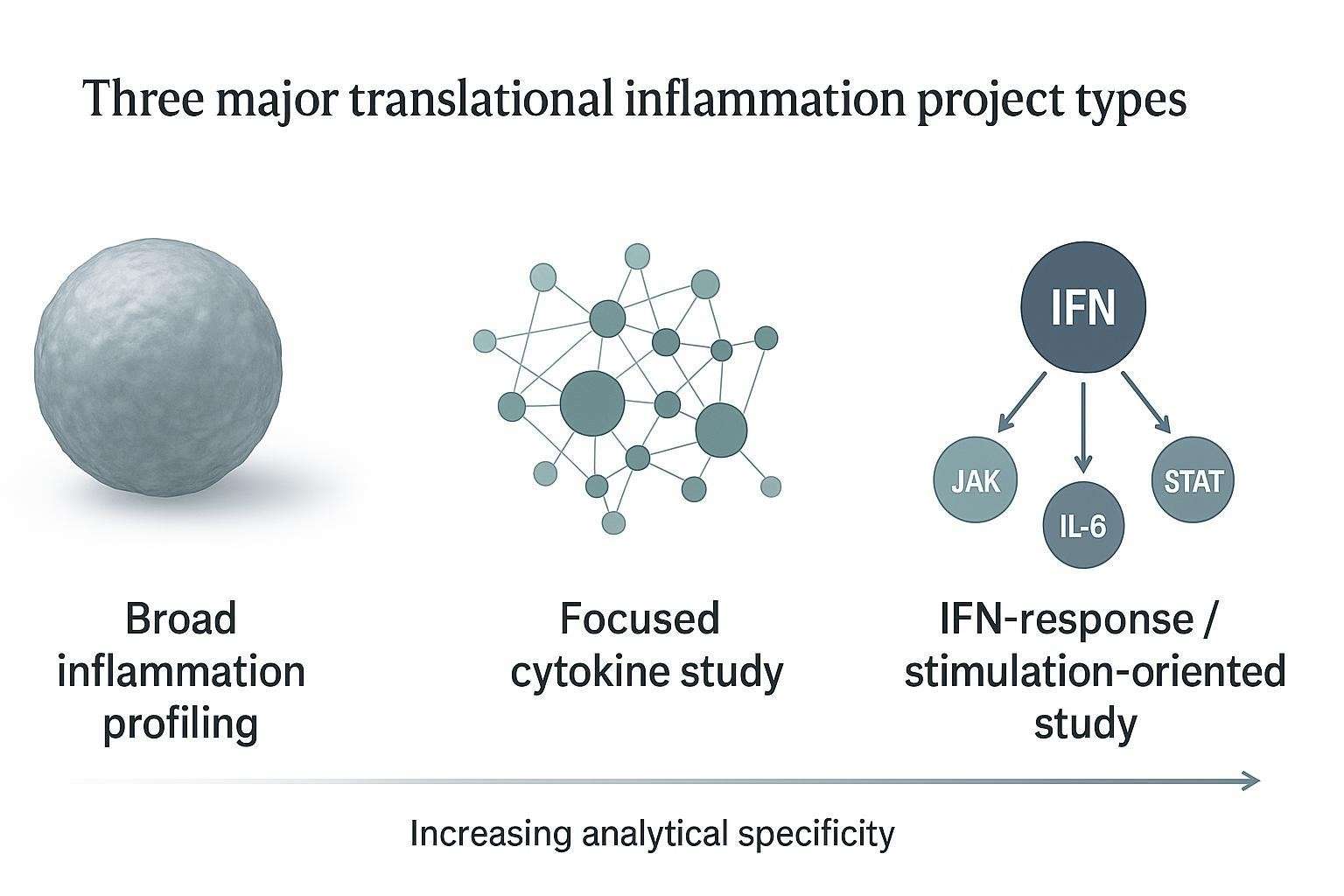 Figure 2. Broad inflammation profiling, focused cytokine studies, and IFN-response projects differ in biological intent as much as in analytical scope.
Matrix and cohort structure shape inflammation-study interpretability
Two studies can measure similar proteins and still have very different interpretability because they differ in matrix and cohort structure.
Matrix choice affects interpretation more than many teams expect
Matrix is not just a sample container—it is a biological context.
Plasma, serum, CSF, and cell-culture supernatants differ in baseline protein composition, dynamic range, and sensitivity to pre-analytical handling. Those differences change what an observed shift means.
A useful reminder from multiplex cytokine measurement literature is that performance and agreement can vary across platforms and markers; see the AACR paper on evaluation of multiplexed cytokine and inflammation marker measurements (2011).
Mini-case: a team studying an interferon-driven inflammatory network in human serum needed to decide whether the project was a broad inflammation screen or a focused response-mapping study. That decision hinged on whether the cohort design supported a response interpretation (timing, covariates, and a clean comparison), not on marker count.
Cohort structure matters: single time point, repeated measures, or multiple groups
Cohort structure determines which comparisons you can legitimately make:
- Single time point: strongest for cross-sectional stratification but vulnerable to confounding.
- Repeated measures: stronger for within-subject change questions but demands consistent timing and batch planning.
- Multiple groups (case/control + subgroups): powerful for hypothesis testing but requires clear definitions of what each comparison is meant to prove.
Mini-case: a KOALA-like birth cohort question (early-life immune programming and asthma development) is not scoped like an acute cytokine screen. Timing windows and repeated measures dominate interpretability.
In translational research, comparison structure often matters more than marker count
If the comparison question is weak, increasing marker breadth often increases ambiguity.
Mini-case: a 500-patient cardiology cohort can detect many associations. The scoping question is whether the goal is discovery, stratification into inflammatory endotypes, or prioritization of a short list tied to a predefined endpoint.
Cell-based inflammation projects need different scoping logic from cohort-based plasma studies
Cell-based inflammation studies are often described as a marker list ("measure these cytokines in fibroblasts"). But in cell systems, interpretability is driven by the system and comparison.
Define cell models by system + comparison
A scoping description that works for a cohort study ("cases vs controls, plasma") does not work for a cell model.
For cell-based studies, the inquiry should specify:
- the system (primary vs immortalized; species; passage constraints)
- the comparison (stimulated vs baseline; treated vs untreated)
- timing (single time point vs response curve)
- readout matrix (lysate vs conditioned media/supernatant)
Mini-case: an inflammatory panel on cultured fibroblast conditioned media can be a response-mapping study (stimulation → secretion pattern) or a mechanism study (perturbations → axis change). Those should not be scoped identically.
When a standard inflammation-focused analysis path is enough—and when customized scope becomes more realistic
Customization is not automatically better. It helps when it aligns with a narrowed biological axis or a constrained decision.
Standard inflammation-focused analysis can work when biology is still open-ended
A standard inflammation-focused analysis path is often sufficient when:
- the goal is discovery-style mapping,
- the cohort comparisons are well defined,
- and matrix and pre-analytical conditions are consistent.
Customized scope becomes useful when the project question is narrower than the default marker space
Customization becomes realistic when:
- the biological axis is already narrow (for example, IFN-centric programs),
- the study is moving toward a specific translational decision,
- or constraints demand tighter selection to avoid irrelevant measurement space.
This is where a customized pathway—such as the Olink Flex Customized Inflammation Panel or the Olink Flex Customized Pro-inflammatory response Panel—is worth discussing as a scoping tool.
Customization should follow biology, not curiosity
A useful test is: Can you explain, in one paragraph, why each marker would change under your hypothesis?
If not, you are probably still in discovery mode.
| Study situation | Standard inflammation-focused fit | Sign that scope should be narrowed | Service path to discuss |
| Biology unclear; goal is mapping | Strong fit | Many competing hypotheses; no defined axis | Explore 384 Inflammation II analysis path |
| Known mechanism; focused cytokine question | Often fits | Need axis-tight coherence; avoid irrelevant markers | Target 96 vs narrow scope |
| IFN-centered response question | Sometimes fits | Need response-module coherence; timing/stimulus is critical | Flex IFN stimulation scope |
| Cohort stratification / biomarker prioritization | Often fits | Too many goals mixed in one design | Narrow scope + customized discussion |
Table 2. When does a standard inflammation-focused analysis path fit—and when should the scope be narrowed?
Disease examples: the same "inflammation" label can hide very different project needs
This is not a disease review. The point is that "inflammation" represents different analytical problems in different biological settings.
Cardiology often sits between broad profiling and focused inflammation axes
Cardiology cohorts can be large and heterogeneous. The key scoping decision is whether you are mapping inflammation programs, stratifying endotypes, or prioritizing a shortlist tied to an endpoint.
Neurodegeneration-linked inflammation can be subtle and confounded
PD-related plasma inflammation markers are often confounded by age, medication, comorbidities, and collection variability. Scoping should specify the comparison (progressors vs non-progressors; baseline vs follow-up) and the covariates that must be included.
Developmental immune programming is dominated by timing and repeated measures
In early-life immune programming cohorts, timing windows and longitudinal structure are the core of interpretability.
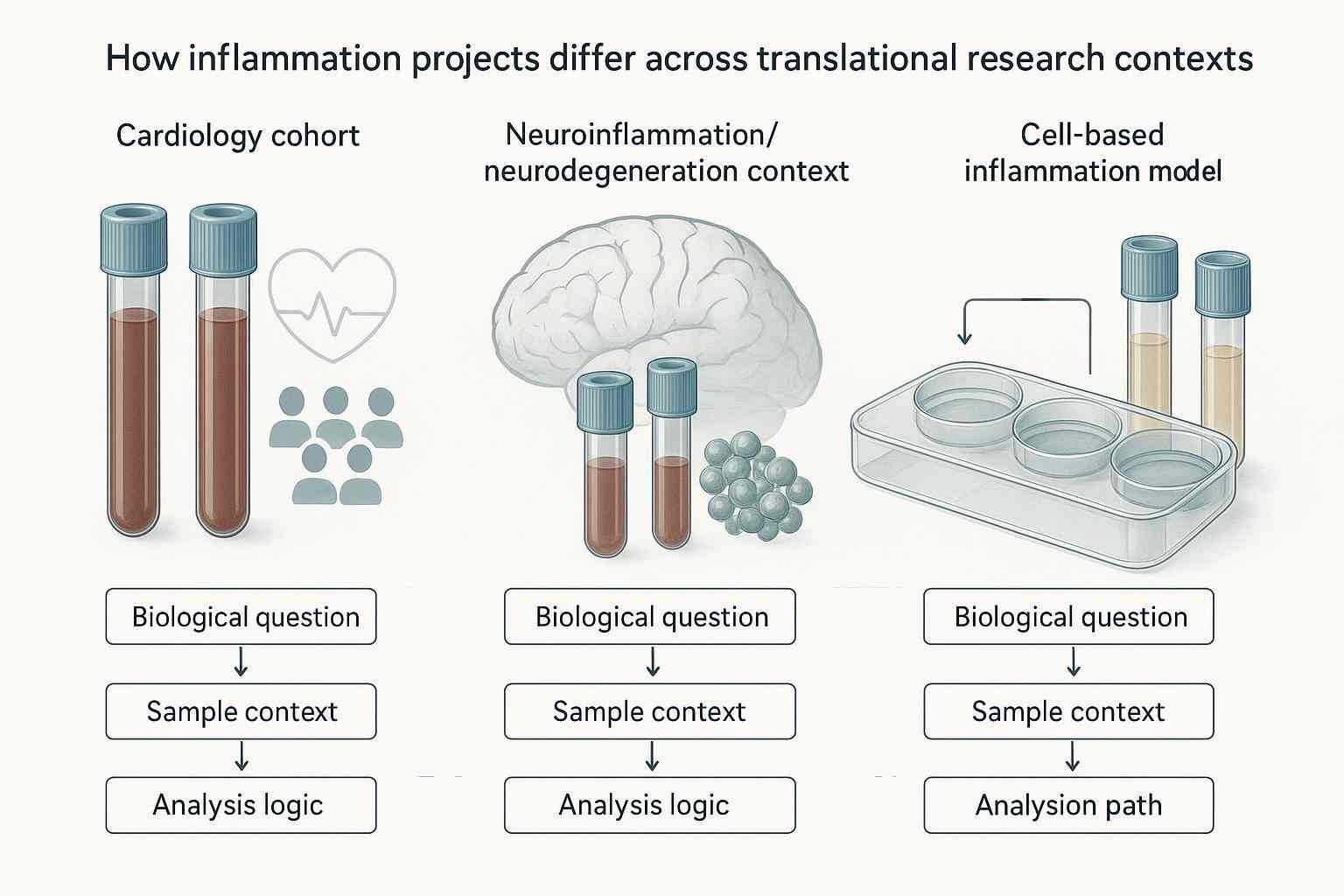 Figure 3. The same "inflammation" label can represent very different analysis logic across cardiology cohorts, neuroinflammatory projects, and cell-based systems.
Cytokine project planning Olink analysis service: how to describe your study clearly
A scoping email does not need to be long. It needs to be structured.
1) Define matrix + cohort structure first
Start with:
- matrix (plasma, serum, CSF, cell supernatant, other biofluid)
- sample counts and groups
- whether repeated measures or time points exist
- any known site/batch structure
2) State what kind of project it is
Use explicit language:
- "broad inflammation profiling"
- "focused cytokine study" (your Olink cytokine project design frame)
- "IFN-response mapping" (your Olink IFN stimulation study frame)
- "translational biomarker prioritization" (your Olink translational inflammation study frame)
3) Explain the decision the protein data must support
End with the decision:
- stratify the cohort into inflammatory endotypes
- prioritize a shortlist for follow-up
- test whether an IFN program explains a network signal
Before submitting your inquiry, clarify:
- sample type / matrix
- cohort size and group structure
- whether time points are involved
- whether the question is broad inflammation, focused cytokine profiling, or IFN-response mapping
- whether the project is exploratory or already moving toward validation
- what biological or translational decision the protein data is expected to support
If your inflammation study currently combines multiple goals—such as broad cytokine screening, pathway activation, and cohort stratification—share your matrix, cohort structure, and primary biological question with our team so the project can be scoped more clearly before analysis begins.
Common scoping mistakes that make cytokine studies harder to interpret
Starting with a panel label before defining the comparison question
A panel choice is not a hypothesis. Without the comparison, "run cytokines" produces signals that cannot be interpreted as biology.
Treating all inflammation markers as one interchangeable category
Inflammation proteins are not interchangeable. Many are correlated; many are context-sensitive; some are best interpreted as part of modules.
A review on inflammatory biomarkers highlights how "inflammation markers" span different biological roles and contexts; see common and novel inflammation markers (Antioxidants, 2021).
Ignoring matrix and cohort structure in the first discussion
If matrix and cohort structure are missing, scoping conversations stay abstract and rework becomes likely.
Expanding the scope before the first question is analytically stable
Adding objectives before the comparison is defined is a reliable way to turn a focused study into an uninterpretable screen.
FAQ
1) What is the difference between a broad Olink inflammation study and a focused cytokine project?
A broad inflammation study maps which programs are changing without prespecifying the dominant axis. A focused cytokine project tests or quantifies a defined axis or stratification hypothesis. The success criteria and analysis logic differ.
2) When should I consider an IFN-response-oriented study instead of a general inflammation analysis path?
Consider an IFN-response frame when interferon signaling is your primary hypothesis and you expect coordinated, directional changes across IFN-linked proteins. IFN projects are more interpretable when the response context (stimulus, timing, comparison) is explicit.
3) How do I know whether a standard inflammation-focused approach is enough for my study?
If your biology is still unresolved and your goal is discovery-style mapping, standard inflammation-focused analysis is often sufficient. If your axis is already narrow or the dataset must support a specific translational decision, narrowing scope can improve interpretability.
4) What information should I provide before asking about an Olink inflammation biomarker cohort study?
At minimum: matrix, cohort size, group structure, timepoints (if any), primary question, and what decision the data needs to support.
5) Can the same inflammation strategy work equally well across cardiology, neurology, and cell-based research?
Not reliably. These contexts differ in confounding structure, expected effect sizes, and what constitutes a meaningful comparison. The scoping framework can be reused, but the best analysis path often differs.
6) What is the biggest scoping mistake in translational inflammation project planning?
Not defining the comparison question and the decision the data must support.
7) When should a translational inflammation study move toward a customized analysis path?
When the biological axis is already narrow (for example, IFN-centric programs) or when the project is moving toward a decision that benefits from a tighter marker set.
8) How should I describe a cohort study if I am still at the exploratory stage?
Say so explicitly. Describe it as exploratory broad profiling, define the cohort structure and covariates, and state what "next-stage narrowing" would look like if coherent signals appear.
Conclusion
A strong Olink inflammation project begins with a defined question, not a marker category or a panel label.
When you scope the study around comparison structure, matrix context, cohort design, and the decision the protein data must support, the resulting dataset becomes easier to interpret—and easier to translate into next-stage prioritization.
Planning an Olink cytokine or inflammation-focused translational study? Send us your sample type, cohort design, disease context, and primary project question for a preliminary study-scoping discussion.
Methods & QC notes (what we typically do)
The goal of this section is transparency: how we usually handle Olink inflammation / cytokine datasets to keep comparisons interpretable. Details may vary by study design.
- Preprocessing (principles): follow Olink-recommended normalization/QC outputs, inspect missingness patterns, and define handling rules before testing. When values are near detection limits, we avoid over-interpreting small shifts and focus on comparison structure and module-level coherence.
- Batch and site structure: record plate/run/site variables and treat them as design constraints, not afterthoughts. When batch effects are plausible, we plan the analysis to separate biological comparisons from technical structure (for example, by blocking/adjustment strategies matched to the cohort design).
- Covariates and confounding: specify the primary comparison and a minimal covariate set (for example age, sex, medication class, collection timing) based on the disease context and sampling protocol.
- Multiple testing and robustness: control false discovery rates where appropriate and prefer patterns that are stable under reasonable sensitivity checks (for example, alternative covariate sets or within-subject models in longitudinal designs).
- Interpretation guardrails: we treat discovery-style findings as hypotheses unless the project is explicitly designed for validation. Protein panels inform biology and prioritization; they do not by themselves establish causality.
Disclaimer
For Research Use Only. Not for use in diagnostic procedures.
Conflict of interest & editorial note
This article is published by a service provider in the Olink/PEA ecosystem and is intended as study-scoping guidance. We aim to keep the recommendations comparison-first and tool-agnostic (i.e., good scoping principles should hold regardless of the specific panel or vendor you use).
If you spot an error or want to suggest an update, please contact us via the website contact page.
Version
Last updated: 2026-04-15
Author: CAIMEI LI
Title: Senior Scientist at Creative Proteomics
LinkedIn: Caimei Li