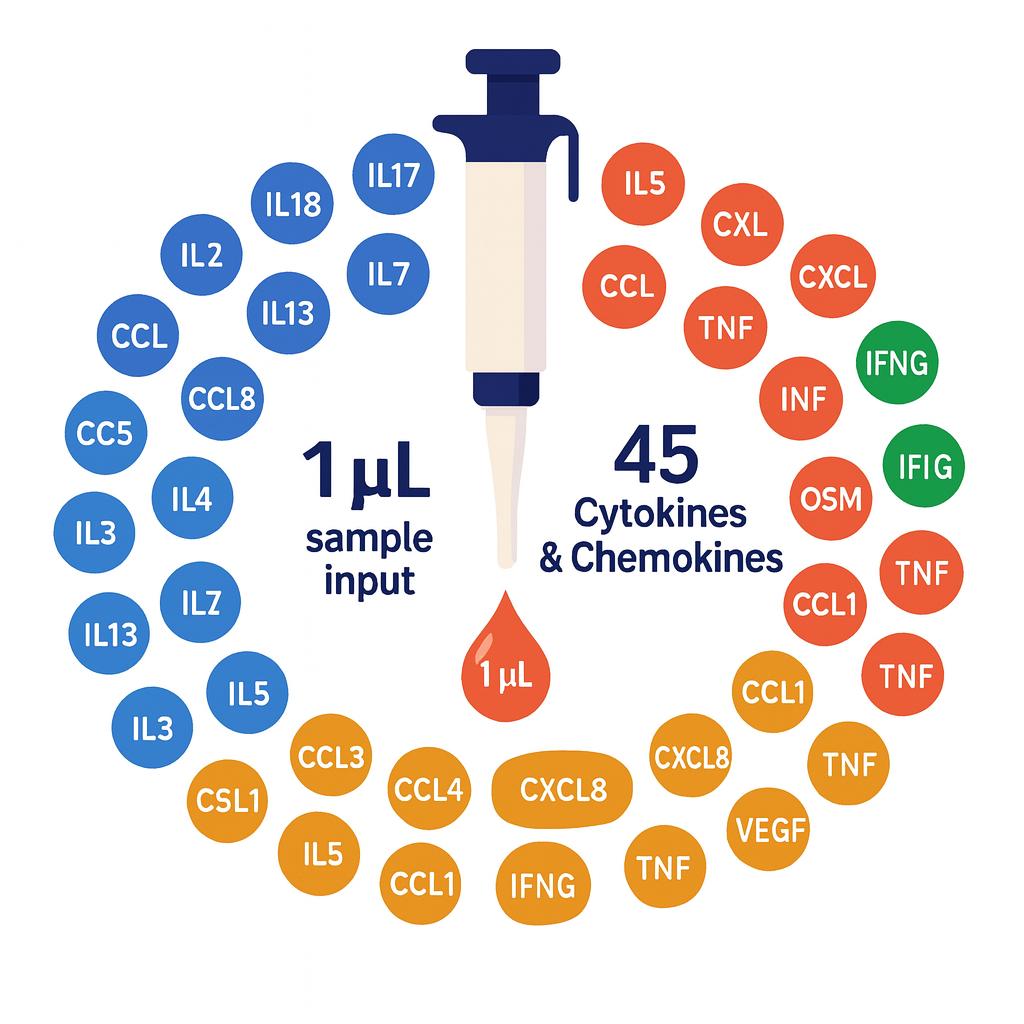
Submit Your Request Now
Introduction
Choosing among Olink PEA, Luminex, and MSD for mouse cytokine measurement is a study design decision that hinges on sensitivity, dynamic range, sample volume, multiplexing, throughput, cross-reactivity, and species coverage. In murine models, practical aims often include longitudinal sampling from microvolumes, detecting low-abundance cytokines, and running high-throughput screens across cohorts.
For many teams, the crux is this: Olink PEA vs Luminex/MSD mouse cytokines isn't about picking a single "winner," but selecting the platform that fits your constraints and objectives.
Key takeaways
- Olink PEA supports ~1 µL per panel with high analytical specificity, making it particularly strong for small-volume longitudinal designs; vendor validation shows low pg/mL sensitivity and broad dynamic ranges.
- Luminex (Bio-Plex/MILLIPLEX) is widely used for in-house high-throughput screens, typically requiring 12.5–25 µL per well; sensitivity commonly sits in the low pg/mL range, with careful attention to cross-reactivity at higher plex.
- MSD offers electrochemiluminescence with preconfigured mouse panels (V-PLEX), customizable sets (U-PLEX), and ultra-sensitive S-PLEX reagents achieving fg/mL-level detection; sample volumes are often 25–50 µL/well in base formats, with posters demonstrating <1–3.125 µL/well in S-PLEX.
- Your matrix matters: serum/plasma/whole blood, BALF, CSF, and tissue homogenate each carry distinct validation needs—plan spike-recovery, dilution linearity, parallelism, and interference checks.
Technologies at a glance
Olink PEA basics
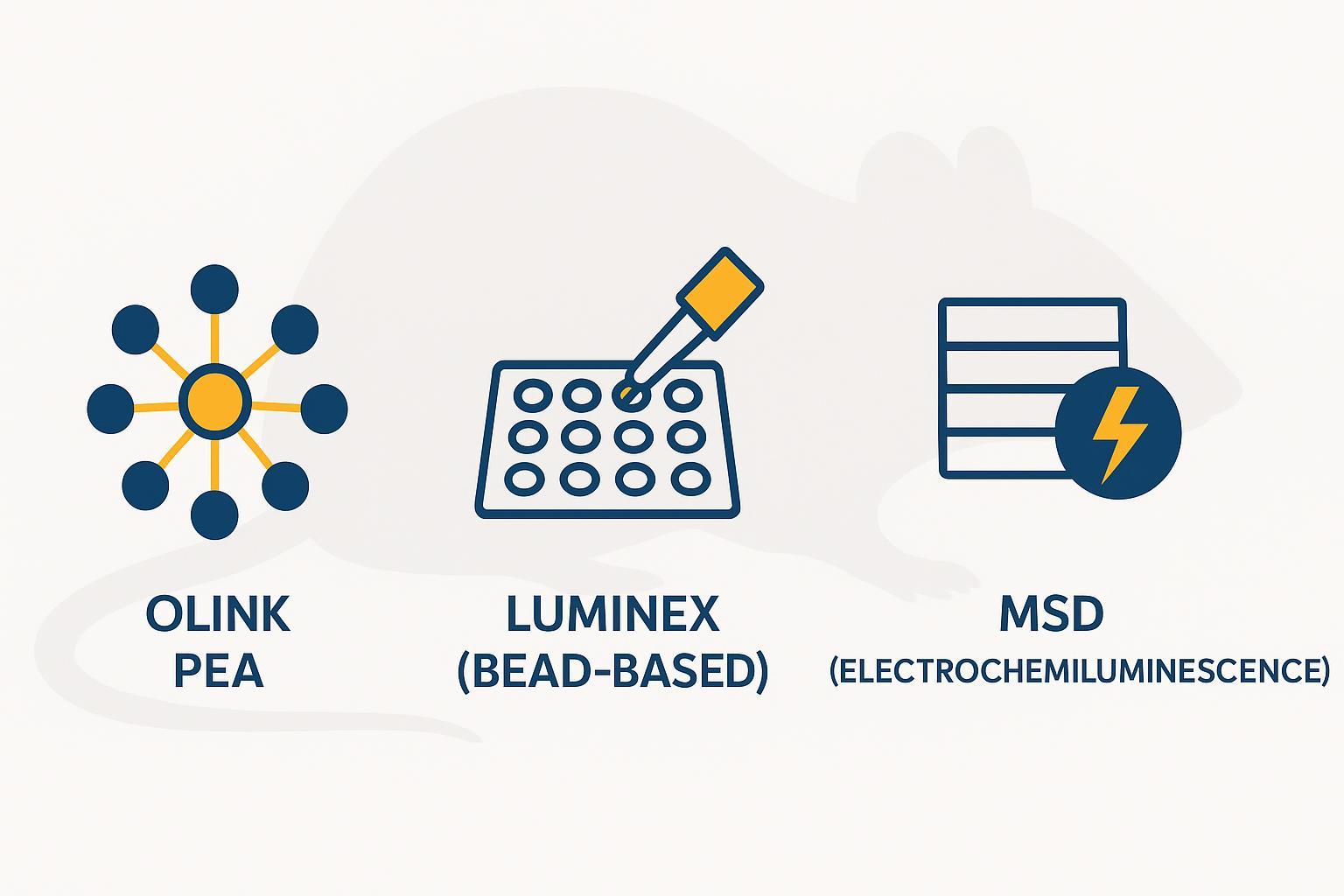
Olink's Proximity Extension Assay uses dual antibodies bearing DNA oligos; when both bind the target, a unique barcode forms and is quantified by qPCR or NGS. This dual-recognition design yields high analytical specificity with minimal sample input (often ~1 µL per panel). See the concise overview in the Olink proteomics introduction.
Luminex bead-based overview
Luminex xMAP bead-based sandwich immunoassays couple antibodies to color-coded microspheres, enabling multiplex detection via fluorescence. Mouse cytokine kits span roughly 8–48 analytes; Luminex xMAP bead assays can, in practice, quantify up to ~48 targets from a single ~12.5 µL sample (kit- and panel-dependent); achievable plex and required input volume vary by kit and matrix, so matrix-specific validation is essential..
MSD electrochemiluminescence
MSD arrays capture antibodies in discrete spots per well, read by electrochemiluminescence. Families include V-PLEX (preconfigured mouse panels), U-PLEX (customizable), and S-PLEX (ultra-sensitive). A mouse-focused poster reports S-PLEX delivering a ~19-fold sensitivity improvement and detecting 9/10 cytokines with <1 µL/well, all 10 at 3.125 µL/well; see MSD's **[ultra-sensitive multiplex poster (mouse)](https://www.mesoscale.com/~/media/files/scientific%20poster/ultra-sensitive-multiplex-detection-mouse-proinflamm-cytokines.pdf)**.
Performance comparison: Olink PEA vs Luminex MSD mouse cytokines
Sensitivity and dynamic range
- Olink PEA (Target 48 Mouse): Vendor validation indicates analyte-specific LOD/LLOQ often in the low pg/mL range, with dynamic range near ~5 logs. Product pages host validation PDFs with calibrator-based absolute quantitation options alongside NPX.
- Luminex: Kit manuals commonly report low pg/mL LODs and ~3–4-log dynamic ranges, varying by analyte and kit. Cross-reactivity can rise with higher plex, requiring careful panel selection.
- MSD: S-PLEX achieves fg/mL LLODs with broad dynamic ranges (up to ~5 logs), while base V-/U-PLEX formats are strong for many cytokines but may require larger volumes.
According to a recent comparative article focused on human matrices, electrochemiluminescence and PEA often outperform bead assays in sensitivity for low-abundance targets; while human-centric, it informs platform patterns—see McKinski et al. (2024) in "Comparison of highly sensitive, multiplex immunoassays" . For mouse-specific numbers, rely on vendor validation inserts and your own matrix validation.
Sample volume and throughput
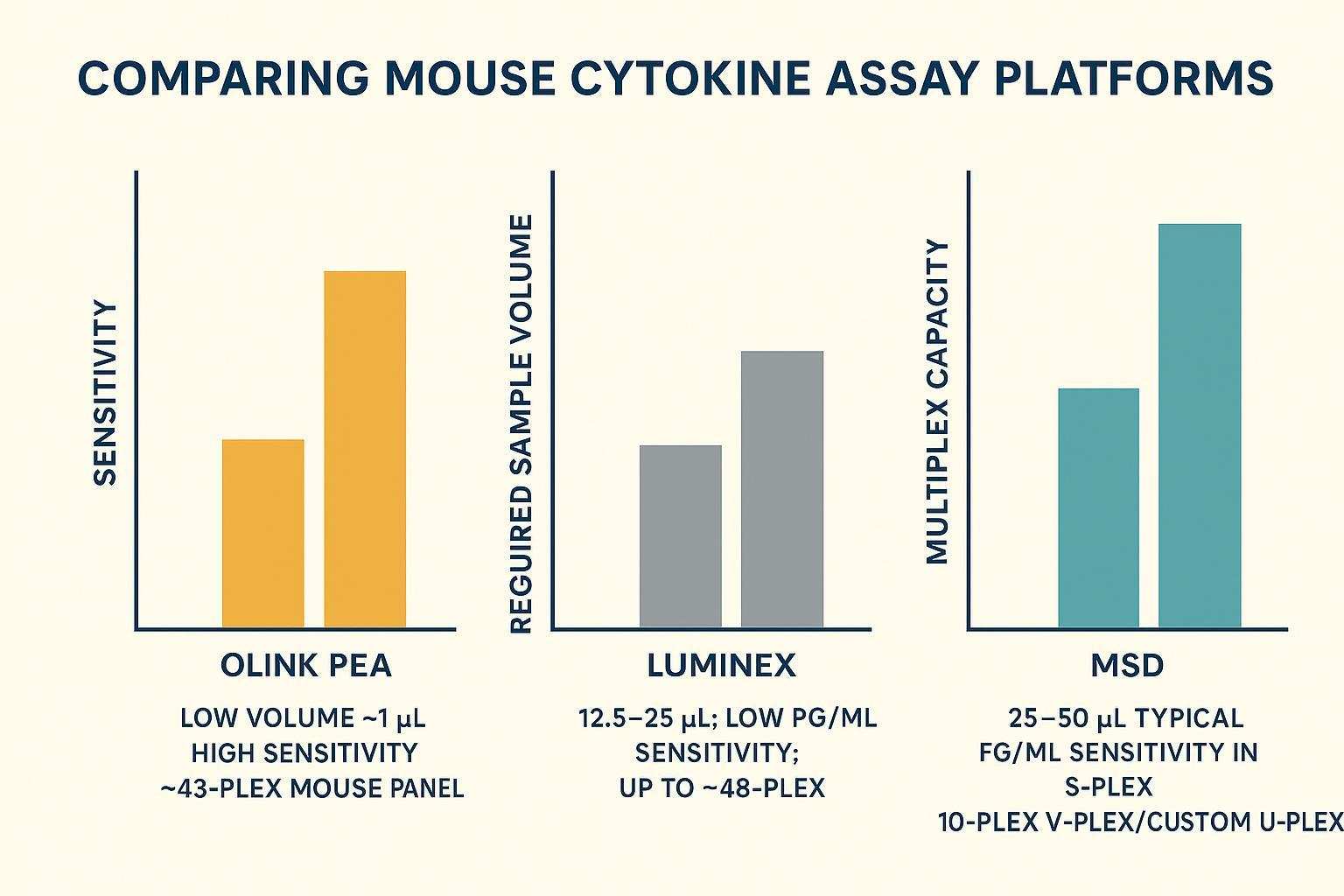
- Olink PEA: ~1 µL per Target 48 panel supports frequent longitudinal sampling without exhausting the allowed blood volume per animal; instruments and service workflows scale to large cohorts.
- Luminex: Typical inputs of 12.5–25 µL per well on 96-well plates make it a natural fit for in-house high-throughput screens; many labs already have compatible analyzers.
- MSD: Base V-/U-PLEX formats often specify 25–50 µL per well, but the mouse S-PLEX poster demonstrates sub-µL feasibility for focused sets; MSD runs on 96/384 plates for robust throughput.
Specificity and cross-reactivity
- Olink PEA: Dual-antibody DNA barcoding confers high analytical specificity, helping limit cross-reactivity and off-target signals.
- Luminex: As plex increases, so does the risk of cross-reactivity and bead/bead interference; diligent validation and matrix optimization are essential.
- MSD: Spot-based capture and ECL detection provide strong specificity; S-PLEX adds sensitivity while maintaining specificity.
Practical considerations for mouse studies
Longitudinal sampling and volume constraints
Designing tail-bleed or facial-vein schedules with ≤10–20 µL per timepoint demands careful accounting. Think of it this way: each assay "withdraws" a portion of your volume budget. Olink's ~1 µL per panel enables repeated measures across many timepoints with minimal cumulative draw. MSD S-PLEX can achieve <1–3.125 µL per well for focused targets. Luminex, at 12.5–25 µL per well, may necessitate fewer timepoints, reduced plex, or pooling strategies.
Matrix effects and assay validation
For serum, plasma, whole blood, BALF, CSF, and tissue homogenates, plan matrix-specific validation:
- Spike-recovery: Aim for 80–120% across representative concentrations.
- Dilution linearity: Accept 80–120% back-calculated values through serial dilutions.
- Parallelism: Confirm similar slopes for matrix vs calibrator curves; adjust diluents/blockers as needed.
- Interference checks: Evaluate hemolysis, lipemia, and heterophilic antibody interference; bead assays may need additional blockers at high plex.
For low-protein matrices like BALF and CSF, MSD often shows robust performance. Olink's minimal input is advantageous but may yield more <LOD results in very dilute matrices depending on analyte. Luminex typically requires matrix-tuned conditions per kit—consult kit inserts.
Data normalization and within-platform comparisons
Analyze longitudinal data within the same platform, and include bridge samples to normalize across plates or batches. Report the percentage of <LOD per analyte and apply appropriate censored-data strategies (e.g., substitution at LOD/√2 or Tobit models). For PEA, NPX offers log2-relative expression with robust QC; Target 48 Mouse supports calibrator-based absolute pg/mL.
Disclosure: Creative Proteomics is our product. When panel selection and multi-omics integration are part of the plan (e.g., pairing Olink cytokines with mRNA or metagenomics), neutral resources can help—the Olink data analysis process and Olink sample preparation guidelines outline normalization and handling, and the integrated Olink & mRNA-seq page describes one approach to combining proteomics with transcriptomics.
Mouse compatibility and panel coverage
Validated analytes and matrices
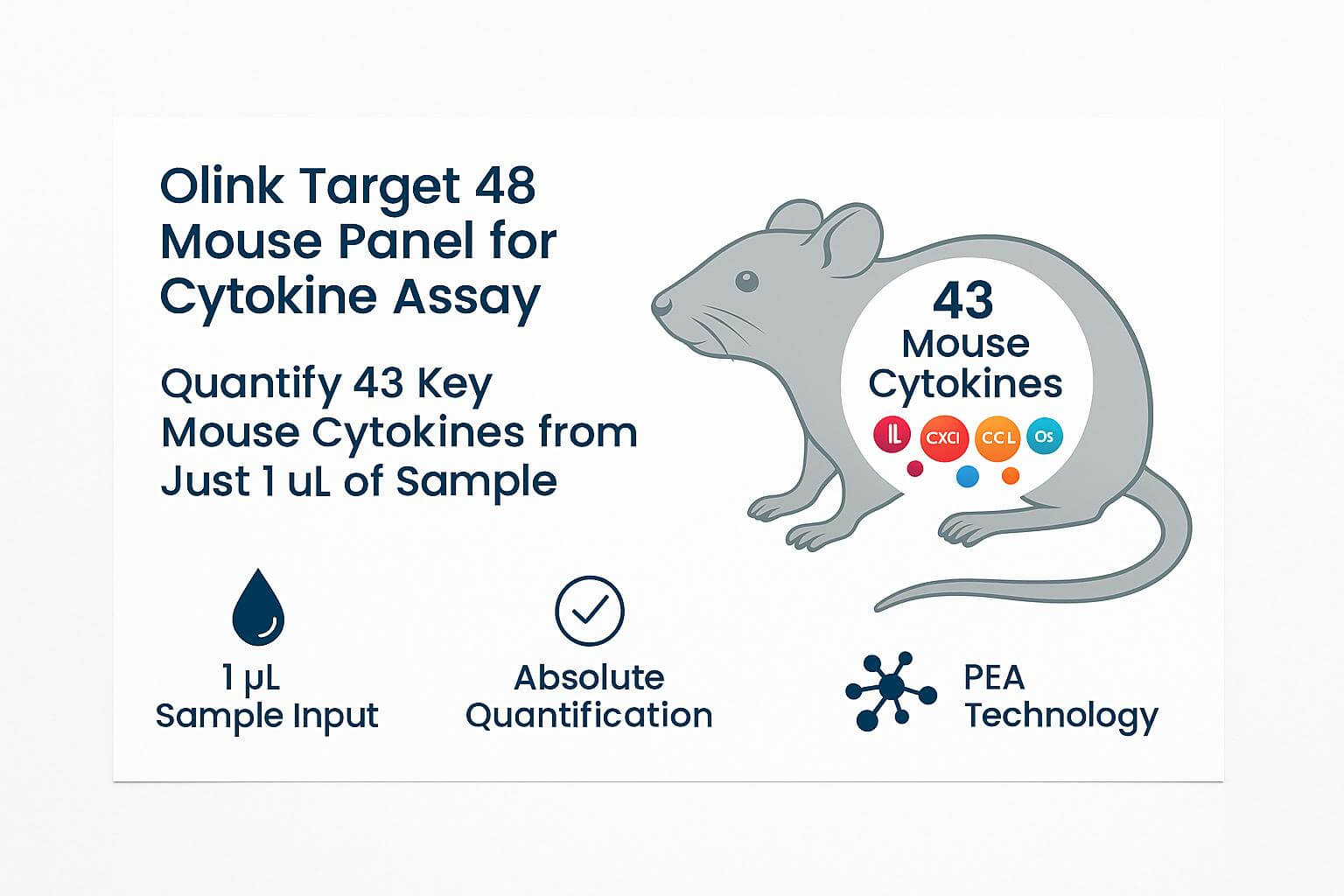
- Olink Target 48 Mouse Cytokine measures 43 mouse-derived cytokines/chemokines with vendor-published validation data and calibrator-based absolute outputs; see Olink's product pages for analyte lists and validation PDFs.
- Luminex/MILLIPLEX offers multiple premixed mouse cytokine panels; analyte lists and species validation vary—check kit inserts for cross-reactivity notes and matrix recommendations.
- MSD provides V-PLEX Mouse Proinflammatory 1 (~10-plex) and mouse-focused U-PLEX configurations; S-PLEX reagents increase sensitivity when needed.
Managing multiplex size and custom targets
Robustness often declines as plex grows. For discovery or broad profiling, Olink's fixed mouse panel (~43 analytes) balances coverage and specificity. For high-throughput, Luminex can push plex higher but demands rigorous validation. For targeted sets, MSD U-PLEX or Luminex custom kits allow tailored analyte choices; plan added validation (specificity, matrix effects).
Decision framework
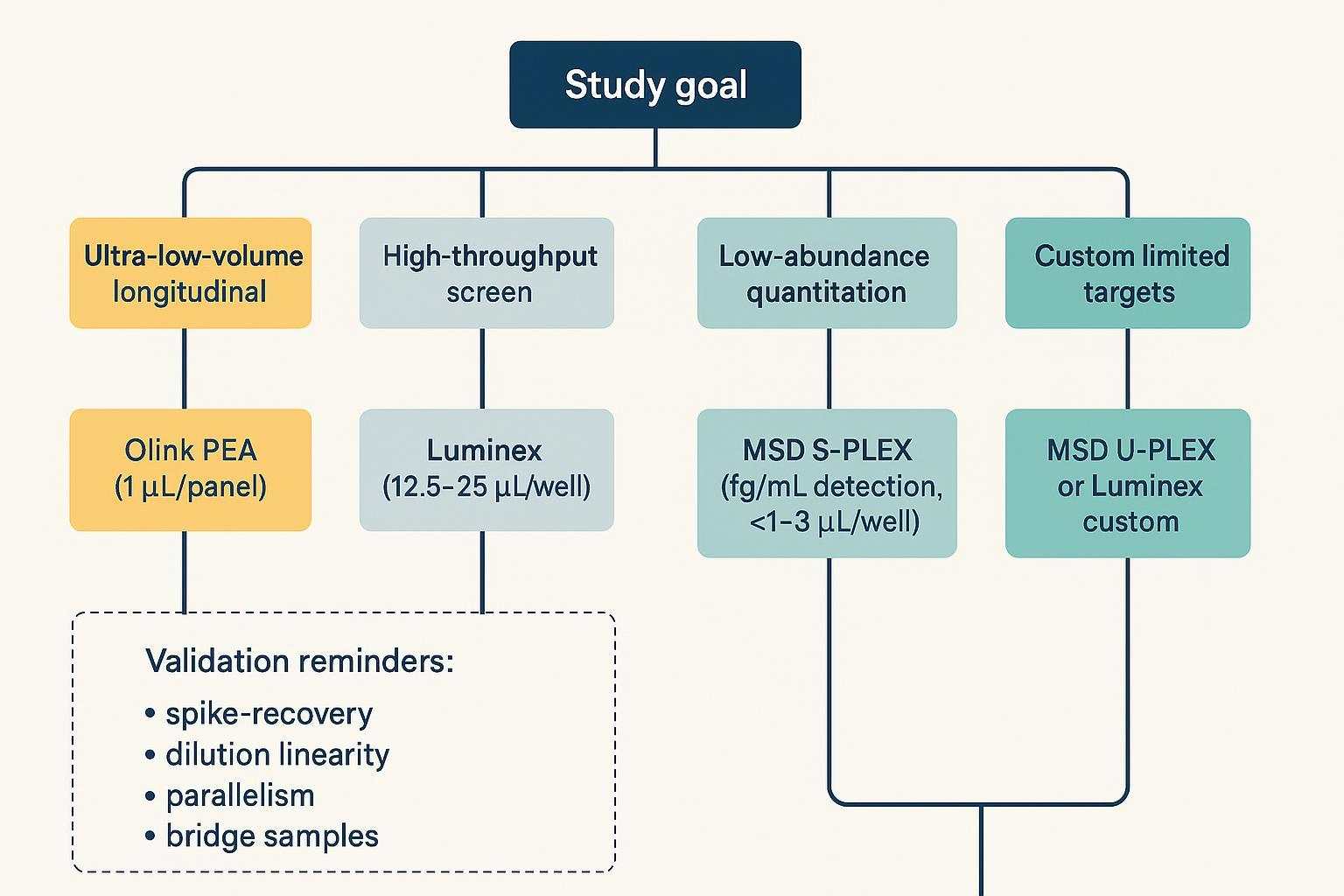
Match platform to study goals
- Ultra-low-volume longitudinal profiling: Olink PEA (1 µL/panel) for broad coverage; MSD S-PLEX for focused fg/mL targets with sub-µL feasibility.
- High-throughput screens: Luminex for in-house 96-well runs at 12.5–25 µL/well; Olink services/instrumentation also scale when infrastructure permits.
- Low-abundance cytokine quantitation: MSD S-PLEX for femtogram-level detection; Olink Target 48 Mouse is strong for many analytes—verify analyte-specific LLOQ in your matrix.
- Custom limited targets: MSD U-PLEX or Luminex custom panels; weigh validation workload and cross-reactivity risk.
Budget, capacity, and lab infrastructure
Consider instrument access and per-sample reagent costs (as of 2026, these vary by kit and analyte count). Luminex suits labs with existing xMAP analyzers and staff familiar with multiplex immunoassays. Olink can be run via service or instrument, minimizing volume but incurring panel costs. MSD requires dedicated ECL instruments; S-PLEX adds sensitivity at additional reagent cost. For very large plex discovery, Olink's Explore families offer high throughput with small volumes; see context pages like Explore HT (2 µL) for how throughput compares (note: human-centric, but useful for scale context).
| Platform | Typical sample volume (mouse) | Sensitivity (indicative) | Dynamic range (indicative) | Typical multiplex (mouse panels) | Strengths | Practical limits / notes |
| Olink PEA (Target 48 Mouse) | ~1 µL per panel | Low pg/mL LOD/LLOQ (vendor validation) | ~5 logs | ~43 analytes | Very low input requirement; high analytical specificity from dual-antibody PEA; good for longitudinal micro-sampling | Some analytes may be <LOD in very dilute matrices (BALF/CSF); consult analyte-specific validation PDFs |
| Luminex (Bio‑Plex / MILLIPLEX) | ~12.5–25 µL per well (kit-dependent) | Low pg/mL (kit-dependent) | ~3–4 logs | 8–48 analytes in practice | Flexible plexing; widely available in-house; cost-effective for large cohorts | Cross-reactivity risks increase with high plex; requires matrix- and kit-specific validation |
| MSD (V‑/U‑/S‑PLEX) | Typical 25–50 µL per well (base); S‑PLEX shown <1–3.125 µL for focused mouse sets (poster) | fg/mL achievable with S‑Plex; V/U‑Plex in low pg/mL range | ~3–5 logs | V‑Plex ~10-plex; U‑Plex customizable | Very high sensitivity (S‑Plex); robust performance in dilute/complex matrices; scalable 96/384 formats | Base kits may need larger volumes; S‑Plex increases reagent cost and setup complexity; gated product inserts for some mouse specifics |
Note: Values are indicative and drawn from vendor validation documents and peer-reviewed comparisons where available (see main text and cited sources). Always verify analyte- and matrix-specific LOD/LLOQ in the latest kit insert or validation PDF before experimental planning.
Conclution
Platform choice for mouse cytokines is fundamentally about aligning sensitivity, dynamic range, volume, and multiplexing with study goals and matrices. Olink PEA excels when longitudinal microvolumes and broad coverage are paramount. Luminex shines for in-house high-throughput screens where volumes of 12.5–25 µL/well are manageable. MSD, particularly with S-PLEX, is compelling for low-abundance targets that demand fg/mL sensitivity.
Whichever route you take, plan rigorous validation—spike-recovery, dilution linearity, parallelism, and interference checks—and keep analyses consistent within the chosen platform, using bridge samples to control batch effects. That way, your mouse cytokine data will stand up to repeated scrutiny and truly reflect biology across timepoints and tissues.