Submit Your Request Now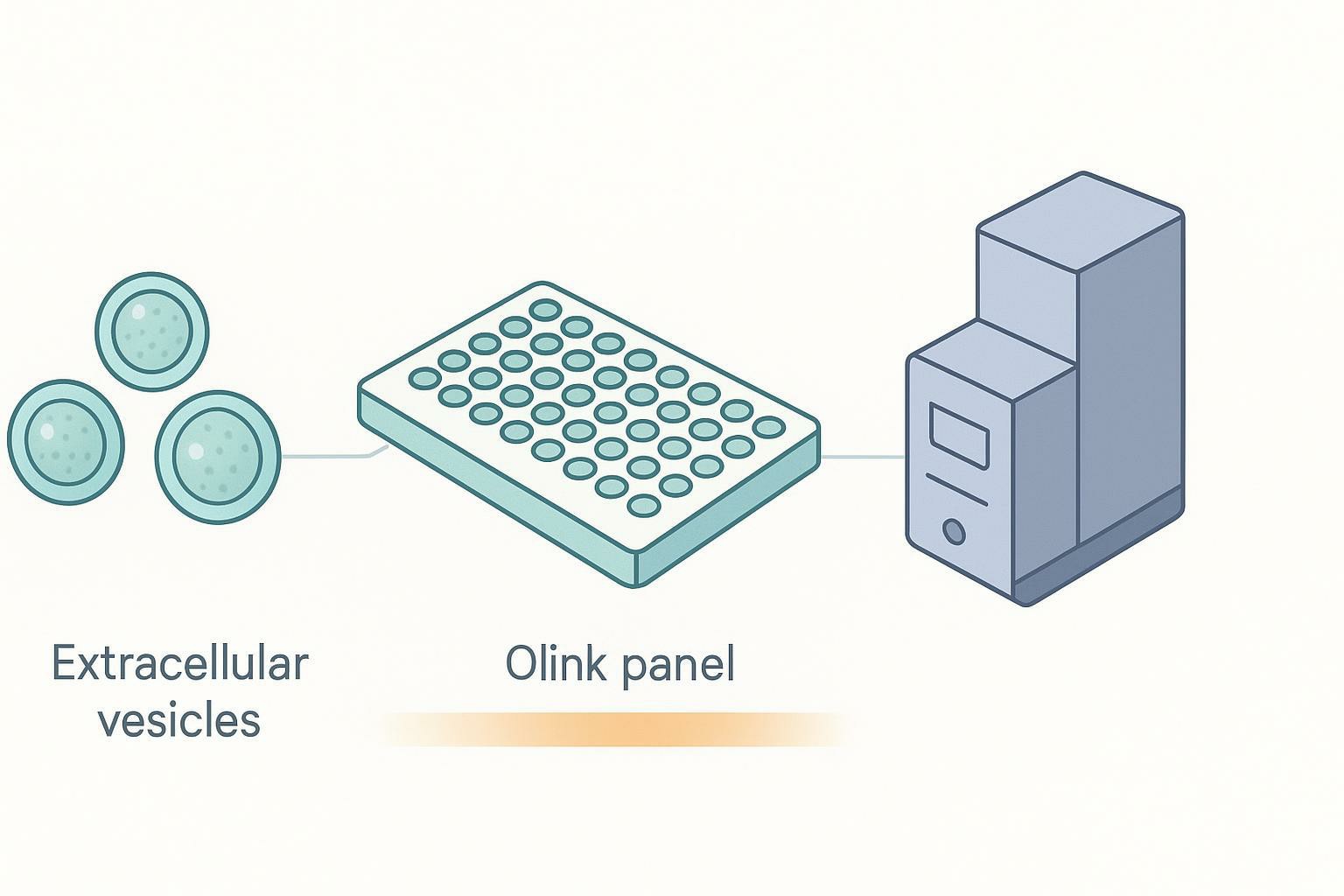
EV protein content analysis is almost never limited by interest. It's limited by feasibility: low protein input, mixed vesicle populations, and background contamination.
That's why the extracellular vesicle proteomics Olink question shows up right after teams commit to EV work: Should we start with shotgun LC-MS/MS to discover EV cargo? Or can Olink panels give us a more targeted, scalable readout—especially when sample amount is tight?
This article compares Olink panels and shotgun mass spectrometry for EV biomarker discovery and follow-up, with a practical "choose-this-when" framework, a combined workflow, and a quote-prep checklist.
Key Takeaway: Shotgun LC-MS/MS is usually stronger for broad, untargeted discovery in EV proteomics. Olink is usually stronger for targeted proteomics panels when pathways/candidates are already defined and you want cohort-scale profiling—one reason EV teams often do MS discovery first, then targeted panel follow-up.
Introduction: Choosing the Right Proteomics Strategy for EV Protein Content Analysis
Start with the real research decision
Most researchers aren't asking "Which platform is better?" They're asking:
- Do we need untargeted EV discovery, or do we already have candidate proteins/pathways?
- Is our EV isolation method likely to preserve signal (and minimize background)?
- If EV input is limited, what workflow is realistic?
- After MS discovery, what's the best follow-up across more samples?
Why there is no universal best platform
Method choice depends on:
- Discovery vs targeted profiling goals
- EV isolation method (SEC vs UC vs immunocapture vs precipitation)
- Protein input and background (lipoproteins and abundant soluble proteins matter)
- Sample number and throughput
- Downstream plan (candidate prioritization and orthogonal confirmation)
Why Extracellular Vesicle Proteomics Is Technically Challenging
EV proteomics is not "proteomics on a different sample." It is extracellular vesicle protein profiling where isolation and characterization can change what you think you measured.
Consensus guidance like the International Society for Extracellular Vesicles' MISEV2018 guidelines (Théry et al., 2018) and the MISEV2023 update (JEV 2024) emphasizes the same idea: interpret EV results in the context of isolation method, controls, and co-isolated material.
EV samples are heterogeneous
A single EV preparation may include small EVs/exosomes, microvesicles, and other extracellular particles from multiple cell types. Biology is heterogeneous—and so is what gets enriched.
EV isolation methods shift protein readouts
Common EV isolation approaches include:
- ultracentrifugation (UC)
- size exclusion chromatography (SEC)
- precipitation-based enrichment (e.g., PEG)
- immunoaffinity capture (marker-based)
- commercial isolation kits
A practical rule from EV methods discussions (for example, van der Pol et al., 2018) is the purity–recovery tradeoff: cleaner preps can reduce yield, while higher-yield preps can carry more background.
Protein input is often limiting
Low EV yield and sample loss during enrichment/buffer exchange can constrain both MS depth and targeted profiling feasibility.
Background contamination can dominate
Common contributors include abundant soluble proteins and lipoproteins (especially in plasma). Reporting frameworks such as EV-TRACK (Van Deun et al., 2017) exist because transparency about isolation, characterization, and controls strongly affects interpretability.
What Shotgun Mass Spectrometry Offers for EV Proteomics
Broad, untargeted discovery
Shotgun LC-MS/MS is often the default starting point because it does not require a predefined target list. If the question is "what's in these EVs?", this is typically the most direct tool.
What you get
Depending on workflow depth and sample quality, shotgun proteomics can support:
- protein identification and relative quantification
- pathway/hypothesis generation
- assessment of what dominates the preparation (helpful for troubleshooting)
Limitations that matter in EV studies
EV samples amplify typical shotgun constraints:
- Low-abundance proteins may drop out in complex backgrounds.
- Missing values across samples are common in data-dependent acquisition, especially with low input.
For a citation on why missingness is a fundamental analysis constraint in proteomics datasets, see Lazar et al., 2016.
Best-fit use cases for shotgun MS
Shotgun MS tends to fit when:
- targets are unknown and discovery breadth matters
- you can support enough EV protein input (or a staged design)
- you want EV cargo characterization alongside candidate discovery
What Olink Panels Offer for EV Proteomics
Targeted profiling on defined panels
Olink is fundamentally different from shotgun MS: it's panel-based. It measures a defined set of proteins rather than searching proteome-wide. That's why it's often discussed as Olink extracellular vesicles feasibility and panel-fit, not as a replacement for discovery.
For a core methods citation on Proximity Extension Assay (PEA), see Assarsson et al., 2014.
Where Olink is a strong fit
Olink panels may be useful when:
- you already have candidate pathways or protein classes (e.g., inflammatory signaling)
- you want consistent targeted profiling across more samples
- you are doing follow-up after MS or literature-based candidate selection
A practical framing: Olink supports targeted follow-up and candidate biomarker prioritization within panel coverage.
Feasibility questions for EV preparations
EV feasibility is not automatic. Before committing, sanity-check:
- isolation method and background (what is likely co-isolated?)
- protein input and sample volume
- whether your proteins of interest are expected in EV preparations (vs soluble carryover)
- buffer compatibility and matrix effects
For general matrix guidance (including exosomes), Creative Proteomics provides Olink Sample Preparation Guidelines.
What Olink cannot do
Olink is not an untargeted discovery platform. It cannot detect proteins outside the selected panel.
Extracellular Vesicle Proteomics Olink vs Shotgun MS: Practical Comparison
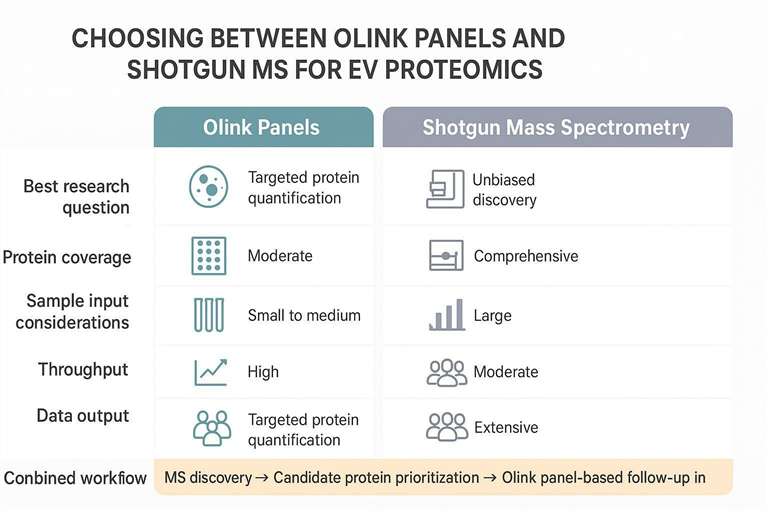
| Decision factor | Olink panels | Shotgun LC-MS/MS |
| Best research question | Targeted pathway or candidate protein profiling | Broad, untargeted EV protein discovery |
| Protein coverage | Predefined panel targets | Proteome-wide discovery depending on sample and method |
| Target knowledge required | Usually yes | No (useful when targets are unknown) |
| Sample input considerations | EV feasibility + panel fit should be reviewed | Sufficient EV protein input and cleanup are important |
| Throughput | Often strong for cohort profiling | Depth and throughput depend on LC-MS/MS strategy |
| Data output | Targeted protein expression data | Protein IDs + quantitative proteomics data |
A practical decision rule
- Choose shotgun mass spectrometry EV proteomics when you need discovery breadth and your candidates are not known.
- Choose Olink when you have defined proteins/pathways and need scalable targeted profiling.
- Choose a combined workflow when you need both discovery and cohort-scale follow-up.
If you're deciding between Olink panels, shotgun LC-MS/MS, or a combined plan, it's usually most efficient to start with a feasibility review.
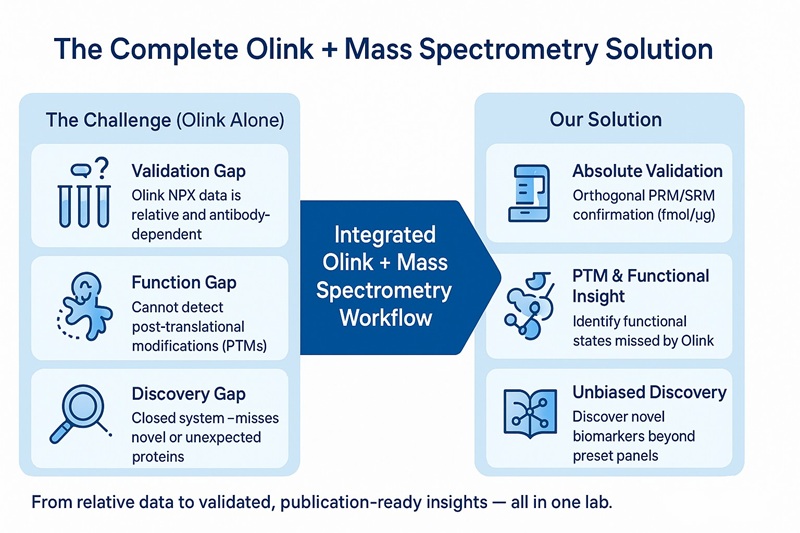
Creative Proteomics can support Olink profiling via Olink Proteomics Assay Services and combined design via the Integrated Olink & Mass Spectrometry Service.
To scope an EV project, share:
- EV source (plasma/serum/CSF/urine/supernatant)
- isolation method (SEC/UC/immunocapture/precipitation)
- total N and group structure
- estimated EV protein amount (or volume + concentration)
- discovery vs targeted profiling goal
When to Choose Olink Panels for EV Biomarker Studies
Candidate proteins or pathways are already defined
If you already have candidates (from literature or upstream omics), Olink panels can be efficient—if targets are covered. Panel alignment is the first check; see How to Choose the Right Olink Panel.
You need targeted profiling across more samples
If the priority is cohort scaling for a defined target list, panel-based profiling can be a practical follow-up.
You're doing follow-up after discovery
A common workflow is MS discovery on a smaller set, then Olink profiling across a larger set for targeted follow-up.
When to Choose Shotgun Mass Spectrometry for EV Proteomics
You need untargeted EV protein discovery
If the main goal is discovery of unknown EV proteins, shotgun LC-MS/MS is typically the more direct tool for LC-MS/MS EV proteomics discovery.
You need EV cargo characterization
MS is often the most informative when you want to understand what dominates the prep and how isolation choices shift apparent cargo.
A Combined Workflow: MS Discovery Followed by Olink Panel-Based Follow-Up
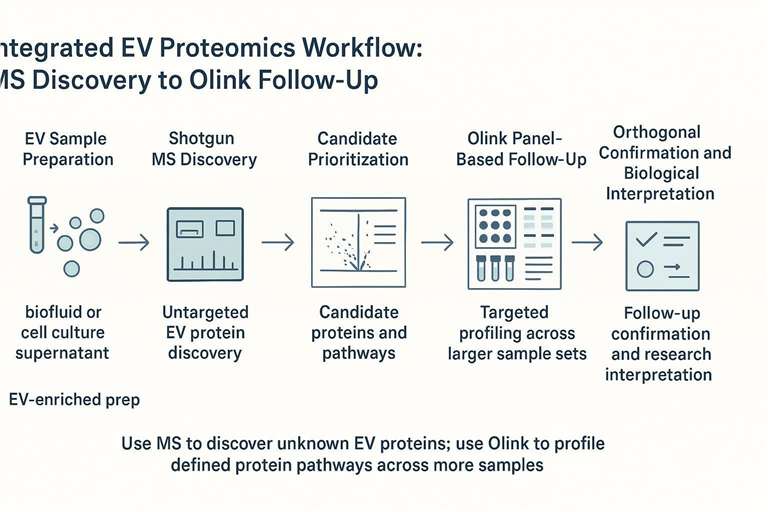
Step 1: MS discovery in a smaller, well-chosen set
Start with a discovery subset that is representative and well-characterized.
Step 2: Candidate prioritization
Prioritize based on effect size, detectability/missingness, biological relevance, and whether candidates are panel-covered.
Step 3: Olink panel-based follow-up
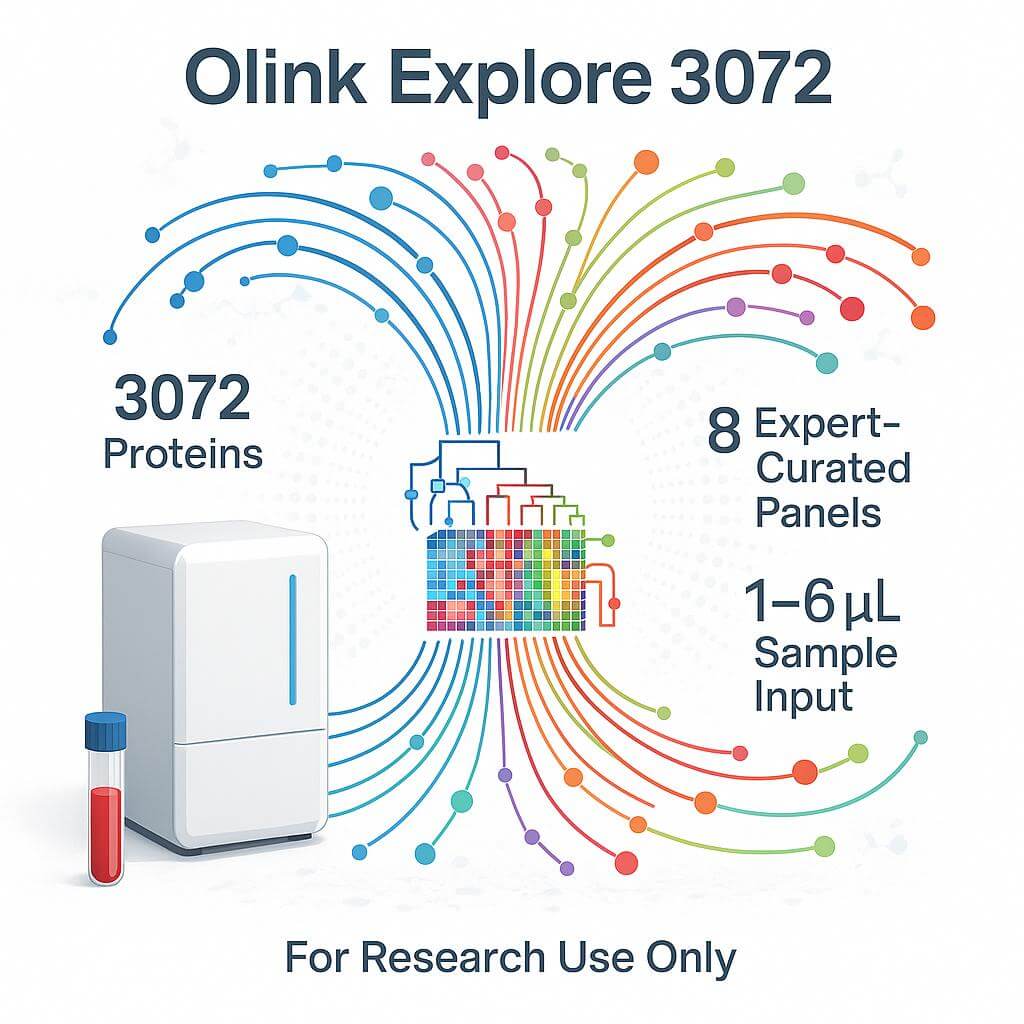
Use Olink to profile defined pathways across more samples once candidates are prioritized (within panel coverage). For high-plex cohort profiling, see the Olink Explore HT Panel.
Step 4: Orthogonal confirmation where needed
Depending on the question, add targeted MS (PRM/SRM), ELISA, western blot, or other appropriate confirmation.
What to Prepare Before Requesting an EV Proteomics Quote
EV source and isolation method
- matrix (plasma/serum/urine/CSF/supernatant)
- isolation method and key protocol details
- storage conditions and freeze–thaw count
EV characterization information (if available)
- particle count and size distribution (NTA or equivalent)
- total protein concentration
- EV marker data
- known contamination concerns
Sample amount and format
- total sample number and group definition
- volume per sample
- estimated EV protein amount per sample (if known)
- buffer composition (detergents/preservatives)
EV proteomics quote preparation checklist
- Confirm matrix + EV isolation method
- Provide N and group structure
- Provide volume and (if possible) EV protein yield estimate
- Share characterization data (NTA/markers) if available
- Clarify discovery vs targeted profiling goal
- List any candidate pathways/proteins
Common Mistakes in EV Proteomics Method Selection
- Picking a platform before defining discovery vs targeted goals
- Assuming EV preparations are pure (background often drives interpretation)
- Ignoring protein input constraints
- Expecting Olink to replace untargeted discovery
- Skipping a pilot feasibility review when EV yield is uncertain
Conclusion: Match the Method to the EV Research Question
If you need broad discovery of unknown EV proteins, start with shotgun LC-MS/MS. If you have defined pathways and need scalable targeted profiling, Olink panels may be a better fit—pending EV feasibility and panel coverage.
For many programs, the most efficient route is MS discovery → candidate prioritization → Olink follow-up, with orthogonal confirmation where appropriate.
FAQ
Is Olink suitable for extracellular vesicle proteomics?
Olink may be suitable for targeted EV protein profiling when candidate pathways or panel-covered proteins are defined—this is the most common framing behind the question "Olink extracellular vesicles: can I run Olink on EV preparations?" EV feasibility should be reviewed based on isolation method, protein input, background, and study goals.
Is shotgun mass spectrometry better than Olink for EV protein discovery?
For broad, untargeted EV protein discovery, shotgun LC-MS/MS is generally the stronger starting point because it does not require predefined targets. Olink is better suited for targeted panel-based profiling.
Can Olink and mass spectrometry be combined in EV biomarker research?
Yes. A common strategy is shotgun MS for discovery, then Olink panels for targeted follow-up across a larger cohort.
What EV sample information is needed before project planning?
Provide EV source, isolation method, sample volume, buffer composition, number of samples, characterization data (if available), and whether the goal is discovery or targeted profiling.
Which method is better for low-abundance EV proteins?
It depends on your targets and EV matrix. Targeted panels may be practical for selected proteins within coverage, while MS performance depends on cleanup, input amount, and workflow depth.
Should EV proteomics studies include a pilot test?
A pilot feasibility test is useful when sample amount is limited, isolation is new, the matrix is complex, or the MS vs Olink route is undecided.
Research-use-only (RUO) disclaimer
All services and results discussed are intended for research use only. They are not intended for diagnostic procedures, clinical decision-making, or patient management.
About the Author
CAIMEI LI
Senior Scientist at Creative Proteomics
LinkedIn: CAIMEI LI on LinkedIn