Submit Your Request Now
Introduction: Why Large Olink Explore HT Studies Need More Than a Sample Count
An Olink Explore HT large cohort project—think a large cohort biomarker study starting as a 1000 sample proteomics study and scaling toward a 2000 sample proteomics cohort—usually starts with a simple request: "Please quote Explore HT for our cohort." In practice, the quote you want is the quote that already anticipates the real work: sample format readiness, Olink plate layout, Olink batching into 2–3 batches, Olink QC planning, and a clear definition of data deliverables (in an Olink ExploreHT workflow).
This is a planning article for large-cohort biomarker and translational teams. The point isn't to restate what Explore HT is; it's to help you avoid the failure modes that only appear at scale—especially batch–group confounding, plate-map ambiguity, and timeline surprises.
Start with the Real Quote Scenario
Here's the common large-cohort quote email:
- "We have ~1,500 plasma samples. Explore HT. Need NPX."
What's missing is what determines feasibility and turnaround:
- Are samples arriving in waves (multi-site release), forcing 2–3 batches?
- Will cases/controls (or sites/timepoints) align with plate position or batch?
- Are samples shipping in tubes or plates, and is a clean plate map available?
- Do you need bridging samples/pools to support cross-batch consistency review?
- What exactly should be delivered (QC summary, normalized data, optional statistics/report)?
Clarify the Article Scope
This article focuses on:
- quote preparation inputs that prevent delays
- sample format and plate layout planning for large cohorts
- batch structure (2–3 batches) and bridging sample logic
- QC planning at sample/plate/assay/data levels
- what affects Olink turnaround time
- panel scope tradeoffs and deliverables alignment
Explain Why This Article Matters for Project Timelines
In our experience, large-scale proteomics study timelines slip most often because readiness and design weren't locked before transfer/shipment:
- plate maps were incomplete or inconsistent with metadata
- group variables weren't balanced across plates and batches
- QC/bridging wasn't feasible with available volume
- downstream reporting scope wasn't agreed
A good planning package prevents weeks of clarification, re-plating, or post hoc debates about technical structure. It also makes it easier to scope Olink Explore HT sample preparation expectations (especially when multiple sites, waves, and reserve aliquots are involved).
When Olink Explore HT Makes Sense for Large Cohort Proteomics
Large Cohorts Need Scalable Protein Measurement
Large cohorts demand a workflow that can measure many proteins across many samples consistently, with enough throughput to keep operational overhead manageable.
Large-Scale Proteomics Is Not Only About Throughput
At 1,000–2,000 samples, the dataset will have technical structure (plate, batch, time). The job is to design the run so that structure doesn't become indistinguishable from biology. A practical protocol-style reference on diagnosing and correcting batch effects in proteomics is Ludwig et al.'s "Diagnostics and correction of batch effects in large-scale proteomic data" (2021).
When a Smaller Targeted Panel May Be More Appropriate
A smaller targeted panel can be a better fit when your hypothesis is narrow, you want maximal power on a constrained protein set, or you want to reduce operational complexity. If you're comparing scope and planning implications, see Creative Proteomics' Olink Explore 3072/384 panel service resource.
What Information Is Needed Before Quoting 1,000–2,000 Samples?
Study Design Information
Provide a minimal design snapshot:
- cohort type (case/control, longitudinal, multi-site)
- group definitions and approximate sizes
- timepoints and expected missingness
- key covariates that must be balanced (site, sex, age bins, treatment exposure)
Sample Matrix and Format
State:
- matrix (plasma, serum, or other)
- available volume per sample (after other planned assays)
- storage history (temperature, freeze–thaw count)
Panel and Analysis Scope
Clarify scope beyond "Explore HT":
- one panel vs multiple panels strategy
- whether you need technical replicates and/or bridging samples
- whether you need deliverables beyond a normalized matrix (QC summary, statistics, bioinformatics report)
Timeline and Turnaround Expectations
When discussing Olink turnaround time, share constraints and options:
- your internal decision date(s)
- whether batch-by-batch release is acceptable
- whether samples arrive all at once or in waves
Why Incomplete Quote Requests Create Delays
Incomplete requests force iteration because missing details are exactly what determines batch structure, plate map review requirements, QC feasibility, and deliverables.
Table 1: Information Needed Before Requesting an Olink Explore HT Quote
| Information Category | What to Prepare | Why It Matters |
| Study design | Groups, timepoints, sites, key covariates | Prevents confounding and guides balancing |
| Sample matrix | Plasma/serum/other; anticoagulant if relevant | Impacts feasibility and comparability |
| Sample readiness | Volume per sample; freeze–thaw history; reserve aliquots | Determines QC/bridging options and rerun feasibility |
| Sample format | Tubes vs plates; labeling scheme; draft plate map | Drives tracking and plate layout review |
| Batch plan | Proposed 2–3 batches; shipment waves | Sets workflow and realistic timeline planning |
| QC & bridging | Pooled QC and bridging approach | Supports cross-batch consistency review |
| Metadata | Sample ID ↔ group ↔ timepoint ↔ site mapping | Enables QC interpretation and defensible stats |
| Deliverables | QC summary + normalized matrix ± analysis/report | Prevents post-run scope creep |
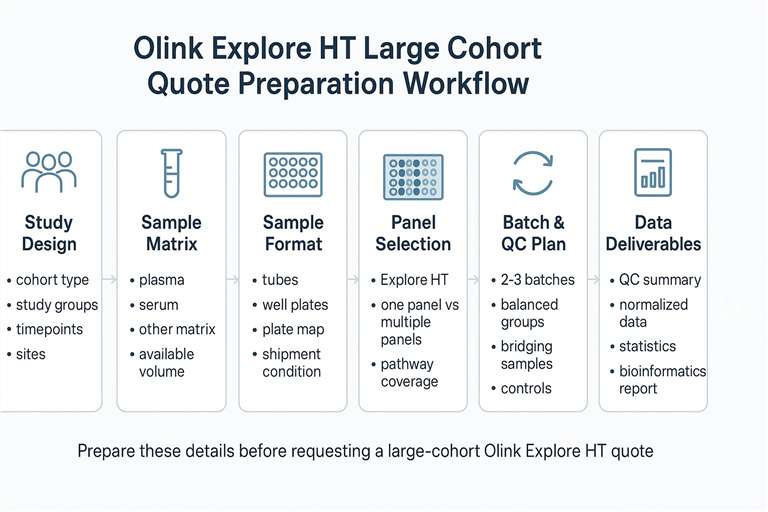 Large Olink Explore HT cohort quotes require more than sample count; study design, sample format, batching, QC, and analysis scope all affect project planning.
Sample Format and Plate Layout Planning for Olink Explore HT
Why Plate Layout Matters in Large Cohort Studies
In a 1,000–2,000 sample run, the plate map is a design artifact. Plate-to-plate shifts and spatial effects are common in high-throughput workflows; the question is whether you've designed your plate layout so that those effects are diagnosable rather than confounded.
Avoid Confounding Study Group with Plate Position
Avoid layouts like:
- early plates = cases; later plates = controls
- one timepoint per plate block
- one site per plate block
If biology aligns with plate position, downstream correction becomes less reliable—and you lose confidence that differences are biological.
Balance Key Variables Across Plates
A practical balancing target per plate is:
- both primary groups (cases/controls)
- key sites (if multi-site)
- timepoints/subgroups (if longitudinal)
Perfect balance is rarely possible; the goal is to prevent any plate from having a single "biological identity."
Maintain Clear Sample Tracking
For a 1000+ sample project, tracking rules prevent avoidable delays:
- one canonical Sample ID across labels and metadata
- one versioned plate map per plate
- one master metadata file treated as source of truth
Confirm Plate Requirements Before Transfer
Do not plate first and confirm requirements later. Confirm acceptable containers/conditions and compatibility constraints before transfer, then plate against an approved plate map. (For matrix handling and shipping constraints, align early with Creative Proteomics' sample preparation guidance.)
Batch Design for 1,000–2,000 Sample Olink Projects
Why Large Cohorts Often Require Multiple Batches
Large cohorts commonly run in 2–3 batches because samples arrive in waves, and interim QC review after Batch 1 can confirm consistency before processing the remainder.
How to Think About 2–3 Batch Structures
A useful rule:
- Biology must cut across batches.
One practical pattern:
- Batch 1: balanced slice across groups/sites/timepoints (not a biased subset)
- Batch 2: majority of remaining samples, balanced
- Batch 3: final wave + planned bridges/replicates, balanced
Avoid Batch-Group Confounding
If all cases are in Batch 1 and all controls are in Batch 2, you've created batch–group confounding. Even if you plan to model batch as a covariate, complete confounding reduces identifiability.
Use Randomization Where Appropriate
Use constrained randomization:
- keep group proportions similar per plate
- distribute sites/timepoints across plates
- avoid clustering any subgroup into one region
Consider Bridging Samples Across Batches
Bridging samples are shared reference points run across batches (often pooled QC material and/or selected study samples repeated as technical replicates). Bridging samples may support cross-batch consistency review when multi-batch execution is unavoidable.
For readers who want peer-reviewed context on bridging concepts in confounded designs, see Dey et al.'s BRIDGE framework in Biostatistics (2022), PMC9617207.
Document Every Batch Decision
At this scale, documentation is part of reproducibility:
- batch definitions (plates per batch)
- plate maps (version-controlled)
- pooled QC definition (how created, aliquoted)
- bridging sample IDs and placement
- deviations/change log
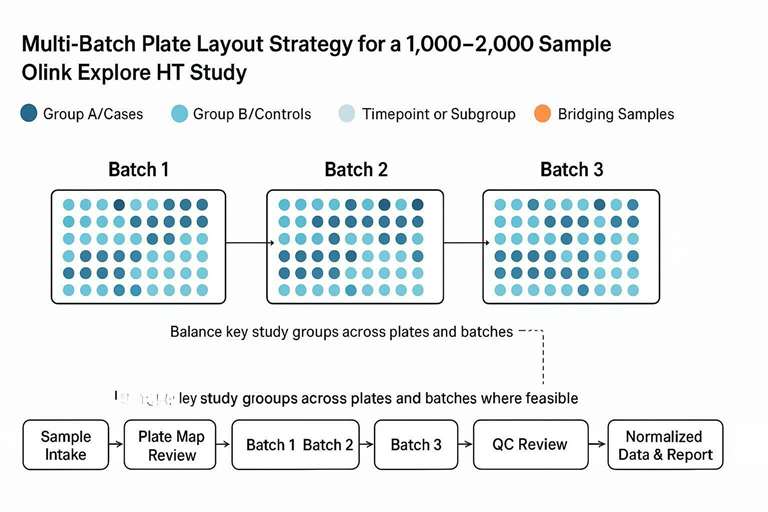 Balanced plate layout, bridging samples, and documented batch structure help reduce technical bias in large Olink Explore HT cohort studies.
QC Planning for High-Throughput Olink Proteomics
Sample-Level QC
Sample-level QC focuses on whether individual samples are interpretable. Practical elements include:
- unusually high missingness (many proteins below detection)
- outlier signal distributions relative to cohort n- metadata inconsistencies (ID mismatch, timepoint ambiguity)
Plate-Level QC
Plate-level QC checks whether a plate behaves like peers:
- distribution shifts vs other plates
- spatial patterns suggestive of position effects
- behavior of pooled QC/bridges used across plates
Assay-Level QC
Assay-level QC examines protein-wise behavior:
- consistently low signal or high missingness assays
- unusually variable assays across plates
For a peer-reviewed discussion of PEA/Olink technical performance and reproducibility considerations that can inform QC conversations, see the 2022 evaluation paper: "Technical Performance Evaluation of Olink Proximity Extension Assay…" (Frontiers in Neurology, 2022).
Data-Level QC
Data-level QC asks: "Is this analysis-ready?" Common elements include:
- missingness summaries by sample and protein
- diagnostic clustering by plate/batch (as checks)
- confirmation that normalization reduces technical separation without erasing expected biology
Why QC Expectations Should Be Discussed Before Project Launch
QC expectations determine whether you need reserve samples, bridging, technical replicates, and what QC summary outputs are required for batch release decisions.
Turnaround Time Planning: What Affects Project Timeline?
Sample Readiness
Sample readiness often dominates the timeline:
- metadata reconciliation
- volume confirmation and reserve aliquots
- consistent pre-analytical handling across sites
Plate Format and Shipment Preparation
Common delays include missing/incorrect plate maps and inconsistent labeling. Align shipment conditions and sample handling early (matrix-specific constraints and shipping details should be agreed before the first shipment).
Batch Number and Panel Selection
More batches and broader scope create more coordination and more QC review windows.
QC Review and Data Processing
Interim QC review after Batch 1 can be a feature, but it needs to be planned as a milestone.
Bioinformatics and Reporting Scope
Define whether you need:
- QC summary + normalized data matrix only
- statistics for primary comparisons
- additional bioinformatics reporting
How to Communicate Deadline Constraints
Communicate deadlines as constraints-plus-options (partial delivery timing, report depth, acceptance of phased shipments), rather than treating turnaround as a fixed guarantee.
One Panel vs Multiple Panels in Large Cohort Studies
When One Panel May Be Enough
One panel is often enough when you need a single unified dataset and want to minimize complexity.
When Multiple Panels May Add Value
Multiple panels may add value when you have distinct biological objectives and sufficient governance (volume, documentation discipline, PM support) to manage added complexity.
Cost and Timeline Implications
Multiple panels typically mean more transfers, more tracking, more QC surface area, and more harmonization work.
How to Decide Panel Scope Before Quotation
Decide, in order:
- primary biological question
- minimum protein coverage needed
- whether added coverage changes decisions
- whether your volume and governance support the added scope
For feasibility framing at the service level, start with the Creative Proteomics Olink Explore HT service page.
Common Mistakes in Large Olink Explore HT Project Planning
Requesting a Quote with Only Sample Count
This triggers clarification loops. Use Table 1 as your quote package.
Plating Samples Before Confirming Requirements
Plating can lock in confounding and reduce QC options. Confirm requirements first.
Letting Biological Groups Align with Batch
Batch–group confounding is the highest-impact avoidable planning error.
Underestimating Metadata Requirements
If sample IDs and key variables don't reconcile, analysis timelines collapse.
Forgetting to Plan QC and Bridging Samples
QC and bridging aren't "extras" in multi-batch runs; they're how you keep cross-batch review defensible.
Treating Turnaround Time as Fixed
Turnaround is a function of readiness, batch structure, QC review windows, and reporting scope.
Table 2: Common Batch Design Risks and Better Planning Practices
| Risky Planning Pattern | Why It Is a Problem | Better Practice |
| Cases in Batch 1, controls in Batch 2 | Confounding undermines interpretability | Distribute groups across all batches and plates |
| One site per batch | Site effects align with batch | Mix sites across batches; add bridging/QC when needed |
| Plate maps created late | Tracking errors become costly | Draft plate map early; review before transfer |
| No bridging/reference material | Cross-batch review becomes weaker | Include pooled QC and/or technical bridges |
| QC defined as "standard" | Expectations mismatch and rework | Define sample/plate/assay/data QC expectations |
| Single fixed deadline | Encourages risky shortcuts | Define partial delivery and scope tradeoffs |
Final Checklist Before Starting an Olink Explore HT Large Cohort Project
Study Design Checklist
- Groups/timepoints/sites defined
- Key variables identified for balancing
- Plan to prevent batch–group confounding
Sample Readiness Checklist
- Matrix and handling constraints confirmed
- Volume per sample confirmed; reserve aliquots identified
- Freeze–thaw history understood
- Metadata reconciles to a single Sample ID system
Batch and QC Checklist
- 2–3 batch structure defined
- Plate layout balances groups and key covariates
- Bridging plan defined (if needed) and feasible with available volume
- QC plan defined at sample/plate/assay/data levels
Data and Reporting Checklist
- Data deliverables defined (QC summary, normalized data, optional analysis/report)
- Metadata template validated for analysis
Quote Request Checklist
- Table 1 completed
- Draft plate map available (or a plan to generate it)
- Batch + QC/bridging plan stated
- Deadline constraints stated with options
Conclusion: Plan the Workflow Before Sending 1,000–2,000 Samples
Summarize the Main Takeaway
Large-cohort success depends less on the assay name and more on the plan: balanced plate layout, defensible 2–3 batch structure, feasible QC/bridging, and aligned deliverables.
Conversion-Oriented CTA
If your team is preparing an Olink Explore HT quote for 1,000–2,000 samples, Creative Proteomics can review your quote package (matrix, volume constraints, metadata, and draft plate map) and help align a batch/QC/deliverables plan before samples ship. Start with the High-throughput Olink proteomics services overview, then confirm handling constraints using the Olink sample preparation guidelines.
FAQ
Can Olink Explore HT be used for 1,000–2,000 sample cohort studies?
Yes. Explore HT is frequently considered for large cohorts because it supports high-throughput proteomics at scale. Interpretability depends on batching (often 2–3 batches), plate layout, and QC design.
What information is needed for an Olink Explore HT quote?
Typically: study design (groups/timepoints/sites), matrix and volume constraints, sample format and plate map, batch plan, QC/bridging expectations, metadata, and deliverables.
How should samples be batched in a large Olink study?
Plan 2–3 batches that each contain a balanced mix of biological groups and key covariates. Avoid letting site or phenotype determine batch membership.
Do large Olink Explore HT studies need bridging samples?
Not always, but bridging samples (pooled QC and/or technical replicates across batches) may support cross-batch consistency review when multi-batch execution is unavoidable.
What affects Olink Explore HT turnaround time?
Sample readiness (format and metadata), shipment/plate map preparation, batch count and scope, QC review windows, and reporting/bioinformatics scope are common drivers.
Should I choose one panel or multiple panels for a large cohort?
Choose one panel when you need a single unified dataset and want to minimize complexity. Consider multiple panels only when added coverage changes decisions and your governance/QC plan supports the added scope.
Research Use Only (RUO) Disclaimer: Creative Proteomics services and any associated data are provided for research use only. They are not intended for diagnostic procedures, treatment decisions, or patient management.
About the Author
CAIMEI LI
Senior Scientist at Creative Proteomics
LinkedIn: https://www.linkedin.com/in/caimei-li-42843b88/
CAIMEI LI is a Senior Scientist at Creative Proteomics with experience supporting proteomics study design, biomarker analysis, and research-use-only assay planning for biomedical and translational research projects.