Submit Your Request Now
Anti-TNF response studies often start with a familiar constraint: you have banked serum samples, a clear biological question (responders vs non-responders), and a grant deadline. What you don't have yet is the certainty that a small discovery cohort will produce interpretable preliminary evidence.
For clarity, this article focuses on treatment response proteomics as research-use-only discovery work: the goal is to explore response-associated protein patterns and prioritize candidates—not to claim patient-level prediction.
This article is built for that moment. It's not a general "What is Olink?" primer. It's a decision-support guide for planning a grant-stage discovery proteomics cohort—including response definition, serum proteomics practicality, and how to frame anti-TNF response biomarkers as discovery-stage candidates (not clinical predictors).
Key Takeaway: A small Olink pilot can strengthen a seed grant when you (1) document responder/non-responder criteria upfront, (2) keep sample matrix and handling consistent, (3) pick panel coverage that matches the grant aim, and (4) frame results as hypothesis-generating—not clinical prediction.
Introduction: Why Anti-TNF Response Studies Need Careful Proteomics Planning
Anti-TNF agents can be effective across immune-mediated inflammatory diseases (IMIDs), but response varies across patients and indications. That variability is exactly why proteomics is attractive—and why small-cohort design has to be deliberate.
In practice, many of these projects sit under the umbrella of inflammatory disease biomarkers: you're looking for proteins that correlate with response status and can be carried forward into future validation work.
Many projects fail at the same two points:
- Unstable group labels (response timepoints, background meds, partial response mixed into both groups)
- Pre-analytical inconsistency that quietly correlates with group membership
If either is true, even high-quality proteomics becomes hard to interpret.
The small discovery cohort scenario (planning example)
A common seed-grant design looks like:
- Serum samples from an IMID cohort (uveitis is one example)
- Grouped by anti-TNF response status
- Discovery set: 10 responders vs 10 non-responders (n=20)
If your grant is ophthalmology-facing, you can frame the same logic as a uveitis biomarker study use case (while keeping the overall workflow disease-agnostic).
This is an example, not a fixed recommendation. The right design depends on how you define response, how heterogeneous the disease is, and what effect sizes you realistically expect.
Why Use Proteomics to Study Anti-TNF Response?
Anti-TNF response biology is rarely single-pathway
Even when TNF signaling is central, response can reflect a broader network:
- cytokines and chemokines
- innate–adaptive immune cross-talk
- tissue remodeling and vascular biology
- concomitant medications and immunogenicity
Proteomics won't simplify this complexity—but it can help you observe multi-protein patterns aligned to plausible biology rather than betting everything on one cytokine.
What proteomics is for at the seed-grant stage
In a grant context, proteomics is most defensible when it supports:
- feasibility and workflow validation
- candidate prioritization for follow-up
- effect-size/variance estimates (with explicit uncertainty)
- rationale for a properly powered validation cohort
Avoid language that implies clinical deployment (e.g., "predict treatment response" or "guide therapy"). Use "response-associated protein patterns" and "candidate biomarkers for future validation."
Olink proteomics anti-TNF response: What a small discovery cohort can (and can't) do
A small Olink pilot study can be useful—but only if you're honest about what n=20 is designed to answer. This is the core story for an Olink proteomics grant proposal: feasibility, rigor, and a clear path to validation.
Table: What a 10 vs 10 discovery cohort can and cannot answer
| A small discovery cohort can help with | A small discovery cohort cannot prove |
| Feasibility testing (sample handling → assay → QC) | Clinical utility |
| Candidate protein discovery | Validated biomarker performance |
| Rough effect-size estimation (wide uncertainty) | Patient-level prediction |
| Grant preliminary figures/tables | Treatment decision support |
| Validation cohort design refinement | Definitive response classification |
Strengthening steps that matter more than adding samples
If you're constrained to ~20 samples, these steps buy the most interpretability (and help you avoid reinventing a vague responder non-responder proteomics analysis after the data arrive):
- Pre-specify one primary comparison (responders vs non-responders at a defined timepoint)
- Balance groups on obvious confounders when possible (without excessive matching)
- Randomize / balance plate and batch placement across groups
- Treat subgroup analyses as exploratory and limited
Pilot-study guidance emphasizes feasibility objectives and cautions against over-interpreting effect sizes from small samples (Teresi et al., 2022: Guidelines for designing and evaluating feasibility pilot studies).
Grant-ready positioning language (reviewer-safe)
Use phrasing such as:
- "pilot discovery study"
- "candidate biomarker screen"
- "hypothesis-generating proteomic profiling"
- "preliminary data to inform validation study design"
A short paragraph you can adapt:
This pilot will assess feasibility, generate a shortlist of response-associated candidate proteins, and refine the design of an adequately powered validation cohort. Given the small sample size, results will be interpreted as exploratory and used to inform follow-up study design.
Defining Responders and Non-Responders Before You Choose a Panel
Why response definition comes first
Your proteomics comparison is only as meaningful as your group labels. If response criteria differ across patients, "responder vs non-responder" becomes a mixture of timepoint effects, treatment exposure, and background medication differences.
What to document (without inventing disease-specific criteria)
Depending on your indication and what data you actually have, document:
- response definition and timepoint (and how partial response is handled)
- treatment duration and agent (adalimumab/infliximab, etc.)
- dose escalation or switching history
- concomitant medications (steroids, immunomodulators)
- prior biologic exposure
Baseline-only vs longitudinal designs
Be explicit about the design you can support:
- Baseline-only: baseline proteins associated with later response status
- Cross-sectional on-treatment: proteins at a defined on-treatment timepoint by group
- Longitudinal: within-patient change (pre vs post)
If you only have grouped samples (not paired timepoints), keep the analysis language association-focused.
Serum Samples for Anti-TNF Proteomics: What to Check First
Serum is workable—consistency is the real issue
Serum is commonly used for biomarker research, but for small cohorts, consistency dominates everything:
- one matrix for the entire discovery set (serum only, if possible)
- one collection and processing approach
- clear documentation of deviations
Don't mix serum and plasma unless it's part of the design
Serum and plasma are not interchangeable. Mixing matrices can create separation unrelated to response.
If you must include both due to real-world constraints, treat matrix as a design factor (and accept that interpretation may become less clean in n=20).
Pre-analytical variables to record (the minimum list)
Record what you can (even retrospectively):
- tube type
- processing delay
- centrifugation conditions (if known)
- storage temperature and duration
- freeze–thaw count
- aliquot history
- visible hemolysis/lipemia notes
- available volume per sample and current format (tubes vs plates)
For a practical internal reference when scoping sample handling, see Olink sample preparation guidelines.
Choosing the Right Olink Panel for Anti-TNF Response Research
The panel decision should follow the grant aim—not the other way around.
When an inflammation-focused direction is a good fit
An inflammation-focused panel strategy is often appropriate when your central aim is:
- "Do inflammatory mediators distinguish responders from non-responders?"
- "Which cytokine/chemokine pathways are response-associated in this cohort?"
A helpful internal overview for panel-scoping language is Olink inflammation panel features and applications.
When broader coverage is more defensible
Broader coverage can be more aligned when:
- response mechanisms are uncertain
- you expect signals beyond classic cytokines
- the future validation plan is intended to expand scope
When focused/custom approaches make sense
Focused or custom marker sets can be justified when:
- you already have a short candidate list from literature or prior data
- budget is constrained and you need a tight aim-to-measurement match
- the grant requires a clean, mechanistically grounded feasibility package
Table: Panel selection logic for anti-TNF response studies
| Research goal | Possible panel direction | Why it may fit |
| Focused inflammatory response | Inflammation-focused strategy | Interpretable immune mediator coverage |
| Broader mechanism discovery | Broader Explore strategy | Wider pathway space beyond inflammation |
| Candidate marker follow-up | Focused/custom markers | Aligns with pre-defined targets |
| Budget-sensitive pilot | Narrower scope | Cleaner interpretation and justification |
Pro Tip: Write the panel rationale as a single sentence that begins with the grant aim ("To test whether…"). Reviewers forgive small n more readily than aim–assay mismatch.
Budget and Grant Planning for a Small Olink Discovery Study
What drives scope for a quote (without discussing prices)
A quote depends less on the headline "proteomics" and more on scope drivers:
- sample number and whether repeats are needed
- panel strategy (single vs multiple panels)
- sample format (tubes vs plates) and QC expectations
- analysis depth (QC-only vs QC + group comparison + interpretation support)
- reporting format (raw outputs vs grant-ready summary)
How to describe the proteomics work package in the grant
Keep the work package deliverable-driven:
- Objective: discovery-stage profiling to identify response-associated candidate proteins
- Cohort: responder/non-responder groups defined by documented criteria and timepoint
- Assay: PEA-based multiplex proteomics aligned to the aim
- Deliverables: QC summary, normalized outputs, group comparison table, ranked candidate list
- Next step: validation plan in an independent cohort / orthogonal assay
Avoid overbuilding the pilot
Seed grants reward focus. In practice:
- prioritize one clean comparison
- avoid stacking many exploratory sub-aims
- reserve broad multi-panel expansion for the next funding stage
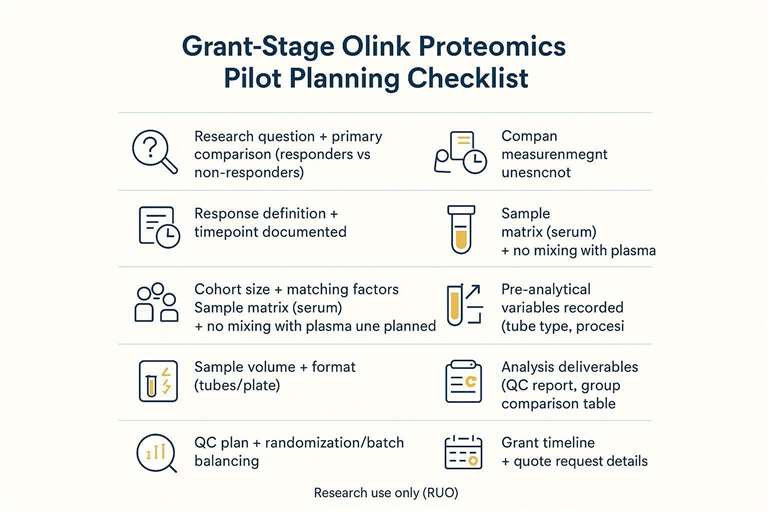 A structured checklist helps researchers prepare an Olink proteomics quote for seed grant applications.
Data Interpretation and Limitations (How to Stay Credible)
Keep outputs aligned to discovery-stage claims
With small cohorts, grant-appropriate outputs include:
- sample-level QC flags and outlier review
- group comparison table (effect sizes with uncertainty)
- candidate ranking and pathway-level summaries (clearly exploratory)
Biomarker development standards emphasize separating discovery from evaluation and avoiding biased performance claims without validation (Pepe et al., 2008: Standards for study design in biomarker evaluation).
Use one precedent study as feasibility—not as proof
Serum proteomics has been used to compare infliximab responders vs non-responders in rheumatoid arthritis as an exploratory feasibility example (Ortea et al., 2012: Discovery of serum proteomic biomarkers for infliximab response in RA).
Use this type of citation to justify feasibility and rationale—not to imply generalizable prediction.
Mention disease context carefully (uveitis as one example)
If you use uveitis as a motivating example, keep it background-level. For instance, a systematic review/meta-analysis compares infliximab and adalimumab in noninfectious uveitis (Liu et al., 2023: Systematic review and meta-analysis in NIU).
Keep biomarker statements conservative unless you have indication-specific validation.
What to Prepare Before Requesting an Olink Quote (Checklist)
Study design
- disease area and treatment context
- responder definition and classification timepoint
- number of responders and non-responders
- whether samples are baseline, post-treatment, or mixed
- one primary comparison
- grant deadline and desired project timeline
Sample information
- matrix (serum) and confirmation that groups use the same matrix
- available volume per sample
- storage conditions and freeze–thaw history
- sample format (tubes vs plates) and aliquot details
- pre-analytical notes (tube type, processing delay, hemolysis flags)
Panel preferences
- inflammation-focused vs broader discovery direction and why
- any candidate pathways/proteins you want considered
- whether you intend a future validation cohort
Analysis and reporting needs
- QC-only vs QC + group comparison
- candidate ranking and visualization preferences
- whether you need grant-ready summary language
Questions to ask the service team
- Does the proposed panel strategy map cleanly to the grant aim?
- Is n≈20 suitable for the discovery objective (and what limitations should we state explicitly)?
- Are serum samples appropriate for the planned workflow?
- What deliverables are included by default?
Conclusion: Build a Focused Plan Before the Grant Deadline
A small anti-TNF discovery study can be worthwhile when it's designed as what it is: a focused, hypothesis-generating cohort that improves feasibility, prioritizes candidate proteins, and supports the next validation step.
If you want a fast scoping pass before requesting a quote, share your response definition, group sizes, serum volume and storage details, preferred panel direction, and grant timeline. You'll get clearer panel rationale, cleaner assumptions, and a quote request that matches what reviewers expect.
FAQ
Can Olink proteomics support anti-TNF response biomarker research?
Yes—at the research-use-only stage, Olink proteomics can support discovery work exploring response-associated protein patterns and generating candidate lists for follow-up validation.
Is n=20 enough for a discovery cohort?
A 10 vs 10 cohort can support feasibility and hypothesis generation, but it is not a validation dataset. Pilot-study guidance warns that small samples yield imprecise effect estimates and should be positioned accordingly.
Can serum samples be used for Olink proteomics?
Serum is commonly used, but consistency and documentation matter more than the matrix label. Provide freeze–thaw history, storage details, and pre-analytical notes in your quote request.
Which panel direction is most common for anti-TNF response studies?
Inflammation-focused strategies are often chosen when the central question is immune mediator differences between responders and non-responders; broader discovery strategies fit when mechanisms are uncertain.
About the Author
CAIMEI LI
Senior Scientist at Creative Proteomics
LinkedIn: CAIMEI LI
Research use only (RUO). This content is for research planning and hypothesis-generating study design. It is not intended for clinical decision-making, diagnosis, treatment guidance, or patient stratification.