Submit Your Request Now
Introduction: Why CAR-T Proteomics Studies Need Careful Planning
Start with the Research Problem
CAR-T translational work is a time-resolved biology experiment running inside a clinical workflow. Plasma proteins can move quickly—especially across early post-infusion windows—so the dataset's interpretability is often determined by operational decisions: timepoints, pre-analytics, and whether batch structure accidentally mirrors biology.
If you're planning an Olink proteomics CAR-T therapy project, the goal is to make longitudinal signal interpretable before the first plate is ever run.
That's why an Olink proteomics CAR-T therapy project can't be planned as "collect samples → run a panel." In longitudinal plasma proteomics, the main signal is frequently the trajectory (rise, peak, recovery), and trajectories are easy to confound if timing and batching aren't designed together.
Mention a Realistic Study Scenario
A common scenario for hematology and translational oncology teams (including multiple myeloma programs) is to profile plasma proteins to:
- focus multiple myeloma biomarkers and immune/toxicity biology into a single, longitudinal readout space
- identify baseline predictors of response or toxicity phenotypes
- support CAR-T therapy biomarker analysis around CRS/ICANS windows
- generate a shortlist for downstream validation
A concrete scoping example we'll use throughout: 40 patients with 3–4 plasma timepoints (≈120–160 biological samples, plus QC/bridge overhead).
Clarify What the Article Will Cover
This is a project-planning article focused on what you should define before you request quotes or ship samples:
- longitudinal plasma sampling timepoints and consistency rules
- Olink panel selection logic (and how it affects scope, timeline, and deliverables)
- sample count estimation plus the metadata needed for longitudinal interpretation
- batch and plate-map design that avoids confounding timepoint, phenotype group, and plate
- pre-analytical variables that commonly distort plasma datasets
- expected deliverables (and why discovery outputs usually need validation)
We'll use a worked example (40 patients, 3–4 timepoints) to keep the planning concrete for plasma proteomics CAR-T studies.
All guidance is research use only (RUO) and does not support diagnosis, treatment, or patient management.
Why Use Olink Proteomics in CAR-T Therapy Research?
Capturing Systemic Protein Changes Over Time
CAR-T can drive systemic immune activation involving inflammatory mediators, myeloid activation, endothelial injury signals, and downstream tissue stress responses. In longitudinal plasma proteomics, the most actionable readout is often the time pattern: when signals rise, peak timing, and recovery.
Supporting Biomarker Discovery and Mechanistic Research
A well-scoped CAR-T proteomics study typically supports RUO goals such as:
- discovery of candidate proteins/pathways associated with response or toxicity phenotypes
- mechanistic hypothesis generation and integration with cellular measures
- prioritization for validation in an independent cohort and/or orthogonal assays
For a concrete example of longitudinal modeling tied to CRS timing (rather than just "day 7 vs baseline"), see Flora et al. (Blood Advances, 2024) in the References.
Why Plasma Is Often Used in CAR-T Biomarker Studies
Plasma is convenient for repeated sampling, but it's sensitive to tube type, processing delays, hemolysis/lipemia, and freeze–thaw history. Planning is your lever to keep those factors from dominating biology.
What Olink Adds Compared with Single-Protein Assays
Single-protein assays are ideal when the target list is defined and confirmation is the goal. In contrast, a translational proteomics study in CAR-T often starts with uncertainty about which pathways will be robust in your cohort.
Olink's PEA-based multiplex profiling is commonly used for RUO discovery because it supports high-plex measurement with standardized relative outputs (NPX). For methods grounding on PEA with NGS readout, see Nygaard et al. (2021) in the References.
Define the Biological Question Before Choosing an Olink Panel
Response, Toxicity, or Mechanism?
Before you pick a panel, define the primary objective:
- response biology (baseline predictors; response-associated trajectories)
- toxicity biology (CRS/ICANS-associated systemic signals)
- mechanism mapping (pathway hypotheses; integration with cell data)
You can pursue more than one objective, but one should drive the design so deliverables remain coherent.
Discovery-Oriented vs Hypothesis-Driven Study Design
- Discovery-oriented: broader coverage; explicit validation planning; higher multiple-testing burden.
- Hypothesis-driven: narrower protein space; often trades breadth for more patients, tighter timepoint control, or both.
Why This Decision Affects Cost, Timeline, and Deliverables
This decision influences:
- platform/panel scope and sequencing workload
- sample count (patients × timepoints) and QC overhead
- batch design complexity and bridge sample needs
- deliverables (discovery shortlist vs longitudinal models vs pathway interpretation)
Designing Longitudinal Plasma Sampling Timepoints
Why Timepoints Matter in CAR-T Studies
CAR-T biology is time-structured. Sampling that is "close enough" on paper becomes inconsistent in practice unless you define windows and capture timestamps. A slightly simpler plan executed consistently is often more informative than a dense plan with uneven missingness.
Example Timepoint Structure for CAR-T Plasma Proteomics
Use the structure below as a "core schedule" that can be supplemented with event-anchored draws (e.g., around CRS onset) when feasible.
Table 1: Example CAR-T Sampling Timepoint Structure
| Timepoint | Research Purpose | Notes |
| Pre-treatment baseline | baseline predictors; stratification | define whether baseline is pre-lymphodepletion; record bridging therapy/steroids |
| Day 0 / infusion day | anchor for trajectories | specify pre- vs post-infusion draw timing and enforce |
| Early post-treatment | capture early inflammatory kinetics | define windows (e.g., within first week) and record exact timestamps |
| Later follow-up | recovery/persistence biology | avoid systematic missingness in a subgroup |
Balancing Scientific Resolution and Budget
Each additional timepoint multiplies plate/batch complexity and increases pre-analytics burden. If you're choosing between more patients vs more timepoints, prioritize the design your collection teams can execute reliably.
Keeping Timepoint Collection Consistent Across Patients
Build consistency controls into the protocol:
- define allowable windows for each nominal timepoint
- record collection, processing-start, and freeze timestamps
- standardize tube type and centrifugation conditions across sites
 Example longitudinal plasma sampling structure for CAR-T therapy proteomics research.
Estimating Sample Number for a CAR-T Olink Study
From Patients to Total Sample Count
Start with biological samples:
- total biological samples = patients × timepoints
Worked example:
- 40 patients × 3 timepoints = 120 samples
- 40 patients × 4 timepoints = 160 samples
Then add explicit overhead for bridge/QC samples and possible re-runs. Quote-ready scopes are easier when you separate "biological samples" from "QC overhead."
Why Longitudinal Studies Are More Complex Than Cross-Sectional Studies
Repeated measures are correlated within patient. Planning implication: your metadata and batch design must support longitudinal modeling (e.g., mixed models) and must not structurally confound timepoint with plate/run.
Metadata Needed for Longitudinal Interpretation
At minimum, create a data dictionary that includes:
- de-identified patient ID, site ID
- nominal timepoint label plus actual time from infusion
- indication context (e.g., multiple myeloma) and relevant baseline covariates
- research phenotype annotations (response group definition; CRS/ICANS timing as captured for research)
- pre-analytics: tube type, processing timeline, freeze–thaw count, visible sample quality flags
Choosing the Right Olink Panel for CAR-T Biomarker Research
When to Consider Olink Explore HT or Broad Discovery Panels
Broad discovery fits when you want wide pathway coverage for hypothesis generation and you can support a disciplined batch/bridging plan.
A starting point for scoping is Creative Proteomics' Olink Explore HT service.
When to Consider Olink Explore 3072 or 384-Plex Panels
Explore 3072 can be a practical option when you want broad coverage with modularity. See the Olink Explore 3072/384 panel service.
384-plex panels are often useful when:
- your question is hypothesis-driven (immune/inflammation or oncology lens)
- you are piloting feasibility/detectability
- you want more focused deliverables
When to Consider Focused or Targeted Olink Panels
Focused panels tend to fit pilots, limited budgets, limited sample volumes, or follow-up studies where the candidate set is already defined.
When Multiple Panels May Be Useful
Multiple panels are most defensible when they're biologically additive (not just "more proteins"), such as a discovery pilot followed by a focused expansion.
Avoid Choosing a Panel Based Only on Protein Count
Use a panel decision framework that accounts for cohort size, operational constraints, and deliverable intent. Creative Proteomics' Olink Explore HT vs Explore 3072/384 comparison is a practical starting point.
Table 2: Olink Panel Selection Logic for CAR-T Studies
| Study Goal | Possible Panel Direction | Why It May Fit |
| Broad discovery | Explore HT / broad discovery | maximize pathway coverage for hypothesis generation |
| Immune or inflammatory focus | 384-plex immune/inflammation-oriented panels | aligns with toxicity/immune kinetics and simplifies interpretation |
| Oncology-related candidate markers | oncology-oriented panels (often paired with inflammation) | useful when tumor–immune context is central |
| Limited budget or pilot study | focused panel + tight timepoint plan | tests feasibility before scaling |
Planning Batch Design for 40 Patients and 3–4 Timepoints
Why Batch Design Is Critical
Batch design is where longitudinal studies become uninterpretable. The key failure mode is confounding: if timepoint or phenotype group aligns with plate/run, technical variation can look like biology.
Batch-effect best practices emphasize diagnosing and correcting batch effects, but prevention by design remains the strongest option (Lazar et al., 2021).
Keep Patient Timepoints Strategically Distributed
For a 40-patient design, aim for each plate to contain a balanced mix of timepoints and patients—avoid "one patient per plate" and avoid "one timepoint per plate."
Balance Key Study Groups Across Plates
Before you build the plate map, define your stratification variables (indication, response bins, toxicity bins) and balance them across plates.
This is a straightforward way to reduce technical bias in your CAR-T plasma biomarker profiling dataset.
Consider Bridging Samples and Controls
Plan a pooled plasma bridge/QC sample that appears on every plate. The purpose is to create a measurable reference to support cross-plate comparability checks.
For practical guidance, see Creative Proteomics' overview of High-throughput Olink proteomics services.
Prepare a Plate Map Before Shipment
A plate map is a design document. Include:
- sample IDs and wells
- timepoint labels
- key stratifiers (site, phenotype bins)
- bridge/QC sample placement
Then do a confound check: if you color wells by timepoint or group, do you see clustering?
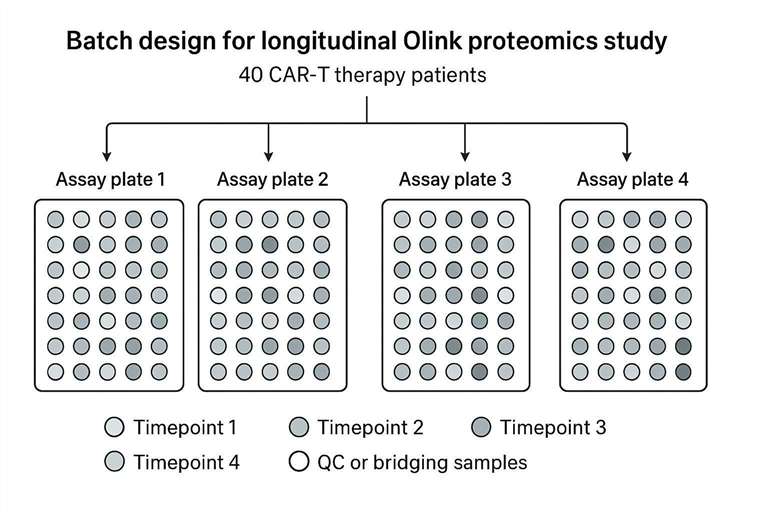 Balanced batch and plate layout planning helps reduce technical bias in longitudinal CAR-T plasma proteomics studies.
Pre-Analytical Factors That Affect CAR-T Plasma Proteomics
Sample Matrix Consistency
Choose plasma (or serum) and keep it consistent across the study. Mixing matrices, anticoagulants, or SOPs increases technical variance.
Collection Tube and Processing Protocol
Standardize tube type, processing timeline (time to spin and time to freeze), and centrifugation conditions across sites.
Freeze-Thaw History
Plan immediate aliquoting, track freeze–thaw counts, and minimize repeated thaws.
Hemolysis, Lipemia, and Visible Sample Quality Issues
Define how you handle compromised samples (exclude, re-draw when feasible, or retain with annotation). Consistency plus documentation matters more than "perfect" samples.
Sample Volume and Plate Format
Assay input volume is not the same as submission volume. Submission volume needs to cover dead volume, QC overhead, and potential repeats.
For SOP-level handling guidance, reference the Olink sample preparation guidelines.
Data Deliverables and Interpretation for CAR-T Olink Studies
Expected Data Outputs
Typical RUO deliverables include NPX tables (log2 relative expression), QC flags/control summaries, detection/LOD-related fields, and an annotated sample manifest.
For a practical overview of NPX/QC concepts and bridging, see Creative Proteomics' Olink data analysis support.
Longitudinal Analysis Considerations
Longitudinal analysis should respect repeated measures. Depending on goals, approaches include mixed models, event-anchored comparisons (relative to CRS onset), and trajectory comparisons.
Interpreting NPX or Normalized Protein Expression Carefully
NPX is a relative, log2-scale unit. Planning implication: protect cross-plate comparability with bridge/QC samples and balanced plate maps.
Avoid Overinterpreting Discovery Data
Discovery-stage proteomics is exploratory. Candidate proteins typically require validation (independent cohort and/or orthogonal assays) before translational claims are made.
Common Mistakes in CAR-T Proteomics Study Planning
Choosing the Panel Before Defining the Research Question
If deliverables aren't defined, panel choice becomes arbitrary and downstream interpretation becomes difficult.
Treating Longitudinal Samples Like Independent Samples
Repeated measures require longitudinal modeling and appropriate metadata. Plan this upfront.
Confounding Timepoint with Batch
This is a major failure mode in Olink longitudinal cohort study designs: if timepoint aligns with plate/run, you can't confidently separate biology from technical effects.
Missing or Inconsistent Metadata
Timestamps and pre-analytics metadata can't be reconstructed reliably after the fact.
Underestimating the Quote Preparation Step
Quote preparation is faster when you provide timepoints, sample counts, SOP constraints, panel preferences, and analysis expectations in one page.
What to Prepare Before Requesting a Quote
Study Design Information
Prepare a one-page summary of the primary goal, cohort size/indication, timepoints and allowable windows, and primary comparisons/stratifiers.
Sample Information
Include matrix and tube type, site count and SOP harmonization plan, processing/storage conditions, and submission volume per aliquot.
Panel and Biological Pathway Preferences
State whether you want broad discovery vs focused profiling, the pathways of interest, and whether this is a pilot or scale study.
Batch, QC, and Analysis Preferences
Specify your intent to balance timepoints and groups across plates, your bridge/QC plan, and the analysis outputs you need.
Questions to Ask the Service Team
Scoping questions to include:
- What submission volume do you recommend per timepoint sample, and what overhead should we plan for?
- How will bridge/QC samples be used to evaluate cross-plate comparability?
- What QC flags and acceptance criteria will be reported?
- What analysis deliverables are included for a longitudinal cohort?
If you want a structured intake template, Creative Proteomics provides an Olink quotation checklist.
Conclusion: Turn CAR-T Samples into a Clear Proteomics Study Plan
Summarize the Main Takeaway
A high-quality dataset is created at the planning stage. For CAR-T longitudinal plasma proteomics, the core is:
- define the biological question before you choose the panel
- design timepoints that match CAR-T kinetics and can be executed consistently
- estimate samples realistically (40 patients × 3–4 timepoints ≈ 120–160 samples, plus QC)
- design plate maps so timepoint and key groups are balanced across plates
- capture the metadata needed for longitudinal interpretation
Conversion-Oriented CTA
If you're ready to scope execution, share your draft timepoint schedule, cohort size, matrix/SOP details, and panel preference so the service team can review batch structure and deliverables with you. (For convenience, you can use the quotation checklist above as your intake template.)
FAQ
Can Olink proteomics be used for CAR-T therapy research?
Yes—Olink profiling can be used in RUO CAR-T studies to measure multiplex protein changes across timepoints.
Which Olink panel is suitable for a CAR-T biomarker study?
It depends on whether you need broad discovery coverage or a focused, hypothesis-driven panel; panel choice should match deliverables and operational constraints.
How many samples are needed for a longitudinal CAR-T proteomics study?
A starting estimate is patients × timepoints. For 40 patients with 3–4 timepoints, that's ~120–160 biological samples, plus QC/bridge samples and possible repeats.
How should CAR-T longitudinal plasma samples be batched?
Balance timepoints and key groups across plates and include bridge/QC samples consistently so technical variation doesn't track with biology.
What information should I provide for an Olink CAR-T study quote?
Timepoint plan, sample counts, matrix/SOP details, panel preference, and expected deliverables.
Should discovery-stage Olink findings be validated?
Generally, yes—discovery-stage findings are exploratory and typically require validation in an independent cohort and/or with orthogonal assays.
References (peer-reviewed)
- Flora C, et al. Longitudinal plasma proteomics in CAR T–cell therapy patients implicates neutrophils and NETosis in the genesis of CRS. Blood Advances. 2024.
- Lotta Wik, et al. Proximity Extension Assay in Combination with Next-Generation Sequencing for High-Throughput Proteome Profiling. 2021.
- Jelena Čuklina, et al. Diagnostics and correction of batch effects in large-scale proteomic studies. 2021.
About the Author
CAIMEI LI Senior Scientist at Creative Proteomics LinkedIn: CAIMEI LI on LinkedIn
CAIMEI LI is a Senior Scientist at Creative Proteomics with experience supporting proteomics study design, biomarker analysis, and research-use-only assay planning for biomedical and translational research projects.
Research Use Only (RUO) Disclaimer: Creative Proteomics services and any data discussed are for research use only and not for use in diagnostic procedures, treatment decisions, or patient management.